

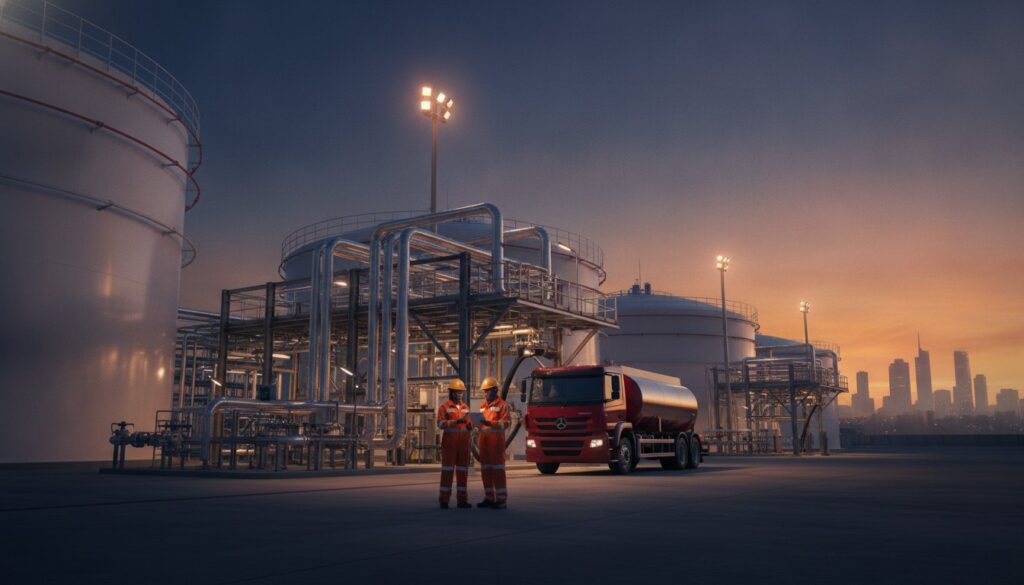
Did you know that South Africa’s domestic refineries now meet as little as 30% of our daily fuel demand? This fundamental shift toward an import-heavy model has transformed fuel infrastructure planning South Africa from a secondary operational concern into a mission-critical strategic priority for 2026. You’ve likely felt the pressure of an increasingly volatile supply chain and the heavy burden of NERSA compliance that threatens to stifle your growth. It’s a precarious position for any industrial leader to occupy when national logistics bottlenecks dictate the pace of your enterprise.
This guide provides the strategic framework required to reclaim control by mastering the complexities of modern energy storage and regulatory alignment. You’ll gain a clear roadmap for designing scalable, compliant infrastructure that ensures long-term energy security and operational independence. We’ll explore the latest SANS standards, the implications of the 21-day mandatory stockholding policy, and the technical requirements for industrial-grade fuel systems that ensure unwavering reliability in an uncertain landscape.
Key Takeaways
- Understand how private on-site storage serves as a strategic shield against national supply chain volatility and the shifting import landscape of 2026.
- Navigate the complexities of NERSA licensing whilst ensuring your facility adheres to the latest SANS 10131 standards for safety and environmental compliance.
- Identify the optimal technical specifications for your enterprise by integrating fuel infrastructure planning South Africa with scalable tank technologies and high-throughput designs.
- Streamline your project lifecycle through turnkey construction management, covering every phase from initial civil works to final mechanical commissioning and site handover.
- Secure long-term energy stability by aligning your new infrastructure with a reliable nationwide distribution network that offers 24/7 support for industrial operations.
The Strategic Landscape of Fuel Infrastructure in South Africa
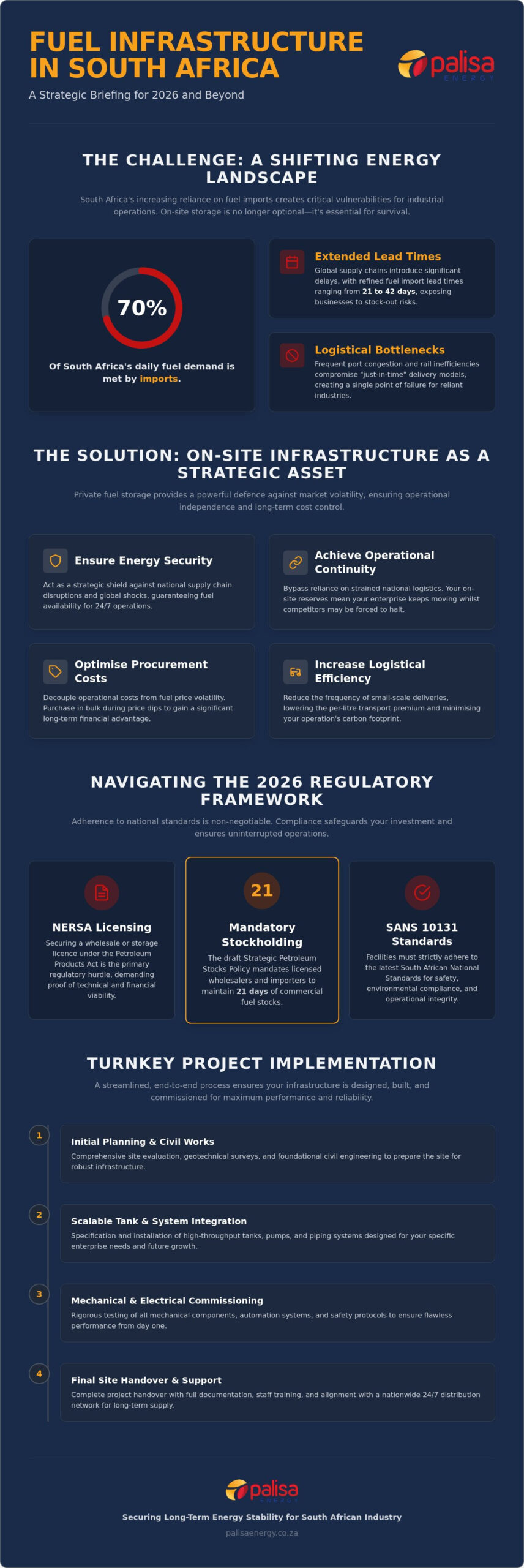
In the South African industrial context, fuel infrastructure planning represents the deliberate engineering of resilience. It’s no longer a secondary logistical concern; it’s a mission-critical strategy for survival. As domestic refining capacity currently meets only 30% to 40% of our daily demand, the nation’s reliance on refined imports has reached a critical threshold. This dependency exposes enterprises to global supply shocks and extended import lead times, which often range between 21 and 42 days. For large-scale mining, manufacturing, and agricultural operations, the ability to store significant reserves on-site is the only viable hedge against these external pressures.
The 2026 regulatory environment underscores this necessity. With the recent draft Strategic Petroleum Stocks Policy mandating that licensed wholesalers and importers maintain 21 days of commercial fuel stocks, the burden of energy security has shifted decisively toward the private sector. Decentralised fuel hubs are becoming the new standard. By establishing independent storage facilities, businesses can bypass the traditional “just-in-time” delivery model that is frequently compromised by rail inefficiencies and port congestion. Effective fuel infrastructure planning South Africa ensures that your enterprise remains a formidable player, capable of maintaining growth whilst competitors struggle with supply volatility.
Energy Security and Operational Continuity
Energy security is the prerequisite for industrial progress. In an environment where transport hurdles can halt productivity in an instant, on-site infrastructure serves as a strategic buffer. Whilst the Transnet Pipelines system remains a vital artery for the national movement of liquid fuels, its capacity is often strained by the growing volume of imports required to fuel the economy. Relying solely on national distribution networks introduces a single point of failure that few high-stakes industries can afford. Robust fuel infrastructure planning South Africa ensures that 24/7 operations remain shielded from local supply deficits, maintaining the momentum of the wider economic landscape through periods of national volatility.
Infrastructure as a Strategic Asset
Modern enterprises must view infrastructure as a proactive energy management tool rather than a reactive procurement cost. Investing in bulk storage allows for the strategic purchase of diesel or petrol during price dips, effectively decoupling operational costs from the immediate fluctuations of the Basic Fuel Price. The long-term cost benefits are substantial. Bulk storage reduces the frequency of small-scale deliveries, lowering the per-litre transport premium and minimising the carbon footprint associated with constant tanker movements. Integrating these systems into corporate sustainability goals isn’t just about environmental responsibility; it’s about building a formidable, self-sustaining operation that can withstand the high-stakes challenges of the energy sector.
Regulatory Frameworks and Compliance Standards for 2026
Integrity in the energy sector begins with a rigorous adherence to the law. In 2026, the regulatory environment for fuel infrastructure planning South Africa has become increasingly sophisticated, requiring a proactive approach to legal and environmental obligations. Compliance isn’t a mere administrative checkbox; it’s a strategic safeguard that protects your capital investment and ensures the longevity of your operations. Failing to align with these standards doesn’t just result in fines; it risks the total suspension of your industrial activities.
National Energy Regulator of South Africa (NERSA) Requirements
The Petroleum Products Act governs the heartbeat of the industry. Securing a wholesale or storage licence through NERSA remains the most significant hurdle for new projects. This process demands a meticulous demonstration of technical competence, financial viability, and a commitment to socio-economic transformation. Many industrial projects face delays because they underestimate the complexity of the application or fail to provide sufficient evidence of site security. Professional bodies like the Fuels Industry Association of South Africa play a vital role in shaping these standards, ensuring that private entities operate within a framework that balances economic growth with national security. To navigate these complexities without stalling your timeline, engaging in an expert compliance audit can identify potential bottlenecks before they become costly disruptions.
Environmental Impact Assessments (EIA) have also evolved. Modern fuel facilities are now scrutinised for their long-term impact on local ecosystems and groundwater. A successful EIA requires comprehensive data on soil composition, drainage patterns, and spill response capabilities. It’s about demonstrating that your facility is a responsible addition to the industrial landscape, capable of managing hazardous materials with absolute precision.
Safety Standards and Risk Mitigation
Safety is the cornerstone of industrial confidence. Implementing automated fire protection and secondary spill containment systems is now a non-negotiable requirement for any site handling bulk liquid fuels. These systems must be integrated into the initial design phase to ensure seamless operation during an emergency. Regular auditing isn’t just a legal requirement; it’s an opportunity to refine your Health, Safety, and Environment (HSE) protocols and reinforce a culture of excellence amongst your staff.
SANS 10131 serves as the definitive national standard for the storage and handling of liquid fuels, providing the technical specifications required to ensure that storage tanks and piping systems remain structurally sound and environmentally secure throughout 2026 and beyond. By adhering to these rigorous engineering benchmarks, you mitigate the risk of catastrophic failure and ensure that your infrastructure remains a reliable asset for decades to come.
Core Components of Industrial Fuel Infrastructure Design
The physical architecture of your energy reserve must reflect the strategic weight of your operational goals. Precision in fuel infrastructure planning South Africa ensures that every component, from the base of the storage tanks to the tip of the dispensing nozzles, contributes to a seamless and secure energy flow. It’s a holistic engineering challenge that requires balancing high-throughput requirements with the uncompromising safety standards dictated by the South African industrial landscape. When your enterprise depends on a constant supply of diesel or jet fuel, the design of your facility becomes your first line of defence against operational downtime.
Selecting the right storage tank technology is a foundational decision. Above-ground tanks are often the preferred choice for modern industrial sites; they offer superior accessibility for inspections and simplify the maintenance of leak detection systems. Conversely, underground installations provide significant space-saving advantages and enhanced protection against environmental temperature fluctuations, though they require more intensive civil works and environmental monitoring. Regardless of the configuration, integrating high-volume pumping systems and advanced filtration units is essential. These components ensure that fuel remains free from contaminants, safeguarding your machinery and maintaining the integrity of the fuel according to Euro 5 specifications as the 2027 Clean Fuels II deadline approaches.
Engineering for Scalability and Efficiency
Future-proofing your facility is about more than just current capacity; it’s about the ability to adapt to a changing energy mix. Effective fuel depot design South Africa requires a forward-looking approach to site layout. Large-scale transport vehicles, such as 40,000-litre tankers, require generous turning circles and reinforced surfacing to maintain site safety and efficiency. By designing layouts that accommodate these heavy vehicles whilst allowing for the future addition of multi-fuel storage tanks, you ensure that your infrastructure remains a scalable asset that grows alongside your enterprise.
Advanced Monitoring and Security
Precision is non-negotiable. Modern fuel infrastructure planning South Africa must integrate automated tank gauging (ATG) systems that provide real-time data on inventory levels and fuel temperature. These digital tools eliminate the margins for error associated with manual dipping and allow for immediate detection of discrepancies that could indicate leaks or unauthorised fuel removal. In a landscape where fuel is a high-value target, security infrastructure must be robust. Integrating digitised inventory management with physical security measures, such as high-definition surveillance and restricted-access loading bays, creates a formidable barrier against external threats whilst providing the data necessary for agile procurement strategies.
Turnkey Implementation: From Planning to Commissioning
Realising a strategic vision requires more than just blueprints; it demands a transition from theoretical design into the actualisation of fuel infrastructure planning South Africa. Turnkey solutions offer the most robust path for industrial enterprises, providing a single point of accountability that eliminates the friction of managing fragmented vendors. By consolidating the engineering, procurement, and construction phases under one authoritative partner, you ensure that the integrity of the original design is preserved throughout the build. This holistic approach is essential for maintaining the high-stakes precision required in the energy sector.
The physical construction journey begins with meticulous site preparation, where earthworks and soil stabilisation create the foundation for long-term reliability. Civil works follow, focusing on the critical engineering of bund walls and containment areas that satisfy SANS 10131 safety benchmarks. Once the structural environment is secure, mechanical installation commences. This phase involves the precision placement of storage tanks, high-volume pumping systems, and the complex network of piping that will serve as the artery of your fuel logistics. Every weld and every seal is a testament to the industrial confidence that defines a world-class facility.
Commissioning represents the final validation of your investment. It’s an exhaustive testing phase where systems are pressurised, calibrated, and stress-tested to ensure they meet the exact operational specifications defined during planning. This process confirms that the facility isn’t only functional but also capable of handling the heavy throughput of modern industrial fuel demands without compromise.
Project Management and Construction Oversight
Effective project management is the steadfast guardian of your timeline. Coordinating multiple contractors whilst maintaining uncompromising safety standards requires a methodical, structured approach. Typical South African fuel depot projects involve clear milestones, from initial civil handover to final mechanical sign-off. Leveraging fuel depot turnkey solutions South Africa allows your executive team to focus on core business growth whilst we manage the logistical complexities of the build.
Operational Integration and Staff Training
Operational readiness is the final step in the transition to active fuel logistics. Training your personnel on the new infrastructure’s technology and safety protocols is vital for preventing asset degradation and ensuring site security. Establishing rigorous maintenance schedules from day one protects your capital investment. Integrating these strategic on-site fuel storage solutions South Africa into your daily workflows creates a seamless energy supply chain that supports your enterprise’s forward momentum. To secure your energy future, partner with Palisa Energy for your next infrastructure project today.
Future-Proofing Your Energy Supply with Palisa Energy
In an era of shifting regulatory mandates and global supply chain fragility, Palisa Energy emerges as the steadfast guardian of your industrial energy needs. We don’t merely consult; we enable the long-term growth of your enterprise by bridging the gap between sophisticated engineering and reliable fuel delivery. Effective fuel infrastructure planning South Africa requires a partner that understands the high-stakes nature of the energy sector, providing the stability necessary for you to focus on your core operations whilst we manage the complexities of your energy reserve. Our role is to ensure that your infrastructure isn’t just a static asset but a dynamic component of your success.
The value of our partnership extends far beyond the initial construction phase. We provide 24/7 support to industrial customers, ensuring that your operations never falter due to logistical hurdles or technical failures. By integrating fuel infrastructure planning South Africa with our robust nationwide distribution network, we offer a holistic solution that secures your energy future. As the industry prepares for the 2027 Clean Fuels II deadline, we are already helping our partners adapt their facilities to handle Euro 5 standard products, ensuring that your investment remains relevant and compliant for the next decade and beyond.
Comprehensive Fuel Logistics and Supply
Securing your infrastructure is only half the battle. Our nationwide distribution network ensures that your new storage facilities remain optimally supplied with bulk diesel and petrol, regardless of your geographic location. As a 100% South African-owned entity, we bring deep local expertise to every project, customising procurement strategies that align perfectly with your site’s specific capacity and throughput requirements. This integration of infrastructure design and consistent fuel supply creates a seamless energy ecosystem that empowers your business to operate with total industrial confidence. We leverage our partnerships with major oil companies to guarantee a reliable flow of energy to your most remote operations.
Expert Consulting and Compliance Auditing
Regulatory landscapes are never static. As we move through 2026, our consulting team provides ongoing compliance auditing to ensure your facility adheres to evolving NERSA requirements and environmental laws. The advantage of a single partner for design, compliance, and fuel delivery cannot be overstated; it provides a holistic solution that reduces administrative overhead and mitigates operational risk. We take pride in our role as a visionary enabler, managing the complex logistics and legal frameworks so your executive team doesn’t have to. It’s essential to choose a partner that prioritises operational excellence and shares your unwavering commitment to industrial progress.
Securing Your Industrial Momentum
Mastering fuel infrastructure planning South Africa is the cornerstone of industrial resilience in an increasingly import-dependent economy. By integrating sophisticated engineering with proactive compliance and real-time monitoring, your enterprise gains a formidable strategic advantage over national supply chain volatility. The path from initial site assessment to final commissioning requires a partner that balances visionary design with the grounded precision of turnkey construction management, ensuring every litre of storage contributes to your operational stability.
Palisa Energy stands as your dedicated strategic partner, offering the expertise of an independent South African-owned and operated entity. We manage every phase of the project lifecycle, from regulatory navigation to mechanical installation, whilst providing 24/7 industrial operational support to keep your facility running at peak efficiency. Reclaiming your energy independence is a decisive step toward long-term growth and environmental responsibility. Partner with Palisa Energy for your strategic fuel infrastructure planning to ensure your operations remain shielded from uncertainty. We invite you to build a future defined by reliability and unwavering progress.
Frequently Asked Questions
What are the primary regulations for fuel storage in South Africa?
The regulatory framework is primarily governed by the Petroleum Products Act and the National Energy Regulator of South Africa (NERSA). Additionally, facilities must adhere to the National Environmental Management Act (NEMA) for ecological protection and the Occupational Health and Safety Act for site security. The 2026 landscape now includes the draft Strategic Petroleum Stocks Policy, which introduces mandatory stockholding obligations for licensed entities to bolster national energy security.
Do I need a NERSA licence for a private fuel depot?
You require a licence if your facility is used for commercial wholesaling or if your storage capacity exceeds 200 cubic metres. Own-use consumers with smaller capacities may not require a wholesale licence, but they must still comply with local municipal by-laws and national safety standards. It is vital to verify your specific volume thresholds with a compliance expert to avoid the legal repercussions of operating an unlicensed facility.
How long does the fuel infrastructure planning process typically take?
A comprehensive planning and approval cycle usually spans 12 to 24 months depending on the project’s scale. This timeline accounts for Environmental Impact Assessments, which often require six to nine months, and the NERSA licensing process, which can take an additional six months. Technical design and civil engineering preparations typically run concurrently with these applications to ensure the project maintains its forward momentum without unnecessary delays.
What is the difference between SANS 10131 and other safety standards?
SANS 10131 is the specific South African National Standard tailored to the unique environmental and industrial conditions of the country. Whilst international standards like those from the American Petroleum Institute (API) are highly regarded, SANS 10131 is the legally mandated benchmark for the design and maintenance of local fuel depots. It provides precise specifications for bunding, tank construction, and fire protection that are essential for passing local municipal and insurance inspections.
Can Palisa Energy assist with both design and bulk fuel supply?
Yes, Palisa Energy provides a holistic solution that covers both the technical consulting phase and the subsequent energy supply. We offer turnkey support for fuel infrastructure planning South Africa, managing the design and construction oversight whilst also serving as a reliable reseller of bulk diesel and petrol. This integrated approach ensures that your new infrastructure is perfectly calibrated for the specific fuel grades and delivery schedules required by your enterprise.
What are the environmental requirements for industrial fuel storage?
The primary requirements include a mandatory Environmental Impact Assessment (EIA) for any new bulk storage facility. Your site must incorporate secondary containment systems, such as reinforced concrete bund walls, to prevent soil and groundwater contamination in the event of a leak. Modern facilities are also required to implement groundwater monitoring boreholes and automated leak detection systems to satisfy the increasingly rigorous standards of 2026 environmental legislation.
Is on-site fuel storage safer than frequent deliveries?
On-site storage is often safer because it significantly reduces the frequency of high-risk tanker movements within your operational areas. By consolidating deliveries into fewer, larger drops, you minimise the windows of vulnerability associated with fuel offloading and hose connections. A well-designed, permanent storage facility provides a controlled environment for fuel handling that is far superior to the risks of managing constant small-scale deliveries amongst active industrial machinery.
How do I ensure my fuel infrastructure is future-proofed for 2026 and beyond?
Successful fuel infrastructure planning South Africa requires the integration of digital inventory monitoring and a design that is compatible with the upcoming Clean Fuels II standards. Ensuring your tanks and piping are ready for 10ppm sulphur diesel is essential before the 2027 deadline. You should also design for scalability, allowing for the future addition of sustainable fuel alternatives or increased capacity as your industrial throughput grows over the next decade.