

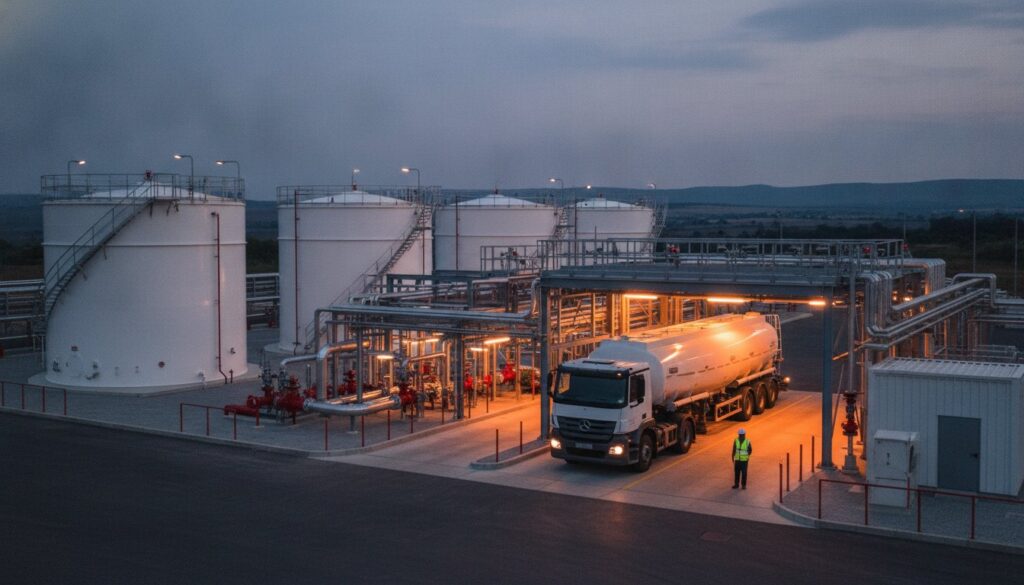
A fuel depot is no longer merely a collection of tanks; it is a sophisticated strategic hub that determines the resilience of your entire industrial supply chain. Within the 2026 energy sector, where diesel prices have recently fluctuated by more than R13 per litre, the precision of your fuel depot design South Africa serves as the primary barrier against operational volatility. You recognise that maintaining uninterrupted fuel security for your fleet is paramount, yet the burden of navigating complex SANS 10089 regulations and mitigating high-stakes fire risks often hampers your progress.
We agree that the regulatory environment is increasingly stringent, particularly as insurers now demand absolute compliance to avoid voiding essential coverage. This comprehensive guide promises to help you master these complexities by providing a clear framework for building safe, efficient, and scalable storage solutions. We will explore the technical nuances of SANS 10089-1 bunding requirements, the integration of real-time logistics monitoring, and the specific strategies required to lower your long-term operational costs whilst ensuring total environmental integrity.
Key Takeaways
- Understand the strategic role of a fuel depot as a critical node in your industrial supply chain, designed to mitigate market volatility and secure long-term energy resilience.
- Navigate the mandatory regulatory landscape by mastering SANS 10131 and SANS 10089 standards for above-ground storage, fire safety, and environmental protection.
- Evaluate the performance benefits of modern self-bunded tanks against conventional built-in-situ installations to optimise your facility’s scalability and operational efficiency.
- Implement a structured five-phase framework for fuel depot design South Africa to ensure every stage, from needs analysis to geotechnical evaluation, meets rigorous industrial benchmarks.
- Discover the operational advantages of a turnkey “design-to-supply” model that integrates professional infrastructure planning with a reliable nationwide diesel supply.
The Strategic Importance of Modern Fuel Depot Design in South Africa
An Oil terminal, or fuel depot, functions as the vital pulse of South Africa’s industrial landscape. It is far more than a collection of storage tanks; it is a critical node in a complex supply chain that powers mining, manufacturing, and logistics. When you invest in fuel depot design South Africa, you aren’t just building infrastructure. You’re establishing a strategic energy hub that protects your operations from the unpredictability of the global market. Effective design directly influences long-term fuel security and operational costs, ensuring that every drop of diesel is accounted for and every vehicle remains in motion.
Industrial sectors are currently witnessing a decisive shift toward decentralised storage. Mining and manufacturing giants no longer rely solely on central distribution points. They’re building their own capacity to ensure they remain insulated from external logistics bottlenecks. Integrating logistics capability into the earliest design phases isn’t optional; it’s a fundamental requirement for maintaining a competitive edge in a high-stakes economy, a goal often supported by advanced digital solutions such as a Siemens Teamcenter implementation UAE for lifecycle and asset management.
Fuel Security as a Competitive Advantage
Establishing on-site storage allows your business to mitigate the inherent volatility of the South African supply chain. When you control your own reserves, you remove the risk of third-party delivery delays that can halt production lines. A well-conceived depot design prevents costly operational downtime by providing a buffer against fuel shortages. This proactive approach to fuel security for business South Africa ensures that your fleet remains operational even during peak demand periods or regional supply constraints. It transforms fuel from an unpredictable expense into a manageable asset that you control with precision.
Economic Impact of Efficient Throughput
The physical layout of your depot determines the speed of fuel delivery and dispensing. If your design creates bottlenecks for tankers or slow throughput for your fleet, you’re losing valuable hours every day. Sizing your storage to match specific procurement cycles allows you to capitalise on price drops, such as the diesel price decreases seen in July 2026. Future-proofing your facility is also essential to ensure longevity. A smart design considers several factors:
- Scalability to accommodate future increases in fleet size or consumption.
- Compatibility with emerging alternative fuel types to stay ahead of energy transitions.
- Optimised pump rates and tank positioning to reduce vehicle turnaround times.
By focusing on these technical details during the initial fuel depot design South Africa process, you ensure your infrastructure remains an asset rather than a liability. Precise planning allows you to manage complex logistics with confidence, leaving you free to focus on your core business growth.
Regulatory Framework: SANS Compliance and Environmental Standards
Adherence to the South African regulatory framework is the cornerstone of any industrial infrastructure project. Navigating this landscape requires more than a cursory understanding of the law; it demands a commitment to the rigorous standards that protect your assets and the environment. When undertaking fuel depot design South Africa, your blueprint must align with the Petroleum Products Act and the specific standards set by the South African Bureau of Standards (SABS). These regulations aren’t merely administrative hurdles. They are essential safeguards that ensure your facility operates within the legal parameters of South African fuel industry legislation, which governs everything from site licensing to safety protocols.
The primary standard for above-ground storage tanks is SANS 10131. This standard dictates the structural integrity and layout requirements for tanks and their associated pipework. Complementing this is the SANS 10089 series, which focuses on fire safety and emergency response. SANS 10089-1 specifically addresses the layout and design of bulk petroleum depots, whilst Part 2 manages electrical installations in hazardous areas. For facilities handling significant volumes of diesel, a Major Hazard Installation (MHI) assessment is often mandatory. This assessment evaluates the potential impact of a catastrophic failure on the surrounding community, ensuring that your fuel depot design South Africa incorporates sufficient risk mitigation strategies from the outset. A thorough understanding of fuel infrastructure planning South Africa is therefore essential before committing to any specific design configuration.
The Role of SABS and SANS Standards
Technical precision in bunding and spill containment is a non-negotiable aspect of SANS 10089-1. Your containment walls must be engineered to hold at least 110% of the volume of the largest tank within the bunded area to prevent soil contamination during a leak. The latest 2026 updates to atmospheric tank venting standards now require enhanced vapour recovery and pressure-vacuum relief valves to minimise environmental emissions. SANS 10131 compliance ensures that every industrial depot meets the minimum safety and structural requirements for the above-ground storage of petroleum products. Failure to meet these specifications doesn’t just invite legal penalties; it can void your insurance coverage entirely.
Environmental and Safety Auditing
Securing an Environmental Authorisation (EA) is a prerequisite for construction under the National Environmental Management Act (NEMA). This process involves a detailed Environmental Impact Assessment (EIA) to identify potential risks to local ecosystems. Modern depots must integrate sophisticated groundwater monitoring and automated leak detection systems to provide early warnings of integrity failures. You can find more detail on these requirements in our fuel compliance auditing South Africa guide. Engaging with a dedicated partner to manage your fuel infrastructure compliance ensures that your facility remains a steadfast guardian of both your energy security and the local environment.
Technical Selection: Comparing Storage and Dispensing Technologies
Selecting the correct technology is a pivotal moment in fuel depot design South Africa. It bridges the gap between theoretical compliance and operational reality. Decision-makers must weigh the immediate benefits of rapid deployment against the enduring stability of permanent civil works. This choice dictates your facility’s lifecycle costs and its ability to adapt to shifting industrial demands. Whether you are supporting a remote mining operation or a centralised manufacturing plant, your technical specifications must align with your long-term consumption profile.
Material selection remains a foundational technical consideration. Carbon steel, typically coated with high-performance epoxy, remains the industry standard for bulk diesel storage due to its robust nature and cost-effectiveness. Whilst stainless steel offers superior corrosion resistance, it is often reserved for specialised applications or highly corrosive coastal environments. Integrating an automated Fuel Management System (FMS) further enhances these physical assets. By pairing robust hardware with sophisticated software, you gain absolute visibility over your inventory. This transformation turns a passive storage tank into an active data terminal that provides real-time insights into your bulk diesel reserves.
Self-Bunded Tanks vs. Conventional Infrastructure
Self-bunded “plug-and-play” tanks have revolutionised rapid infrastructure deployment, particularly in remote areas where time is a critical currency. These units arrive pre-tested and ready for immediate connection, significantly reducing on-site construction timelines. In contrast, conventional built-in-situ depots, protected by reinforced concrete bunds, offer unmatched durability for large-scale, permanent operations. Whilst they require more extensive civil engineering and a larger footprint, they provide a formidable solution for facilities with massive throughput requirements that span decades. For industrial stakeholders seeking to consolidate every phase of development under a single managed process, exploring fuel depot turnkey solutions South Africa offers a strategic pathway to eliminating the friction of multi-vendor coordination.
| Feature | Self-Bunded Tanks | Built-in-Situ Depots |
|---|---|---|
| CAPEX | Lower initial investment | Higher upfront civil costs |
| Footprint | Compact and modular | Extensive and fixed |
| Scalability | High (add units as needed) | Low (requires new construction) |
| Deployment Speed | Rapid (weeks) | Slow (months) |
Advanced Dispensing and Filtration Systems
Operational efficiency is often won or lost at the dispensing point. High-flow pumps are essential for industrial fleets; they reduce vehicle idle time and ensure that refuelling does not become an operational bottleneck. The sensitivity of modern Tier 4 engines also necessitates stringent filtration standards. Multi-stage filtration systems remove particulate matter and water, protecting your fleet from expensive engine failures and maintaining manufacturer warranties. Integrating RFID technology and real-time data capture allows for seamless logistics management, ensuring every litre is tracked with precision from delivery to combustion. This level of detail is a hallmark of superior fuel depot design South Africa, providing the industrial confidence required to manage complex energy needs.
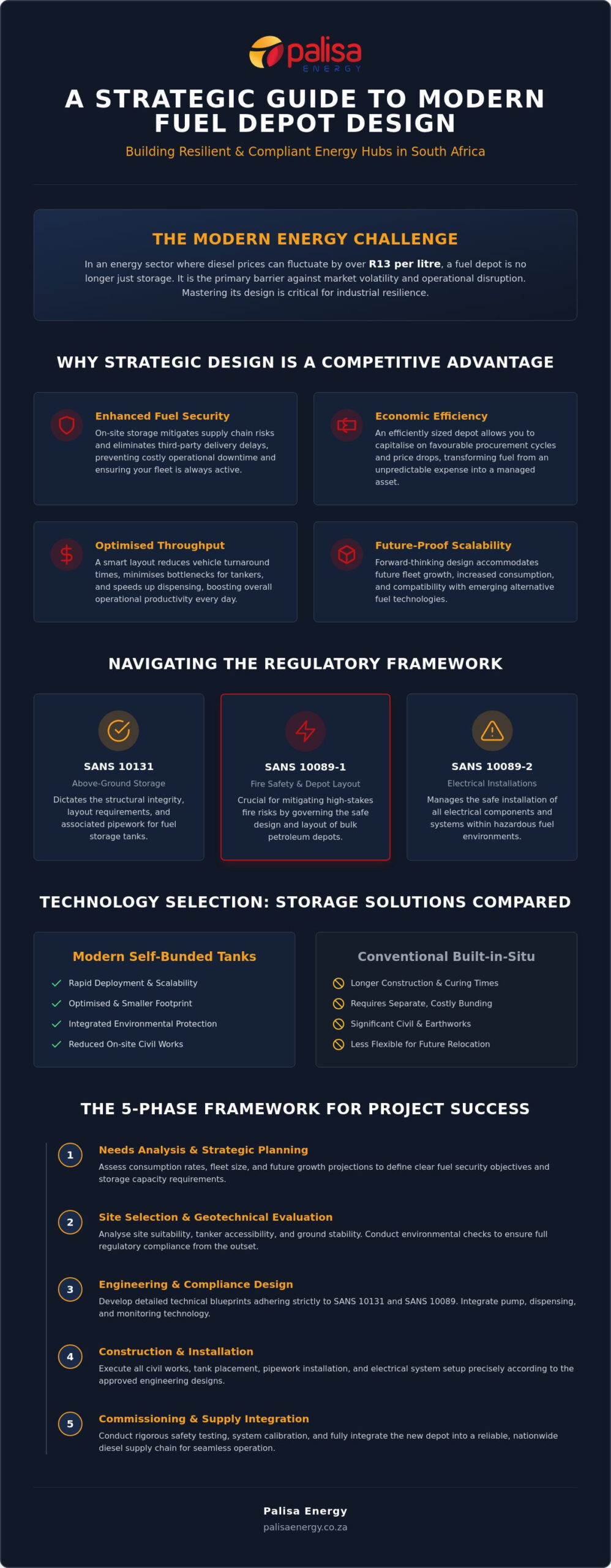
The Industrial Fuel Depot Design Template: A 5-Phase Framework
Success in industrial infrastructure depends on a methodical transition from vision to execution. A robust fuel depot design South Africa requires a structured approach that balances operational requirements with stringent safety codes. This five-phase framework serves as a definitive template for stakeholders seeking to establish a resilient energy hub. By following this sequence, you ensure that every technical and regulatory variable is addressed before the first foundation is poured. It is a process of vision followed by precise execution.
Phase 1 & 2: Laying the Strategic Foundation
The process begins with a rigorous needs analysis. You must calculate your optimal storage volume by analysing historical consumption data and factoring in a safety buffer for supply chain volatility. This prevents stock-outs during periods of peak demand or logistical disruptions. Site selection follows, where you evaluate topography to identify natural spill containment advantages; at this stage, partnering with industrial property specialists like Galetti can help in identifying locations that meet both regulatory and logistical criteria. A comprehensive geotechnical survey is non-negotiable for ensuring the structural integrity of heavy tank foundations on varied South African soil types. These early evaluations determine the long-term stability and safety of your entire investment.
Phase 3 & 4: Engineering for Compliance and Efficiency
Conceptual design involves preparing pre-submission documents for NEMA and SANS regulators to ensure the project remains viable within the legal landscape. Detailed engineering then focuses on the micro-level logistics of your facility. This includes detailing the piping layout to minimise friction loss and reduce the energy required for fuel transfer. You must also integrate automated fire suppression systems that meet the rigorous benchmarks of SANS 10089. For a deeper look at specific hardware configurations, explore our guide on on-site fuel storage solutions South Africa.
The final phase involves construction management, commissioning, and staff training. This is where the physical installation is cross-referenced against the original engineering specifications to ensure total compliance. Commissioning includes pressure testing pipework, calibrating dispensing systems, and conducting thorough safety drills. This ensures that your team is fully equipped to manage the facility with the precision it requires. If you are ready to secure your energy future, you can partner with Palisa Energy to manage your turnkey infrastructure and diesel supply needs.
Executing Your Infrastructure Project with Palisa Energy
Building a resilient energy infrastructure requires a partner that understands the intricate relationship between physical assets and the fuel that flows through them. Palisa Energy serves as a formidable strategic partner, bridging the gap between high-level engineering and the daily realities of industrial fuel consumption. By choosing an integrated approach to fuel depot design South Africa, you ensure that your facility is not merely a static structure but a dynamic asset optimised for growth. We manage the entire lifecycle of your project, from the initial regulatory pre-submissions to the final commissioning of your dispensing systems.
The traditional model of separating infrastructure planning from fuel procurement often leads to operational bottlenecks and unforeseen costs. Our “design-to-supply” model eliminates these inefficiencies by ensuring your depot is engineered specifically to accommodate your procurement cycles and delivery logistics. Professional infrastructure planning and consulting fees represent a vital investment in the longevity of your site. This proactive involvement allows us to identify potential risks early, ensuring your project remains compliant with the latest SANS 10131 and SANS 10089 standards whilst maintaining a clear path to environmental authorisation. Stakeholders who invest time in comprehensive fuel infrastructure planning South Africa consistently achieve faster regulatory approvals and lower long-term operational costs.
Turnkey Solutions for Industrial Growth
Managing the complexity of fuel depot construction demands precision and a deep commitment to excellence. Palisa Energy navigates the labyrinth of municipal bylaws and hazardous installation assessments so you don’t have to. We act as a steadfast guardian of your energy security, overseeing every technical detail to ensure your facility meets the highest industrial benchmarks. Once your depot is commissioned, our 24/7 support model provides continuous reliability, ensuring that your operations never falter due to technical or logistical failures. This holistic oversight allows you to focus on your core business objectives whilst we secure your energy future.
Strategic Fuel Procurement Integration
A superior fuel depot design South Africa is only as effective as the supply chain that supports it. By integrating your infrastructure with our nationwide distribution network, you gain an uninterrupted flow of high-quality energy. Our logistics monitoring systems provide real-time visibility into your inventory, allowing for precise replenishment and protection against market volatility. This synergy is why we are recognised amongst the leading bulk diesel suppliers South Africa. We ensure that your storage capacity and dispensing speed are perfectly matched to your fleet’s requirements, driving down long-term operational costs.
Your journey toward total fuel security begins with a single strategic decision. Whether you are expanding an existing facility or establishing a new industrial hub, our expertise ensures your infrastructure is safe, compliant, and highly efficient. Enquire about our infrastructure planning services today to secure a steadfast partner for your energy landscape.
Securing Your Industrial Energy Future
The transition from basic storage to a strategic energy hub is a defining move for any industrial operation in 2026. By mastering the five-phase framework and adhering strictly to SANS and NEMA standards, you transform a potential liability into a resilient asset. Modern fuel depot design South Africa requires this meticulous balance of technical precision and regulatory foresight to ensure uninterrupted throughput and long-term security. Establishing a facility that integrates advanced filtration with automated management systems is no longer a luxury; it is a fundamental requirement for operational excellence.
Palisa Energy stands as a steadfast guardian in this process. Our strategic partnerships with major oil companies and comprehensive 24/7 industrial support ensure your facility remains operational and secure. We bring specialised expertise in SANS and NEMA compliance auditing to every project, managing the complex logistics so your focus remains on growth. Consult Palisa Energy for your turnkey fuel depot design and construction requirements to begin building a compliant, efficient, and future-proof energy infrastructure. Your commitment to industrial progress starts with a foundation built on precision and reliability.
Frequently Asked Questions
What are the main SANS standards for fuel depot design in South Africa?
The primary standards governing fuel depot design South Africa are the SANS 10089 series and SANS 10131. SANS 10089-1 regulates the layout and design of petroleum bulk installations, whilst SANS 10089-2 manages electrical safety in hazardous areas. SANS 10131 provides the technical specifications for above-ground storage tanks and pipework. Compliance with these standards is essential for maintaining insurance coverage and ensuring operational safety across your facility.
How long does it take to get environmental approval for a fuel depot?
Obtaining environmental authorisation through the National Environmental Management Act (NEMA) typically takes between six and twelve months. This timeline depends on whether your project requires a Basic Assessment or a full Environmental Impact Assessment (EIA). The process involves public participation and specialist studies to identify potential ecological risks. Engaging with a specialist early in the planning phase helps prevent administrative delays during the submission process.
Is a self-bunded tank better than a built-in-situ concrete bund?
The choice depends on your specific volume requirements and deployment speed. Self-bunded tanks offer a “plug-and-play” solution that is ideal for rapid installation and modular growth in remote areas. Built-in-situ concrete bunds are generally preferred for permanent, high-volume facilities that require extensive civil works. Whilst self-bunded units reduce on-site construction time, conventional infrastructure provides unmatched durability for large-scale operations spanning several decades.
When does an industrial fuel storage facility require an MHI assessment?
A Major Hazard Installation (MHI) assessment is mandatory when the quantity of fuel stored on-site exceeds the thresholds specified in the Occupational Health and Safety Act. This evaluation determines the potential impact of a catastrophic event on the surrounding community and environment. If your facility is classified as an MHI, you must implement rigorous risk management plans and notify local emergency services and relevant provincial authorities.
What is the minimum distance between fuel tanks and property boundaries?
SANS 10089-1 dictates specific separation distances based on tank capacity and the type of product stored. For industrial diesel storage, these distances typically range from 3 metres for smaller units to over 15 metres for larger bulk installations. These safety zones protect adjacent properties from thermal radiation in the event of a fire. Your site layout must strictly adhere to these benchmarks to secure municipal building approval and ensure site safety.
Do I need a wholesale licence to operate a private fuel depot?
You do not require a wholesale licence if the fuel stored in your private depot is strictly for your own industrial use. However, if you intend to sell fuel to third parties, you must obtain a wholesale or retail licence from the Department of Mineral and Petroleum Resources. Most industrial stakeholders operate under a “consumer installation” status, which focuses on safety and environmental compliance rather than commercial licensing.
How does fuel depot design affect bulk diesel pricing and delivery?
Efficient fuel depot design South Africa allows you to capitalise on bulk procurement and reduce delivery frequencies. By sizing your storage to match procurement cycles, you can take advantage of price decreases, such as the significant drops recorded in July 2026. Optimised throughput and high-flow pumps also reduce vehicle idle time, which lowers your overall operational costs and improves the efficiency of your fleet logistics.
What fire suppression systems are mandatory for industrial fuel storage?
Mandatory fire suppression systems include foam-pourers for tank interiors, cooling water rings, and strategically placed fire hydrants as specified by SANS 10089-1. Your facility must also be equipped with portable fire extinguishers and automated detection systems that trigger alarms in hazardous areas. These systems are designed to contain incidents quickly, protecting your assets and ensuring the safety of personnel on-site during an emergency.