

With South Africa now entirely reliant on imported refined products and the 2026 draft policy proposing mandatory 21-day inventory stockholding, energy sovereignty is no longer a luxury; it is a prerequisite for industrial survival. You’ve likely found that coordinating between civil engineers, tank suppliers, and regulatory bodies is a fragmented process that often leads to costly delays. This is why fuel depot turnkey solutions South Africa have emerged as a strategic necessity for the modern industrial landscape. By consolidating every phase of development, from SANS 10089 compliance to final commissioning, you eliminate the friction of multi-vendor management and ensure your facility is built to withstand the complexities of current environmental legislation.
We recognise that the burden of navigating NEMA requirements whilst managing bulk diesel logistics can feel like a distraction from your core commercial objectives. This article will show you how to streamline your energy security through a professionally managed framework that prioritises safety and operational reliability. You’ll discover the essential components of a high-performing depot, the critical compliance benchmarks for 2026, and how a strategic partnership ensures your tanks remain a source of strength rather than a point of vulnerability. We provide the technical precision and logistical oversight required to transform your infrastructure into a reliable asset for long-term growth.
Key Takeaways
- Gain a comprehensive understanding of the “design-to-commissioning” model that centralises vendor management and accelerates infrastructure deployment for industrial enterprises.
- Explore the technical specifications of industrial storage and high-flow dispensing systems designed to optimise fuel management and long-term operational efficiency.
- Master the complex legislative requirements of NEMA and SANS 10131 to ensure your fuel depot turnkey solutions South Africa remain fully compliant with 2026 safety standards.
- Follow the structured lifecycle of a turnkey project to effectively transition from initial feasibility and needs analysis to a fully operational, high-capacity fuel facility.
- Recognise the strategic value of partnering with a provider that integrates infrastructure planning with a robust, nationwide bulk diesel supply network for total energy sovereignty.
Defining Fuel Depot Turnkey Solutions in the South African Context
Turnkey solutions represent a paradigm shift in how industrial entities approach energy infrastructure. Rather than managing a disparate collection of civil engineers, tank manufacturers, and environmental consultants, a turnkey model provides a singular point of accountability. It’s a comprehensive “design-to-commissioning” service that delivers a fully operational storage facility tailored to the specific consumption profile of a business. In the current 2026 climate, where the draft Strategic Petroleum Stock Policy has heightened the urgency for private stockholding, fuel depot turnkey solutions South Africa offer a streamlined pathway to compliance and operational stability. This model reduces the administrative and technical burden on enterprises, allowing them to focus on core operations whilst a dedicated partner manages the complex engineering and regulatory requirements.
The Strategic Importance of On-Site Storage
The total reliance on imported refined products has made the South African industrial sector vulnerable to global supply chain disruptions. Since the closure of major domestic refineries in 2022, the logistical pressure on South Africa’s fuel pipeline system and road transport networks has increased significantly. On-site storage allows enterprises to bypass the risks of “just-in-time” delivery models that often fail during periods of national shortage or infrastructure maintenance. Bulk procurement doesn’t just lower the per-litre cost; it builds a vital buffer against the price volatility seen in mid-2026. Fuel security is the ability to maintain operations regardless of external market shocks. By controlling your own reserves, you transform a logistical variable into a predictable, high-value asset that supports long-term growth.
What ‘Turnkey’ Truly Entails
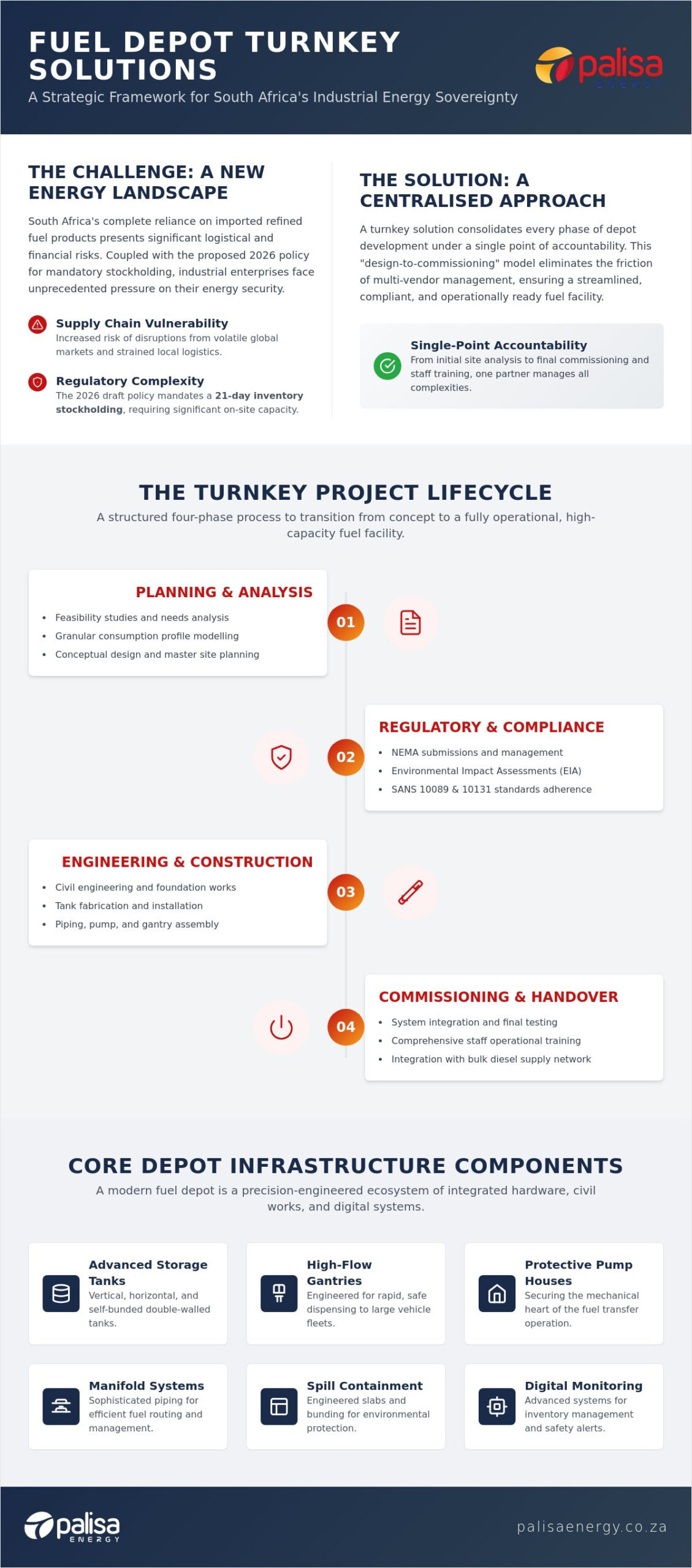
A genuine turnkey engagement begins long before the first tank is placed. It starts with meticulous master planning and conceptual design based on granular consumption profiles. This phase includes the rigorous technical work required for National Environmental Management Act (NEMA) submissions and Environmental Impact Assessments (EIA). A proactive partner manages these authority approvals on your behalf, ensuring that every safety standard is met without draining your internal management resources. The lifecycle concludes with final commissioning and comprehensive staff training for safe operation. This methodical approach ensures that the transition from a construction site to an active fuel depot is seamless, safe, and immediately productive for the enterprise. It’s about delivering a complete ecosystem where infrastructure and supply chain logistics are perfectly integrated. Understanding the broader context of fuel infrastructure planning South Africa is essential for enterprises seeking to align their depot development with the latest SANS standards and the 21-day mandatory stockholding policy.
Core Components of Industrial Fuel Depot Infrastructure
A robust industrial infrastructure requires more than mere storage; it demands a precision-engineered ecosystem where every component functions in total synchronicity. Modern fuel depot turnkey solutions South Africa integrate hardware, civil engineering, and digital monitoring into a holistic framework designed for longevity and environmental safety. This isn’t just about placing a tank on a slab. It’s about constructing a secure facility that includes high-flow dispensing gantries, sophisticated manifolds, and pump houses that protect the mechanical heart of your operation. Every ancillary system, from additive injection to spill containment slabs, must be designed to handle the high-stakes demands of bulk fuel movement whilst adhering to rigorous national standards.
Advanced Storage Tank Technology
The choice between horizontal and vertical storage tank installations depends heavily on your site’s footprint and required capacity. Whilst vertical tanks are often the preferred choice for high-volume storage, the rise of self-bunded, double-walled tanks has revolutionised rapid deployment. These units provide secondary containment within their own structure, which significantly reduces the time and cost associated with traditional concrete bunding. Choosing the correct configuration is central to fuel depot design South Africa, as the physical layout dictates the operational flow and safety profile of the site. Aboveground installations have become the industrial standard due to their ease of maintenance and visible leak detection, offering a clear advantage over underground systems that carry higher environmental risks and remediation costs.
Pumping and Filtration Logistics
Fuel purity is a non-negotiable requirement for modern industrial engines, especially with the impending shift toward Clean Fuels II (CF2) standards. High-performance centrifugal and positive displacement pumps form the backbone of the dispensing system, ensuring that fuel moves at the required high-flow rates without compromising the integrity of the product. Organisations like the Fuels Industry Association of South Africa provide the industry standards that inform these engineering choices, ensuring that every meter and valve is fit for purpose. Integrating a robust Fuel Management System (FMS) is equally critical. These systems provide real-time monitoring of inventory levels and leak detection, whilst allowing you to track consumption behaviour across large fleets with absolute precision. This level of data-driven oversight reduces operational risk and prevents the costly losses associated with fuel shrinkage or undetected leaks. You can explore how these components integrate into a scalable energy strategy at palisaenergy.co.za.
Civil works remain the steadfast guardian of the facility. Bund walls must be engineered to hold 110% of the largest tank’s volume, providing a fail-safe against catastrophic failure. Spill containment slabs and drainage systems are designed to capture every drop of runoff, ensuring that your facility remains compliant with the National Environmental Management Act. When these physical barriers are combined with advanced filtration and digital oversight, the result is a turnkey facility that offers total control over your energy supply chain.
Navigating Regulatory Compliance and Safety Standards
Industrial infrastructure in the energy sector is bound by a complex web of legal mandates. Navigating these requirements demands more than just technical knowledge; it requires a deep understanding of how various legislative frameworks intersect. Comprehensive fuel depot turnkey solutions South Africa provide the regulatory oversight necessary to secure and maintain an operational licence. From the National Environmental Management Act (NEMA) to the Occupational Health and Safety Act (OHSA), every aspect of your facility must align with national safety and environmental objectives. A failure to adhere to these standards doesn’t just invite legal penalties; it jeopardises the safety of your workforce and the continuity of your supply chain.
Central to this compliance is SANS 10131, which governs the storage and handling of liquid fuel in South Africa. This standard dictates the technical specifications for tank construction, bunding, and piping systems. It works in tandem with the Petroleum Products Act regulations to ensure that fuel depots operate within a safe and standardised environment. For facilities exceeding specific storage thresholds, a Major Hazard Installation (MHI) assessment becomes mandatory. This rigorous process identifies potential risks to the surrounding community and environment, establishing the protocols required to mitigate catastrophic events. Professional turnkey partners manage these submissions as long-lead items, ensuring that construction doesn’t outpace legal approval.
Environmental Stewardship and Risk Mitigation
Managing the Environmental Impact Assessment (EIA) process efficiently is critical for avoiding project stagnation. This phase involves detailed studies of soil integrity, groundwater protection, and air quality impacts, especially with the 2027 implementation of Clean Fuels II looming. Your facility must incorporate robust spill response protocols and soil contamination prevention strategies, such as impervious secondary containment systems. Compliance is not merely a legal hurdle but a cornerstone of operational longevity. By integrating environmental stewardship into the initial design, you protect your business from future remediation costs and the reputational damage associated with environmental negligence.
Safety Auditing Frameworks
Operational safety is maintained through a continuous auditing framework that begins with hazardous area classifications. These classifications define the “zones” around gantries and pump houses where explosive atmospheres may exist, dictating the type of electrical equipment permitted. Implementing advanced fire suppression systems and emergency shut-off protocols is a non-negotiable requirement for any high-capacity site. Regular compliance auditing ensures that your on-site fuel storage solutions South Africa remain fit for purpose as regulations evolve. This proactive approach to safety transforms your depot from a potential liability into a secure, high-performance asset that supports uninterrupted industrial activity.
The Lifecycle of a Turnkey Project: From Planning to Commissioning
The execution of industrial energy infrastructure is a chronological journey that requires meticulous orchestration. A structured lifecycle ensures that fuel depot turnkey solutions South Africa deliver maximum return on investment whilst minimising project risk. This progression moves from abstract feasibility to concrete operational reality across five distinct phases. It begins with a granular needs analysis to align storage capacity with actual consumption profiles, followed by technical design and regulatory submission. Once engineering drawings are finalised and authority approvals secured, the project moves into procurement, fabrication, and civil construction. The final stages involve the integration of mechanical and electrical systems, culminating in rigorous testing and commissioning before the facility is handed over for active use.
Strategic Master Planning
Calculating optimal storage capacity is the foundation of energy security. In the 2026 landscape, where the draft Strategic Petroleum Stock Policy proposes a mandatory 21-day stockholding for private wholesalers, we recommend planning for a minimum 30-day fuel reserve to buffer against the volatility of import-dependent supply chains. Site selection criteria must prioritise accessibility for bulk tankers whilst maintaining the mandatory safety distances required by SANS 10089. Fixed-price turnkey contracts are essential here; they protect your capital expenditure from the budget blow-outs often associated with multi-vendor projects. A comprehensive approach to fuel infrastructure planning South Africa ensures that your storage capacity, site layout, and regulatory submissions are aligned from the outset. Secure your infrastructure investment by partnering with experts who understand the local landscape at palisaenergy.co.za.
Commissioning and Operational Readiness
The final transition to an active facility is defined by rigorous validation. Wet testing the entire system is non-negotiable; it’s the only way to ensure that flow rates meet design specifications and that every seal is airtight. This phase also includes intensive staff training on health, safety, and environmental (HSE) protocols to ensure your team is prepared for high-stakes fuel handling. Handover is only complete when you possess a full suite of documentation, including certificates of compliance and detailed operational manuals. This methodical approach ensures that your facility is ready to perform from the moment the first tanker arrives.
By following this structured pathway, industrial enterprises can bypass the typical friction of construction. Each phase serves as a checkpoint for quality and compliance, ensuring that the final asset is both durable and efficient. This vision-followed-by-execution model is what defines a successful turnkey engagement in the modern South African energy sector.
Palisa Energy: Integrated Infrastructure and Bulk Supply Partnerships
A fuel depot is only as effective as the supply chain that feeds it. Whilst many providers focus exclusively on the physical construction of tanks and gantries, Palisa Energy recognises that infrastructure is merely one half of the energy security equation. We bridge the gap between engineering precision and logistical reliability by integrating fuel depot turnkey solutions South Africa with a robust, nationwide supply network. This holistic approach ensures that your facility is not just a compliant structure, but a functioning hub of industrial activity. By leveraging strategic partnerships with major oil companies, we guarantee the consistent delivery of high-quality fuels even during periods of market volatility or infrastructure pressure.
Managing the intersection of hardware and fuel procurement requires a sophisticated level of oversight. Our model moves beyond the traditional contractor-client relationship, positioning us as a dedicated strategic partner. We provide customised energy solutions that encompass everything from bulk diesel and petrol to specialised industrial lubricants. With the wholesale price of 0.05% sulphur diesel inland at R24.78 per litre as of July 2026, and a Slate Levy of 113.94 cents per litre currently implemented, precise inventory management and cost control have never been more critical. We provide the 24/7 support and real-time monitoring required to protect your bottom line and ensure total peace of mind.
A Steadfast Guardian for Your Energy Needs
We act as a steadfast guardian for your energy requirements, managing the complex logistics of fuel movement so you can focus on your core industrial operations. This single point of accountability eliminates the friction often found when coordinating between construction firms and bulk diesel suppliers South Africa. Whether we are navigating the reinstatement of full fuel levies or preparing for the 2027 implementation of Clean Fuels II (CF2) standards, we ensure your supply remains uninterrupted. Our team takes pride in maintaining the highest operational standards, safeguarding your facility against the risks of contamination or supply instability.
Scaling for the Future
Industrial requirements are rarely static, and your infrastructure should reflect your growth trajectory. We offer modular solutions that allow for the seamless scaling of storage capacity as your demand increases. By securing long-term supply contracts alongside your infrastructure development, you insulate your business from the “just-in-time” delivery failures that plague less prepared enterprises. This forward-thinking strategy transforms your fuel depot into a resilient asset capable of supporting decades of expansion. Partner with Palisa Energy for your turnkey fuel infrastructure today.
Our commitment to excellence is grounded in the belief that reliability is the ultimate industrial currency. We don’t just build depots; we engineer energy sovereignty. Through a combination of technical expertise, regulatory mastery, and a formidable supply network, we empower South African businesses to take total control of their energy future. In a landscape defined by change, we remain the constant partner you can depend on for growth and stability.
Securing Industrial Momentum: The Path to Energy Sovereignty
The evolution of the South African energy landscape demands a shift from reactive procurement to proactive infrastructure ownership. By integrating high-performance storage technology with a guaranteed bulk supply chain, industrial enterprises can effectively insulate themselves from the volatility of external market shocks. You’ve seen how fuel depot turnkey solutions South Africa provide a streamlined pathway to this level of operational autonomy; they consolidate complex engineering, NEMA and SANS compliance, and logistical oversight into a single point of accountability. This strategic alignment ensures that your facility is built for longevity whilst remaining agile enough to scale with your future requirements.
Palisa Energy stands as your steadfast guardian in this journey, leveraging a nationwide fuel logistics network and providing 24/7 dedicated industrial support to keep your operations in motion. Our deep compliance expertise in NEMA and SANS ensures that your facility remains a safe, high-performance asset for decades to come. It’s time to transform your energy storage from a logistical hurdle into a formidable competitive advantage. Secure your industrial energy future with Palisa Energy’s turnkey solutions and take total control of your infrastructure today. Your progress shouldn’t depend on the instability of the retail market; it should be powered by a partner committed to your long-term success.
Frequently Asked Questions
What is included in a fuel depot turnkey solution?
A turnkey solution encompasses master planning, engineering design, authority approvals, civil construction, and final commissioning. It provides a comprehensive framework where a single partner manages the entire project lifecycle, ensuring that the facility is fully operational and compliant upon handover. This integrated approach removes the burden of coordinating between multiple contractors and regulatory bodies whilst ensuring technical synchronicity.
How long does it take to construct a fuel depot in South Africa?
The construction timeline typically spans several months, though the duration is heavily influenced by the scale of the facility and the complexity of regulatory approvals. Environmental Impact Assessments and municipal permits often represent the most time-intensive phase of the project. A structured turnkey programme ensures that civil works and procurement proceed in parallel with these approvals to accelerate the final commissioning date as much as possible.
Do I need an Environmental Impact Assessment (EIA) for on-site fuel storage?
An Environmental Impact Assessment is mandatory for storage facilities that exceed the specific thresholds defined under the National Environmental Management Act (NEMA). For industrial sites, this process ensures that soil and groundwater protection measures are sufficient to prevent long-term contamination. Professional fuel depot turnkey solutions South Africa include the management of these assessments to ensure your facility meets all legislative benchmarks before construction begins.
What are the SANS requirements for bulk diesel storage?
Bulk diesel storage must adhere to SANS 10131 and SANS 10089, which dictate the technical standards for tank construction, piping, and secondary containment. Key requirements include a bunded area capable of holding 110% of the largest tank’s volume and specific safety distances from site boundaries and ignition sources. These standards are critical for maintaining your operational licence and ensuring the safety of your workforce and the surrounding infrastructure.
Can a turnkey solution include the ongoing supply of bulk fuel?
A holistic turnkey partner should provide both the physical infrastructure and the reliable bulk fuel supply required to keep the facility active. This integration ensures that the design of the depot is perfectly aligned with the logistical requirements of bulk tankers and high-flow dispensing. Palisa Energy specifically combines infrastructure expertise with a nationwide diesel supply network to provide total energy sovereignty for industrial clients.
What is the difference between aboveground and underground fuel tanks?
Aboveground tanks are the preferred industrial standard due to their visibility, which allows for immediate leak detection and easier maintenance. Whilst underground tanks save surface space, they carry significantly higher environmental risks and remediation costs if a leak occurs. Most modern industrial depots utilise self-bunded aboveground tanks to simplify compliance and reduce the long-term operational risk associated with subsurface storage.
How much space is required for a compliant industrial fuel depot?
The required footprint depends on the total storage capacity and the space needed for bulk tanker manoeuvrability at the loading gantry. SANS regulations also mandate specific safety buffer zones between fuel tanks and other site structures or public boundaries. A detailed feasibility study during the planning phase will determine the optimal layout to maximise storage capacity whilst adhering to these mandatory safety distances.
Does Palisa Energy provide 24/7 support for fuel logistics?
Palisa Energy provides 24/7 dedicated support to ensure that industrial customers maintain uninterrupted operations regardless of external market conditions. Our nationwide logistics network is designed to respond to the high-stakes demands of the energy sector, managing bulk fuel deliveries with absolute precision. This constant oversight ensures that your fuel depot turnkey solutions South Africa remain a source of stability and growth rather than a logistical concern.