

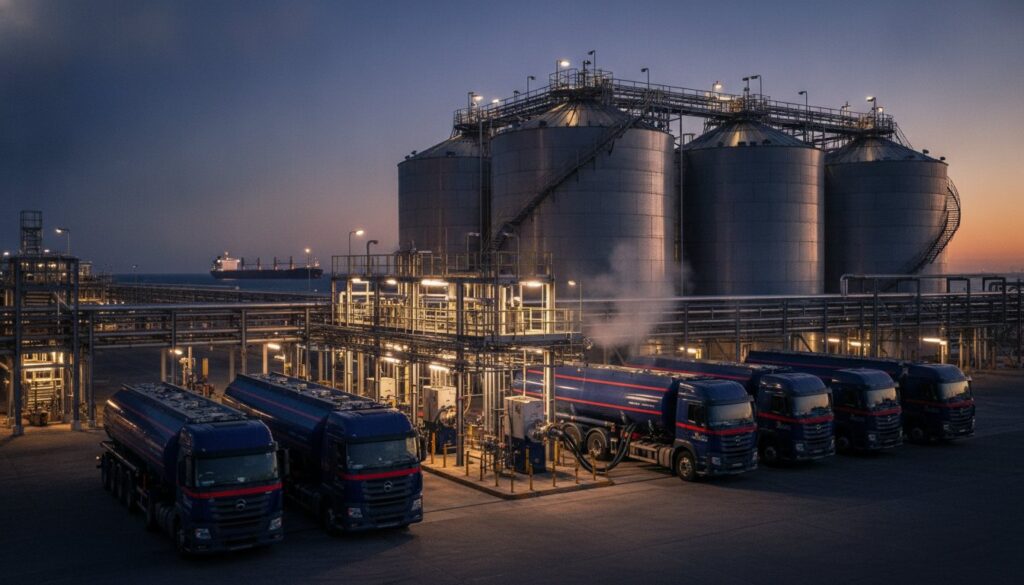
What if the greatest threat to your industrial operations isn’t a national fuel shortage, but rather the pervasive myths surrounding the country’s energy infrastructure? Whilst headlines frequently highlight the loss of approximately half of our domestic refining capacity, the reality of maintaining an uninterrupted fuel supply South Africa requires is far more nuanced than a simple narrative of scarcity. You’ve likely felt the weight of these concerns, navigating the anxiety of refinery closures and the volatility of procurement costs that reached over R32 per litre for diesel earlier this year.
We understand that operational downtime is not an option for a business positioned for growth. This article clarifies the current landscape of the 2026 fuel sector, debunking common misconceptions about reserves whilst providing a definitive strategy for on-site security. You will discover how to move beyond reactive procurement by leveraging strategic logistics and the latest government policies, such as the Draft Strategic Petroleum Stock Policy, to ensure your fleet and machinery never stand idle. We will examine the shift toward import-heavy models and the specific infrastructure investments that transform fuel from a vulnerability into a competitive advantage.
Key Takeaways
- Understand why the closure of local refineries does not signal a national crisis but rather a shift towards sophisticated, import-based energy models.
- Discover how precision logistics and strategic coastal terminals facilitate the uninterrupted fuel supply South Africa needs to maintain industrial momentum.
- Evaluate the financial and operational benefits of investing in on-site storage infrastructure to safeguard your business against short-term market shocks.
- Learn a structured approach to risk management, including consumption auditing and the diversification of your procurement through reliable independent resellers.
- Explore how 24/7 support and real-time delivery monitoring can eliminate operational downtime and streamline your bulk fuel procurement processes.
The Myth of the Fuel Crisis: Understanding South Africa’s Energy Landscape
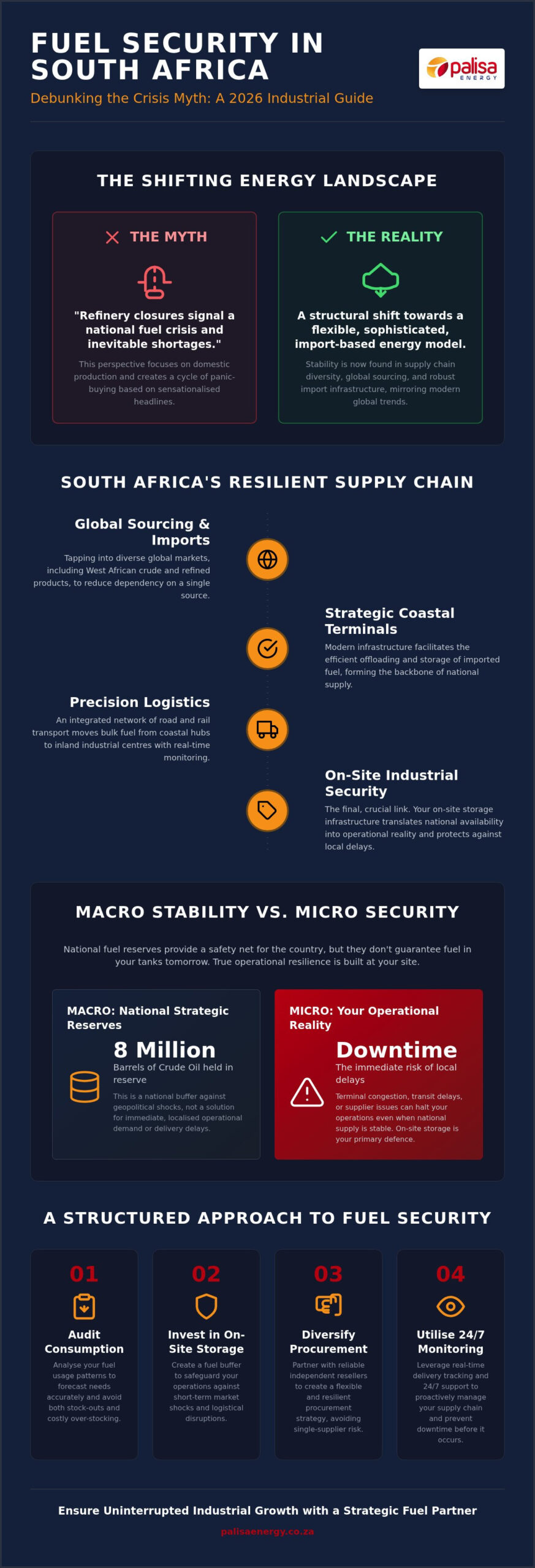
Uninterrupted fuel supply South Africa is not a fortunate accident of geography or a byproduct of historical refining dominance. It is, instead, the calculated result of synchronised global sourcing, robust import infrastructure, and precision logistics. For decades, the national narrative focused on domestic self-sufficiency. However, as we navigate 2026, the industrial sector must confront a fundamental truth: refinery closures do not equate to a permanent fuel shortage. They represent a structural evolution. Whilst headlines often lean toward sensationalism, the underlying reality is one of transition rather than collapse.
The Role of Local Refineries vs. Global Imports
The current operational status of facilities like NATREF and the continued output from Sasol Secunda remain vital anchors for the inland market. Yet, they no longer stand alone. South Africa is successfully transitioning toward a flexible, import-heavy model that mirrors global energy trends. This shift allows for the modernisation of fuel standards, facilitating cleaner energy options that were previously difficult to achieve with ageing domestic infrastructure. By tapping into West African crude oil sourcing and global refined product markets, the country maintains a diverse supply chain that’s less vulnerable to local mechanical failures. Understanding South Africa’s Energy Landscape requires recognising that stability is now found in diversity, not just domestic production. Headlines suggesting “panic buying” often ignore the health of the industrial supply chain, which operates on long-term contracts and strategic import terminal capacities rather than retail pump anxiety.
Why Macro Stability Doesn’t Always Mean Micro Security
National stability is a macro-economic metric. It doesn’t guarantee that a specific industrial site in the North West or a logistics hub in KwaZulu-Natal will have product when a local delivery delay occurs. Whilst the government holds strategic reserves, including the 8 million barrels of crude oil reported in early 2026, these are national buffers. They aren’t immediate solutions for your operational downtime. A “steadfast guardian” approach requires businesses to look beyond general reassurances and take ownership of their own resilience. Fuel security is the intersection of procurement, logistics, and on-site storage. To achieve an uninterrupted fuel supply South Africa businesses must move beyond the panic buying cycle and invest in strategic partnerships that manage these complexities at a granular level. It’s about ensuring that the macro-level availability of fuel actually translates into the micro-level presence of diesel in your tanks.
Logistics: The Invisible Engine of Uninterrupted Supply
Logistics remains the silent architect of energy resilience. Whilst the previous section explored the macro-level shift toward imports, the physical movement of bulk product from coastal terminals to inland industrial hubs is where the promise of stability is actually tested. Many stakeholders operate under the myth that fuel delivery is a simple A-to-B transaction. This perspective dangerously ignores the risks of transit delays, terminal congestion, and potential product contamination. It’s a complex dance of timing and chemistry that requires unwavering oversight.
Securing an uninterrupted fuel supply South Africa can trust requires a sophisticated fuel logistics South Africa strategy. This is not merely about trucks on the road; it is about the integration of real-time monitoring and predictive analytics. Modern logistics platforms now allow for the tracking of deliveries with surgical precision, identifying bottlenecks in the transport network before they result in a stockout at your facility. By visualising the supply chain in real-time, providers can pivot routes and adjust schedules to maintain the momentum of your operations.
Overcoming Distribution Hurdles in 2026
The current year has highlighted the necessity of 24/7 support for high-demand sectors such as mining and manufacturing. Infrastructure maintenance on key arterial routes often necessitates rapid rerouting to maintain delivery windows. Independent resellers have emerged as the agile alternative to traditional oil majors, offering the flexibility to pivot operations in response to local disruptions. This proactive management ensures that your operations remain insulated from the logistical friction that often plagues less sophisticated supply chains. When the standard routes fail, agility becomes your greatest asset.
Precision in Bulk Procurement
Reliability is built on the foundation of diverse sourcing. By maintaining partnerships with multiple major oil companies, a strategic reseller ensures that a localised issue at one terminal does not compromise your entire energy supply. This approach aligns with the broader objectives of the new strategic fuel stocks policy, which seeks to formalise higher levels of refined product reserves across the industry. Such policies are designed to create a buffer against global volatility, but their effectiveness at the site level depends on your procurement partner’s reach.
Mitigating price volatility and ensuring grade consistency requires a partner that understands the nuances of the 2026 market. Precision in procurement means managing the chemistry of the fuel as much as the cost, ensuring that every drop delivered meets the high standards your machinery requires. To safeguard your productivity, you might consider how a dedicated strategic partner can streamline your diesel supply logistics to eliminate the burden of inventory management. This allows your leadership to focus on core growth whilst the “steadfast guardian” manages the complexity of the tank.
Securing the Perimeter: The Case for On-Site Fuel Infrastructure
True operational resilience begins at the perimeter of your own facility. Whilst the national logistics network provides the arteries of energy, a persistent myth suggests that on-site storage is a luxury reserved for remote mining operations or massive agricultural estates. This is a dangerous misconception. In the current 2026 landscape, every large-scale industrial enterprise requires a physical buffer to insulate itself from the friction of the broader supply chain. By establishing a dedicated depot, you reduce your reliance on daily deliveries and create a strategic hedge against short-term shocks that might otherwise halt your production lines.
The business case for private infrastructure is grounded in the pursuit of absolute control. A robust on-site reserve ensures that an uninterrupted fuel supply South Africa businesses demand is not just a theoretical goal but a tangible asset. This internal capacity allows you to capitalise on price dips and maintain momentum during periods of peak demand or logistical congestion. Aligning your internal capabilities with a resilient and reliable liquid fuels network requires moving from a just-in-time procurement model to a more secure, stock-in-hand approach. It is about transforming your energy supply from a variable risk into a controlled component of your operational overhead.
Designing for Operational Resilience
Precision in infrastructure is the catalyst for long-term stability. Effective depot design must account for more than just volume; it requires a holistic consideration of accessibility, environmental protection, and future scalability. When engaging in fuel infrastructure planning South Africa, the objective is to integrate storage seamlessly into your existing fuel security for business South Africa strategy. This integration is enhanced by technologies such as automated tank gauging, which provides real-time visibility into stock levels, preventing the silent threat of a stockout and ensuring your supply remains uninterrupted through data-driven oversight.
Compliance Auditing and Safety Excellence
Safety in petroleum handling is a non-negotiable pillar of industrial excellence. Navigating the legal requirements of fuel storage in South Africa demands a “vision followed by execution” approach, where compliance is viewed as a strategic advantage rather than a regulatory burden. Regular auditing is essential to prevent operational downtime caused by environmental leaks or regulatory shutdowns. By adhering to rigorous safety standards and environmental protocols, you protect your people, your assets, and your reputation amongst stakeholders. This commitment to compliance ensures that your energy hub remains a stable foundation for growth, managed with the precision of a market leader.
Strategic Risk Management: Beyond the Panic Buying Cycle
Industrial energy resilience is not found in reactive headlines. Whilst the retail sector often succumbs to the anxiety of price shifts at the pump, the professional management of an uninterrupted fuel supply South Africa relies upon a cold, calculated assessment of risk and requirement. True security is built through five deliberate steps that move your operations away from the volatility of the spot market and toward a state of total control.
- Step 1: Audit Consumption Patterns. You cannot manage what you do not measure. Establishing an accurate baseline of your monthly and seasonal fuel requirements is the first prerequisite for any security strategy.
- Step 2: Diversify Your Supply Chain. Reliance on a single refinery or terminal is a vulnerability. Engaging an independent reseller with nationwide reach ensures that your supply remains fluid even when local infrastructure faces maintenance or disruption.
- Step 3: Implement On-Site Storage. As established in previous sections, a 7-to-14 day operational buffer is the gold standard for industrial continuity, providing the necessary window to navigate short-term logistical hurdles.
- Step 4: Establish Long-Term Contracts. Transactional buying offers no protection during periods of peak national demand. Priority is always given to those with established supply agreements that formalise their status as a preferred client.
- Step 5: Integrate Real-Time Monitoring. Visibility is the antidote to uncertainty. By utilising modern logistics platforms, you can track your energy assets from the terminal to the tank, ensuring total transparency.
Managing the Cost of Continuity
Procurement departments often focus on the immediate cost per litre, yet this metric is deceptive if it ignores the broader cost of operational downtime. Strategic procurement prioritises the stability of your energy budget by locking in reliable delivery schedules and guaranteed fuel quality. The cheapest fuel is often the most expensive if it arrives late or is off-specification. By viewing fuel as a strategic asset rather than a mere commodity, you insulate your business from the hidden expenses of contamination and stockouts that plague less rigorous procurement models.
The Importance of Long-Term Partnerships
A strategic partnership is the final evolution of risk management. Moving beyond transactional buying allows you to leverage the 24/7 technical and logistical support that is critical in the 2026 energy sector. A “steadfast guardian” partner assumes the burden of managing macro-economic risks, terminal congestion, and transport complexities so you don’t have to. This relationship ensures that your business remains a priority, even when the national supply chain is under pressure. To move your business toward total energy resilience, you can partner with Palisa Energy for reliable diesel supply and strategic logistics support.
Palisa Energy: Your Partner in Uninterrupted Industrial Growth
Palisa Energy stands as the vanguard of industrial energy resilience. We don’t just supply fuel; we provide the architectural stability required for continuous growth in a fluctuating market. By consolidating partnerships with major oil companies, we ensure that your volume requirements are met with unwavering reliability. Our role is that of a strategic partner, managing the intricate dance of procurement and distribution so your leadership can focus on high-level objectives. We manage the high-stakes nature of the energy sector with a composure that builds trust amongst our clients. To understand the specifics of our procurement model, consult our bulk diesel suppliers South Africa guide.
Nationwide Reach, Localised Precision
Coordination is our core competency. We manage complex fuel logistics across the entire South African landscape, ensuring that geographical distance never translates into operational vulnerability. By integrating industrial lubricants and specialised fuels like Jet A1 and paraffin into your existing supply chain, we provide a holistic energy solution. This comprehensive approach guarantees your fleet and machinery never face a dry day, regardless of the market volatility or infrastructure challenges discussed earlier. We provide the uninterrupted fuel supply South Africa requires to power its most critical sectors. Our nationwide network isn’t just a map of routes; it’s a web of reliability that supports your expansion into any province with absolute confidence.
The Turnkey Advantage
Our end-to-end service model represents the pinnacle of industrial support. From initial infrastructure planning and compliance auditing to 24/7 delivery and real-time monitoring, we manage every facet of the energy lifecycle. This turnkey approach is built on a foundation of integrity, safety, and a relentless pursuit of progress for our clients. We act as the steadfast guardian of your fuel reserves, ensuring your path to a resilient energy future is paved with precision and professional authority. Our “vision followed by execution” strategy eliminates the logistical friction that often slows down industrial progress. Choosing Palisa Energy means choosing a partner committed to your longevity and the wider economic prosperity of the nation. It’s time to secure your operations with the confidence that only an established market leader can provide.
Securing Your Industrial Future through Strategic Resilience
The landscape of 2026 has proven that national energy stability is not a static condition, but a dynamic achievement. Whilst the transition from local refining to a sophisticated import-led model has created temporary uncertainty; it has ultimately paved the way for more diverse and modern fuel standards. You’ve seen that true resilience isn’t found in reacting to headlines, but in the deliberate execution of on-site infrastructure and precision logistics. Securing an uninterrupted fuel supply South Africa can depend on is a choice to move beyond the panic buying cycle and into a proactive partnership.
By leveraging a nationwide logistics network and 24/7 industrial support; you can transform your energy supply from a logistical burden into a competitive advantage. Our strategic partnerships with major oil producers ensure that your volume requirements are met with unwavering precision. It’s time to ground your operational growth in the stability of a steadfast guardian. Secure your business continuity with Palisa Energy’s bulk fuel solutions. Your enterprise is positioned for progress, and with the right energy strategy; that momentum will remain unstoppable.
Frequently Asked Questions
Is South Africa currently facing a national fuel shortage?
South Africa is not currently experiencing a national fuel shortage; rather, the energy sector is undergoing a structural transition toward a refined product import model. Whilst local refining capacity has decreased, the national fuel supply remains stable as of early 2026, supported by at least 8 million barrels of crude oil in strategic reserves. The challenge for industry is not a lack of fuel, but the logistical precision required to move it efficiently from ports to inland hubs.
How do refinery closures affect the price and availability of bulk diesel?
Refinery closures increase the nation’s reliance on imported refined products, which ties local availability more closely to global supply chain efficiency and terminal throughput. Whilst this shift can lead to price adjustments based on international shipping costs and Rand volatility, it also allows for the introduction of higher-grade fuels that meet modern environmental standards. Availability is maintained through expanded import terminal capacities and a diversified sourcing strategy that mitigates the risk of single-facility failures.
What are the benefits of on-site fuel storage for my business?
On-site storage provides a critical operational buffer that insulates your enterprise from short-term logistical disruptions or terminal congestion. By maintaining a 7-to-14 day reserve, businesses can hedge against price volatility whilst ensuring an uninterrupted fuel supply South Africa industries require to maintain 24/7 production cycles. This infrastructure transforms energy from a variable risk into a controlled, tangible asset that supports long-term industrial momentum and stability.
Can a private reseller guarantee fuel supply during maintenance periods?
Independent resellers often provide superior supply guarantees during maintenance periods by leveraging diverse sourcing agreements with multiple major oil companies. Unlike a single producer tied to a specific facility, a reseller can pivot procurement to alternative terminals and import hubs to ensure your volume requirements are met without delay. This agility is a cornerstone of industrial resilience, allowing for a steady flow of product regardless of localised infrastructure maintenance.
What is the difference between a fuel reseller and a traditional oil company?
A traditional oil company focuses primarily on the macro-level production and refining of petroleum, whereas an independent reseller specialises in the micro-level logistics and strategic distribution of those products. Resellers act as agile partners, providing customised support and nationwide reach that majors typically don’t offer to individual industrial clients. This relationship allows for more flexible delivery schedules and a dedicated focus on the specific procurement needs of your business.
How does real-time monitoring improve fuel supply security?
Real-time monitoring utilises predictive analytics and automated tank gauging to provide total visibility over your energy assets. This technology identifies potential stockouts before they occur and allows for the surgical precision of delivery schedules, effectively eliminating the human error associated with manual inventory management. By tracking product from the terminal to the tank, businesses can ensure their supply chain remains transparent and fully optimised at all times.
What regulations must be followed for industrial fuel storage in South Africa?
Industrial fuel storage is governed by strict environmental and safety standards, including SANS 10131 for the handling and storage of petroleum products. Compliance requires proper bunding, fire safety certifications, and, depending on the volume, specific licensing from the National Energy Regulator of South Africa (NERSA) to ensure operational legality. Adhering to these regulations is a non-negotiable component of safety excellence and protects your enterprise from regulatory shutdowns or environmental liabilities.
How can my business mitigate the risks of global oil price volatility?
Mitigation of price volatility is achieved through a combination of long-term supply contracts and the strategic use of on-site storage infrastructure. By auditing consumption patterns and purchasing bulk diesel during favourable price windows, enterprises can stabilise their energy budgets whilst securing the uninterrupted fuel supply South Africa businesses need for sustainable growth. A strategic partnership with a reseller further assists in managing these macro risks through expert market insight and procurement precision.