

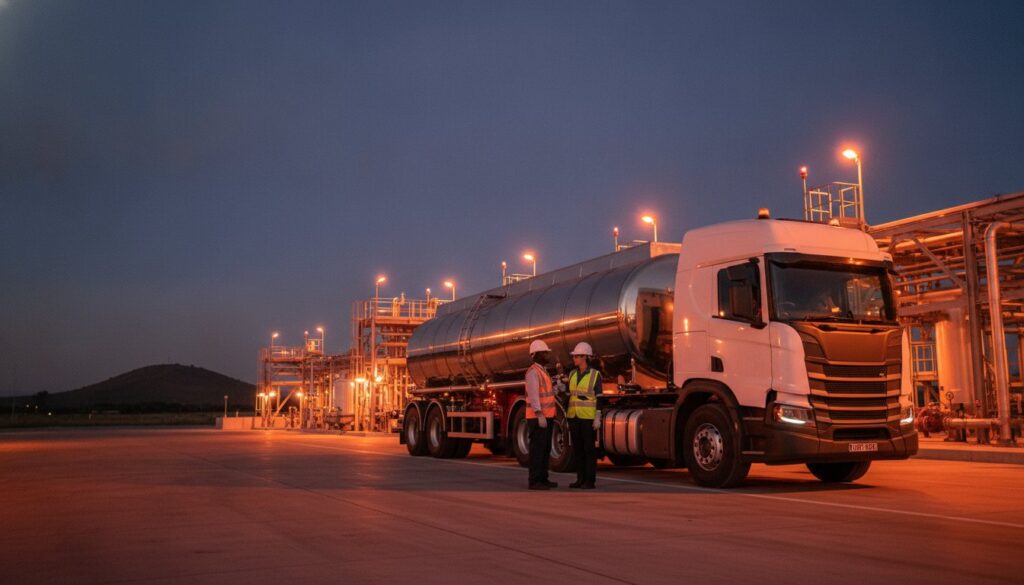
In the unforgiving landscape of South African industry, a single breakdown in your fuel supply chain is more than an inconvenience; it is a direct threat to your commercial viability. Securing reliable bulk diesel delivery South Africa wide is the fundamental anchor that allows your enterprise to maintain momentum whilst others falter under the weight of logistical uncertainty. You likely recognise that managing unpredictable price fluctuations and complex safety compliance is a burden that requires constant vigilance and specialised expertise. This comprehensive reference provides the strategic blueprint you need to master procurement complexities and ensure absolute operational continuity for your South African enterprise. We will explore the nuances of the SANS 342:2016 standards, the impact of recent wholesale price adjustments, and the essential protocols for establishing a transparent, long-term partnership that transforms your fuel logistics from a risk into a competitive advantage.
Key Takeaways
- Understand how to safeguard industrial operations against energy volatility through a resilient and strategically managed fuel supply chain.
- Identify the critical technical differences between 50ppm and 500ppm fuel to enhance engine longevity and maintain peak operational efficiency.
- Master the logistical requirements for reliable bulk diesel delivery South Africa wide to ensure your fleet and backup power systems never face disruption.
- Navigate the complexities of SANS compliance and infrastructure design to establish secure, high-capacity on-site fuel storage solutions.
- Learn the advantages of partnering with a dedicated guardian that offers nationwide distribution and 24/7 industrial support to secure your energy future.
The Strategic Role of Bulk Diesel in South African Industry
Diesel fuel serves as the primary engine of the South African economy. From the deep-level shafts of the mining sector to the expansive agricultural stretches of the Free State, fuel is the non-negotiable prerequisite for industrial output. In an environment where the national grid faces persistent challenges, diesel has transitioned from a mere operational input to a critical pillar of national energy security. Reliable bulk diesel delivery South Africa wide provides a shield against these disruptions, ensuring that manufacturing plants and logistics hubs maintain their momentum regardless of external pressures. Whilst entities like PetroSA (Petroleum, Oil and Gas Corporation of South Africa) play a pivotal role in the national energy framework, private enterprises must secure their own logistical lifelines to remain resilient. Fuel security is no longer just a line item on a balance sheet; it’s a profound competitive advantage that separates market leaders from those vulnerable to supply chain volatility.
Fuel as a Catalyst for Operational Continuity
Precision in fuel supply is the antidote to machinery downtime. When heavy-duty equipment in a mine or a massive transport fleet grinds to a halt due to dry tanks, the financial repercussions are immediate and severe. Industrial momentum relies on a “steadfast guardian” approach to logistics where supply is guaranteed before the need becomes a crisis. 24/7 support ensures that even during peak production cycles or unexpected surges in demand, your operations remain fluid. This continuity is essential for large-scale logistics providers who manage tight delivery windows across diverse terrains. By eliminating the uncertainty of fuel availability, businesses can focus on their core mission of growth and production.
Economic Advantages of Wholesale Procurement
Enterprise-scale operations cannot thrive on retail sourcing. The transition to wholesale procurement offers a vital buffer against the erratic nature of global oil prices and domestic currency fluctuations. By securing fuel in large volumes, businesses achieve a level of price transparency and cost control that is impossible at the pump. This strategic approach to procurement yields a significant long-term ROI by stabilising operational budgets and allowing for more accurate financial forecasting. For a deeper analysis of market dynamics, stakeholders should consult the Strategic Guide to Bulk Diesel Supply to refine their procurement context. Strategic partnerships in bulk diesel delivery South Africa enable firms to:
- Lock in wholesale rates that bypass the high margins of retail outlets.
- Reduce the administrative burden of managing multiple small-scale transactions.
- Ensure a consistent quality of fuel that meets stringent SANS 342:2016 standards.
- Optimise on-site storage to mitigate the risk of sudden price hikes.
Ultimately, the shift to bulk procurement represents a move from passive consumption to active energy management.
Technical Specifications and Procurement Criteria
The integrity of any industrial operation begins with the chemical composition of its energy source. Whilst the Upstream Petroleum Regulations govern the extraction and production phases, the responsibility for quality control shifts to the distributor during the critical “final mile” of delivery. For enterprises managing heavy-duty machinery, the choice of fuel grade is not merely a budgetary decision; it is a fundamental maintenance strategy. Precision in bulk diesel delivery South Africa ensures that the fuel entering your storage tanks meets the exact SANS 342:2016 specifications required to keep modern engines running at peak performance.
Understanding 50ppm vs 500ppm Diesel
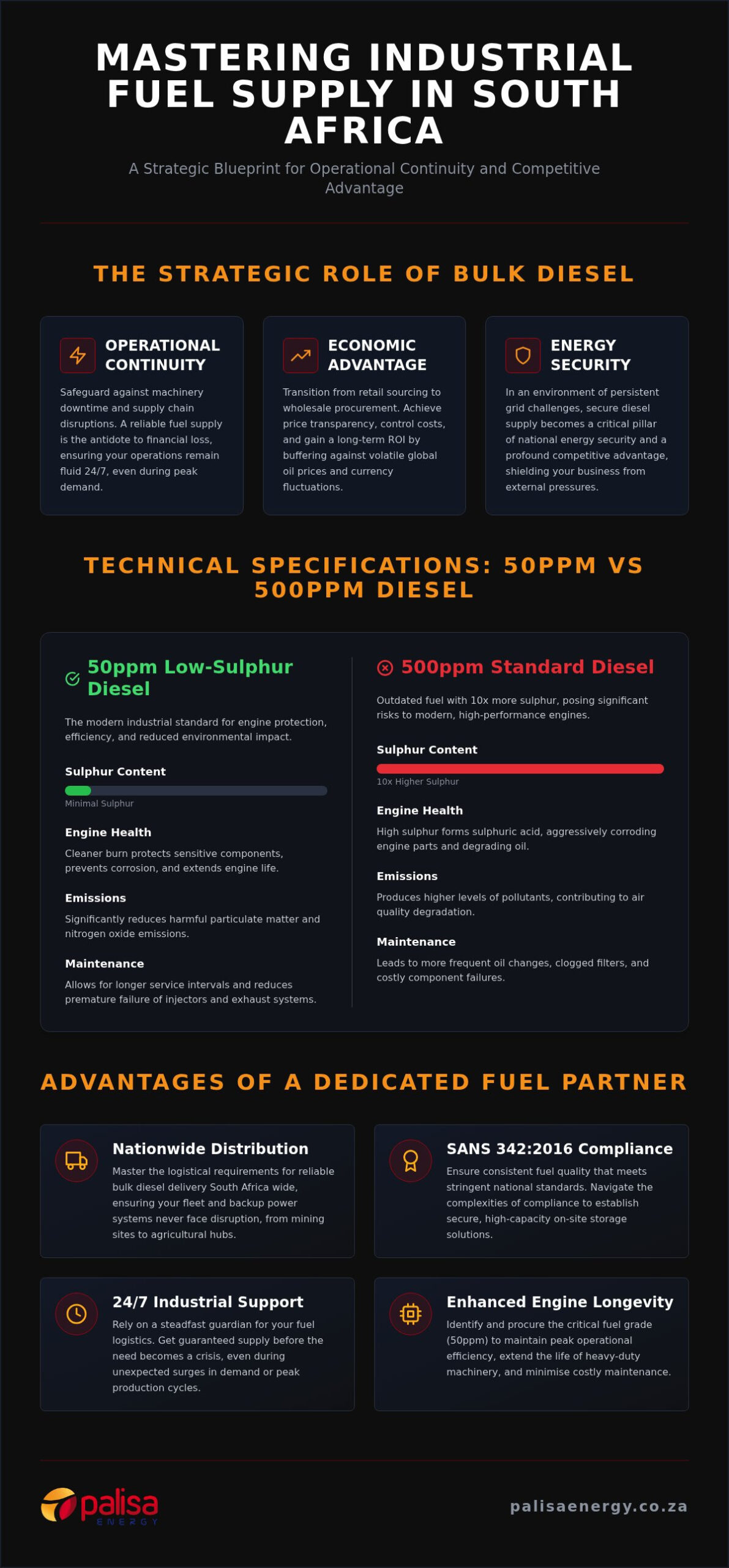
The primary distinction between diesel grades lies in their sulphur content, measured in parts per million (ppm). 500ppm diesel, once the industry standard, contains ten times more sulphur than its 50ppm counterpart. High sulphur levels lead to the formation of sulphuric acid during combustion, which aggressively corrodes engine components and accelerates the degradation of lubricating oil. In contrast, 50ppm diesel offers a cleaner burn, significantly reducing particulate matter and nitrogen oxide emissions. 50ppm diesel represents the modern industrial standard for emission reduction and engine protection in South African commercial fleets. By opting for low-sulphur fuel, operators can extend service intervals and prevent the premature failure of sensitive fuel injectors and exhaust after-treatment systems.
Evaluating Supplier Reliability and Compliance
A resilient fuel supply chain is built on more than just transport; it requires a commitment to rigorous quality control during the uplift process from major oil company terminals. Sourcing directly from these primary hubs guarantees that the product has not been compromised by secondary “blending” or contamination. Beyond the fuel itself, your supplier must meet stringent regulatory benchmarks to ensure your procurement remains beyond reproach. Selecting a partner who understands these technical nuances is essential; you can explore high-grade fuel solutions that align with your specific machinery requirements.
Corporate procurement strategies in South Africa must also account for Broad-Based Black Economic Empowerment (B-BBEE) accreditation. A compliant supplier acts as a strategic asset, contributing to your own preferential procurement scoring whilst ensuring the highest standards of Health, Safety, Security, Environment, and Quality (HSSEQ). These standards are not optional. They are the hallmarks of a professional operation that manages high-stakes logistics with the precision of a market leader. Effective bulk diesel delivery South Africa relies on this intersection of technical excellence and regulatory integrity, providing a foundation of trust that allows your business to focus on growth without the looming threat of equipment failure or compliance risk.
Optimising Fuel Logistics and National Distribution
Managing the physical movement of thousands of litres of combustible liquid across a vast national footprint requires more than just transport; it demands a sophisticated architectural network. South Africa’s diverse terrains, from the high-altitude industrial hubs of Gauteng to the remote agricultural reaches of the Northern Cape, present unique logistical hurdles that only a fit-for-purpose fleet can overcome. Reliable bulk diesel delivery South Africa depends on the seamless integration of primary uplift terminals and a fleet equipped to handle the rigours of long-haul distribution. This isn’t a simple commodity transfer. It’s a high-stakes operation where safety, precision, and efficiency must align to prevent supply chain fractures. For a granular look at these systems, our Fuel Logistics in South Africa guide provides deep-dive distribution insights for industrial stakeholders.
The Impact of Real-Time Monitoring
Modern logistics relies on data as much as it does on fuel. The integration of GPS tracking and advanced fuel level monitoring systems serves as a critical safeguard against theft and operational gaps. These technologies provide a transparent view of the supply chain, allowing for data-driven delivery scheduling that aligns perfectly with your inventory requirements. When you can track a load from the terminal to your storage tank, you build a foundation of trust that is essential for long-term partnerships. It eliminates guesswork. It ensures that every litre ordered is a litre delivered, protecting your bottom line from the “shrinkage” that often plagues unmonitored supply chains.
Managing Delivery Windows and Emergency Supply
Industrial momentum doesn’t wait for late arrivals. Establishing clear delivery windows is vital for maintaining the steady pulse of mining and manufacturing operations. Standard lead times for bulk loads, typically ranging from 7,000L to 40,000L, must be managed with absolute precision to avoid inventory depletion. Strategic uplift points located across the country play a decisive role in reducing transit times and enhancing responsiveness. This decentralised approach allows for:
- Rapid deployment of emergency fuel during periods of unforeseen high demand.
- Minimised vehicle turnaround times through proximity to major industrial centres.
- Increased flexibility in scheduling to accommodate shifting production cycles.
- Redundancy in the supply chain to bypass regional disruptions or terminal maintenance.
By positioning reserves closer to the end-user, a “steadfast guardian” of the supply chain ensures that even in times of national energy strain, your enterprise remains powered and productive. Effective bulk diesel delivery South Africa wide is the result of this methodical, vision-led execution.
Infrastructure Planning and Compliance Auditing
The efficacy of bulk diesel delivery South Africa depends heavily on the physical environment where that fuel is received. Poorly designed depots create logistical bottlenecks and safety hazards that can halt production just as effectively as a primary supply shortage. Strategic infrastructure planning ensures that your site can accommodate high-volume offloading whilst maintaining the highest safety standards. For enterprises looking to scale their capacity or modernise existing facilities, Strategic Fuel Infrastructure Planning serves as an essential roadmap for industrial growth and operational resilience.
Turnkey Solutions for On-Site Storage
Bunded tanks are the gold standard for industrial sites. These double-walled or secondary containment structures are designed to hold at least 110% of the largest tank’s volume, providing a critical fail-safe against leaks and spills. Integrating these physical assets with automated fuel management systems allows for real-time inventory tracking. This level of precision simplifies the scheduling of bulk diesel delivery South Africa, as it eliminates the risk of human error in volume calculations. Palisa Energy acts as a proactive guide in this process, managing the end-to-end construction and integration of depots so that clients can focus on their core operations without the burden of complex project management.
Navigating Compliance and Safety Standards
Compliance is not a one-time event; it’s a continuous commitment to safety and environmental stewardship. In South Africa, SANS 10131 is the primary standard for above-ground storage tanks in South Africa, whilst SANS 10089 governs the broader standards for petroleum storage and handling. Adhering to these protocols involves conducting thorough Environmental Impact Assessments (EIAs) before construction begins to mitigate any potential ecological risks. Regular compliance auditing then serves as a preventive measure against environmental hazards, ensuring that your facility remains a safe, high-performance asset. You can consult our technical team for a compliance audit to secure your facility’s operational integrity and legal standing.
Safe high-volume fuel handling requires strict adherence to several key protocols:
- Establishing clearly marked “no-flame” zones and fire suppression systems.
- Implementing grounding and bonding procedures during fuel transfer to prevent static discharge.
- Conducting regular pressure tests and integrity checks on all piping and valves.
- Maintaining detailed spill response kits and training staff on emergency shut-off procedures.
By treating infrastructure as a strategic asset rather than a utility, businesses build a foundation of stability that supports long-term industrial momentum.
Palisa Energy: Your Partner for Industrial Excellence
Palisa Energy represents more than a supply link. We operate as a formidable strategic partner that bridges the gap between major oil terminals and your specific industrial requirements through a combination of precision procurement and nationwide distribution. Our commitment to operational excellence is rooted in a holistic methodology. We integrate sophisticated logistics with compliant infrastructure design to ensure that bulk diesel delivery South Africa wide remains a guaranteed energy flow rather than a logistical burden. By managing every facet of the fuel lifecycle, we empower your enterprise to achieve Fuel Security for Business, a goal that is essential for maintaining industrial viability amongst the shifting currents of the national energy landscape.
Bespoke Solutions for Diverse Sectors
Industrial requirements are never uniform. A deep-level mining operation demands a different logistical cadence than a high-output manufacturing hub. We provide specialised products tailored to these high-stakes environments, including jet fuel for aviation, paraffin for industrial heating, and high-performance lubricants for heavy-duty machinery. For stakeholders involved in large-scale infrastructure or roadworks, our guide on Bulk Bitumen Suppliers offers targeted sourcing strategies for construction-specific needs. This versatility ensures that regardless of your sector, your energy requirements are met with the same technical precision and unwavering support that defines our brand.
The Future of Energy Partnerships
The landscape of energy is shifting toward greater integration and sustainability. We remain focused on innovation, constantly refining our processes to offer more resilient and sustainable energy solutions that align with modern environmental responsibilities. Reliability is our foundation. Forward momentum is our mission. We invite executive stakeholders to engage in long-term strategic risk management planning to safeguard their operations against future market volatility. Our 24/7 industrial support provides the stability required for such ambitious growth, ensuring that your fleet and facilities never face the cost of downtime. It’s time to move beyond passive supply and embrace a proactive energy strategy. Partner with Palisa Energy for reliable bulk fuel solutions and secure the future of your enterprise through a partnership built on integrity, safety, and excellence in bulk diesel delivery South Africa.
Securing Your Industrial Momentum
Mastering the complexities of fuel procurement is the definitive step toward ensuring your enterprise remains resilient against the volatility of the energy market. By prioritising technical fuel integrity and adhering to rigorous SANS 10131 infrastructure standards, you build a foundation that supports uninterrupted production and fleet operations. A strategic approach to bulk diesel delivery South Africa wide transforms a simple utility into a powerful asset for long-term growth. Palisa Energy stands as your dedicated partner in this mission, offering a unique combination of partnerships with leading oil companies and 24/7 industrial support availability. Our comprehensive fuel infrastructure and logistics expertise ensure that your supply chain is managed with the precision of a market leader. It’s time to transition from passive procurement to active energy management. We invite you to secure your industrial fuel supply with Palisa Energy and experience the stability of a partnership built on excellence. Your operational continuity is our primary objective; together, we can power the future of South African industry with unwavering confidence.
Frequently Asked Questions
What is the minimum order quantity for bulk diesel delivery in South Africa?
Our minimum order quantity for bulk diesel delivery South Africa wide typically starts at 7,000 litres. This threshold ensures that the logistical costs of heavy-duty transport are optimised for your enterprise. Whilst we primarily serve large-scale industrial needs, we can accommodate various volumes up to 40,000 litres per load to align with your specific storage capacity and production demands.
How does Palisa Energy ensure the quality of diesel during transport?
We maintain fuel integrity through a rigorous chain of custody that begins with direct uplift from major oil company terminals. Every tanker is sealed upon loading to prevent contamination or tampering during transit. This methodical approach ensures that the 50ppm or 500ppm diesel reaching your site meets the precise SANS 342:2016 specifications required for your high-performance machinery.
Can you deliver bulk diesel to remote industrial sites nationwide?
We provide comprehensive nationwide distribution that reaches even the most remote industrial and mining sites across South Africa. Our fit-for-purpose fleet is designed to navigate diverse terrains and challenging road conditions whilst maintaining strict delivery schedules. By leveraging strategic uplift points across the country, we ensure that your operations remain powered regardless of your geographical location.
What are the current lead times for a 40,000-litre diesel delivery?
Standard lead times for a 40,000-litre delivery generally range between 24 and 48 hours from the time of order confirmation. This window allows for precise scheduling and logistical coordination to ensure your supply arrives exactly when needed. We recommend establishing a regular delivery cycle to mitigate the risks of sudden inventory depletion during peak industrial periods.
Is Palisa Energy compliant with South African safety and environmental regulations?
Palisa Energy adheres to all relevant South African safety and environmental regulations, including the Occupational Health and Safety Act and SANS 10089 standards. We prioritise integrity and safety in every operation. Our commitment to excellence includes regular compliance auditing of our logistics and support for your on-site storage facilities to prevent environmental hazards.
How does real-time monitoring improve my fuel supply chain efficiency?
Real-time monitoring provides absolute transparency by allowing you to track fuel levels and delivery progress via GPS and digital sensors. This technology eliminates operational gaps and prevents the financial losses associated with fuel theft or “shrinkage” during transit. By utilising data-driven insights, you can optimise your inventory management and ensure a more efficient bulk diesel delivery South Africa wide.
Do you provide on-site fuel tank installation and maintenance?
We provide turnkey solutions for the design, construction, and maintenance of on-site fuel storage depots. Our expertise in infrastructure planning ensures that your tanks are installed in full compliance with SANS 10131 regulations. This holistic service allows you to scale your storage capacity whilst we manage the technical complexities of depot maintenance and safety auditing.
What is the difference between wholesale and retail diesel pricing structures?
Wholesale diesel pricing is regulated by the Department of Mineral Resources and Energy and is typically adjusted on the first Wednesday of every month. Unlike retail pump prices, wholesale structures exclude the profit margins added by service stations, offering significant cost savings for large-scale industrial consumers. This transparent structure allows for more accurate long-term financial forecasting and improved bottom-line results for your enterprise.