


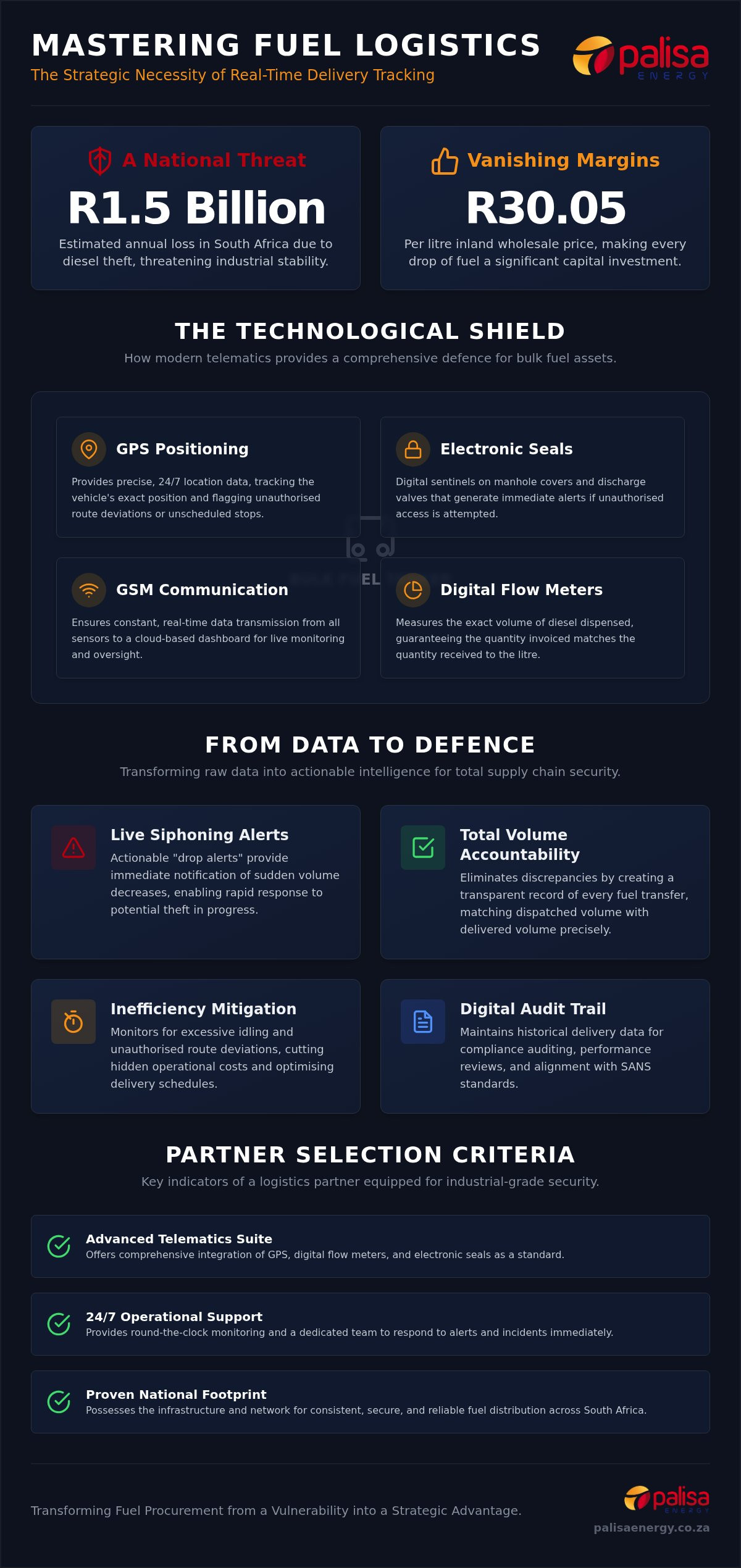
South Africa loses an estimated R1.5 billion annually to diesel theft. This figure represents not just a significant financial drain but a systemic threat to industrial stability across the region. With inland wholesale diesel prices reaching R30.05 per litre in September 2026, the adoption of real-time fuel delivery tracking South Africa has evolved from a peripheral upgrade into a core requirement for any enterprise that values its bottom line. You understand that every litre lost to siphoning or delayed by opaque logistics translates directly into operational downtime and eroded trust. It’s frustrating to manage high-stakes energy needs whilst flying blind regarding the exact location and security of your cargo.
This article provides the blueprint to master the complexities of bulk fuel logistics by leveraging total visibility to ensure absolute accountability and supply chain security. We explore the integration of advanced telematics, the impact of 2026 fuel price surges on security protocols, and how a dedicated partnership can transform your fuel procurement from a vulnerability into a strategic advantage. By the end of this guide, you’ll possess the insights needed to maintain uninterrupted operations through precision-led oversight.
Key Takeaways
- Understand how the sophisticated integration of GPS, GSM, and flow-metering telematics provides a comprehensive shield for your bulk fuel investments against modern logistical threats.
- Discover how real-time fuel delivery tracking South Africa utilises digital flow meters and electronic seals to ensure every litre of diesel reaches its intended destination with absolute precision.
- Learn to identify and mitigate siphoning risks through actionable dashboards that provide immediate “drop alerts” and maintain a transparent record of every fuel transfer.
- Establish clear criteria for selecting a logistics partner that offers 24/7 operational support and possesses the national footprint necessary for consistent, secure distribution.
- Explore the benefits of a strategic partnership that combines nationwide fuel supply with expert infrastructure planning to guarantee long-term industrial reliability.
The Strategic Necessity of Real-Time Fuel Delivery Tracking in South Africa
In a climate where diesel prices have climbed to R30.05 per litre for 0.005% sulphur diesel as of September 2026, the margin for error in bulk procurement has vanished. Operational success depends on more than just securing a supply; it requires absolute command over the transit phase. Real-time fuel delivery tracking South Africa provides this command by integrating GPS positioning, GSM communication, and digital flow-metering into a unified oversight system. This technological triad forms the bedrock of modern fuel logistics South Africa, ensuring that industrial stakeholders don’t just hope for a delivery but actively verify its integrity at every coordinate.
Defining Industrial-Grade Visibility
Standard vehicle tracking monitors the asset, but industrial-grade visibility monitors the product. Whilst basic systems might tell you where a truck is, comprehensive monitoring captures the behaviour of the fuel itself. This involves 24/7 data transmission that accounts for volume, temperature, and valve status across nationwide supply chains. Understanding the mechanics of modern telematics allows procurement officers to see beyond a simple dot on a map. Real-time tracking serves as the digital twin of physical fuel movement, reflecting every litre’s journey from the refinery to your storage tanks with unwavering accuracy.
The Economic Impact of Logistics Uncertainty
Uncertainty is an expensive variable. When deliveries are blind, enterprises absorb the hidden costs of unauthorised route deviations and excessive idling, which silently drain budgets already strained by the R2.94 per litre wholesale price increase seen in late 2026. Live tracking serves as a proactive shield against these inefficiencies. By providing immediate alerts for unscheduled stops or siphoning events, it directly bolsters fuel security for business South Africa. This level of transparency ensures that procurement cycles are grounded in data rather than estimates, allowing for tighter cost control and more predictable operational scheduling. It’s about moving from a reactive stance to one of total logistical dominance.
The necessity for this oversight is compounded by the current slate levy increase to 83.28 cents per litre. Every drop of fuel represents a significant capital investment. Without live monitoring, your business remains vulnerable to the estimated R1.5 billion lost annually to theft across the country. Implementing real-time fuel delivery tracking South Africa is the only way to guarantee that the volume you pay for is the volume that enters your infrastructure.
The Mechanics of Modern Telematics: How Bulk Fuel is Monitored
The efficacy of real-time fuel delivery tracking South Africa rests upon a sophisticated hardware ecosystem that orchestrates data from multiple touchpoints on a tanker. This is not merely about location; it is about the physical state of the cargo. High-precision GPS units provide the spatial foundation, whilst electronic seals act as digital sentinels on manhole covers and discharge valves. These seals generate immediate alerts if unauthorised access is attempted, providing a robust defence in Combating Fuel Theft and Discrepancies. Digital flow meters complete the triad by measuring the exact volume of diesel as it leaves the vessel, ensuring that the quantity invoiced matches the quantity received.
Raw data from these sensors is synthesised into actionable cloud-based dashboards designed for executive oversight. Procurement officers can view historical delivery patterns, which is essential for compliance auditing and performance reviews. This digital record-keeping ensures that every transaction aligns with South African National Standards (SANS) for the transport of dangerous goods. By centralising this information, organisations move away from fragmented spreadsheets and into a regime of total fuel accountability.
Hardware and Software Synchronisation
Sensors on bulk tankers communicate with central logistics hubs via GSM and satellite links to maintain a continuous stream of telemetry. This synchronisation allows for the implementation of geofencing, a critical security feature that ensures deliveries remain on authorised routes. If a vehicle deviates from its pre-approved path, the system triggers an immediate investigation. The use of digital proof of delivery (ePOD) also eliminates the common errors associated with manual paperwork. It provides a timestamped, GPS-verified record of completion that streamlines the billing process and reduces administrative friction.
Compliance and Safety Standards
Monitoring technology plays a vital role in maintaining safety protocols during high-volume fuel discharge. Real-time alerts can identify potential equipment failures or pressure irregularities before they escalate into hazardous incidents. This proactive stance supports environmental protection by enabling a rapid response to any spill or leak. Ensuring that your supply chain adheres to these rigorous standards is a hallmark of operational excellence. For businesses seeking a partner that prioritises these technical benchmarks, engaging with a specialist in diesel supply ensures your logistics are managed with industrial-grade precision. This alignment with national regulatory frameworks safeguards both your assets and your reputation.
Combating Fuel Theft and Discrepancies through Live Oversight
The primary concern for any industrial procurement officer is simple: “How do I know I received exactly what I paid for?” In a landscape where siphoning and “short-drops” are prevalent, real-time fuel delivery tracking South Africa serves as an uncompromising auditor. It transitions the delivery process from a trust-based system to a verification-based one. By monitoring the load from the moment it leaves the depot until the final discharge at your site, the system identifies any discrepancies in volume immediately. This level of oversight creates a culture of accountability amongst logistics partners, acting as a powerful deterrent against the unauthorised redistribution of your assets. It is no longer enough to rely on paper manifests when digital transparency is available.
Identifying and Preventing Fuel Siphoning
The mechanics of fuel drop alerts provide the first line of defence. These sensors detect sudden, unscheduled changes in tank levels whilst the vehicle is in transit or stationary. If a drop occurs outside of a designated geofenced delivery zone, the system triggers an immediate notification to the logistics command centre. This allows for rapid intervention before the product is lost. By analysing route history, managers can identify high-risk zones where theft attempts are frequent and optimise delivery windows to avoid these areas during vulnerable times. Live alerts effectively reduce the window of opportunity for theft to zero. This proactive stance ensures that your diesel supply remains intact and secure throughout its journey across the national road network.
Ensuring Volume Accuracy and Billing Integrity
Precision is the antidote to billing discrepancies. Whilst manual dipstick measurements have been the traditional standard, they are prone to human error and deliberate manipulation. Modern tracking systems compare electronic meter readings with these manual checks to ensure absolute precision. This transparency prevents the common “short-delivery” disputes that often plague supplier-client relationships. By having access to independent, sensor-driven data, you can verify that the volume discharged into your tanks matches the volume invoiced by the supplier.
- Verification of discharge: Confirming exact volumes against invoice quantities in real-time.
- Immutable audit trails: Historical data logs provide a permanent record for financial reviews.
- Detection of phantom drops: Identifying instances where fuel is diverted before reaching your site.
Using historical tracking data allows procurement teams to resolve discrepancies with factual evidence rather than speculation. This ensures that your business only pays for the energy it actually receives, protecting your operational budget from the silent drain of logistical leakage. It is a sophisticated approach that safeguards the integrity of your entire supply chain infrastructure.
Selecting a Logistics Partner: Tracking Criteria for Industrial Success
Identifying a logistics partner in 2026 requires a shift in perspective. It is no longer sufficient to merely hire a transport provider; you must select a strategic ally capable of safeguarding your energy assets through advanced oversight. The right partner understands that real-time fuel delivery tracking South Africa is not an optional feature but a fundamental component of industrial risk management. Vetting a provider involves looking beyond their fleet size and examining the technical and operational infrastructure that supports their delivery promises. Your choice will determine whether your procurement cycle is a source of stress or a pillar of stability for your enterprise.
The Enterprise Logistics Checklist
An enterprise-level fuel supplier must provide a suite of telematic features that offer total transparency. When evaluating potential partners, prioritise those who offer integrated monitoring that combines spatial GPS data with precise volume analytics. This ensures you aren’t just tracking a vehicle, but the actual product within it. Essential requirements include:
- Integrated GPS and Volume Monitoring: The system must synchronise location data with tank levels to provide a holistic view of the cargo’s status.
- Automated Exception Reporting: Immediate alerts for route deviations or volume drops are non-negotiable for maintaining security.
- User-Friendly Client Dashboards: Data is only valuable if it is accessible. A partner should provide a transparent interface where you can monitor your supply chain in real-time.
These technical benchmarks allow you to maintain a high degree of control over your fuel spend whilst reducing the administrative burden on your procurement team.
Beyond the Technology: Operational Support
Technology serves as a powerful tool, but it requires human expertise to be effective. A dedicated 24/7 support team is often more critical than the software itself. You need to know that if an alert is triggered at 02:00, there is a logistics centre actively investigating the discrepancy. This proactive communication separates a visionary enabler from a passive service provider. Furthermore, a partner’s ability to integrate these live insights into fuel infrastructure planning South Africa is vital. Data from tracking should inform your long-term storage strategies and consumption forecasts, turning logistical records into strategic assets.
Nationwide coverage is the final piece of the puzzle. For multi-site industrial operations, having a single provider with a national footprint ensures consistent standards and unified reporting across all locations. This consistency is essential for accurate cost control and compliance auditing. When you partner with a leader in diesel supply, you gain more than just a delivery; you secure a dependable partnership that values precision as much as you do. This long-term commitment to operational excellence is what ultimately drives industrial growth and supply chain resilience.
Palisa Energy: Nationwide Distribution with Unwavering Operational Excellence
Palisa Energy operates as more than a reseller; we are a strategic partner committed to the forward momentum of South African industry. Our role as an independent leader in bulk petroleum distribution is defined by a relentless pursuit of operational excellence and a national footprint that guarantees reliability. By integrating real-time fuel delivery tracking South Africa into every logistical movement, we provide our clients with the industrial confidence necessary to scale in a volatile market. We manage the complexities of the energy sector so you can focus on your core business objectives. Precision is our standard, and reliability is our promise.
Orchestrating National Fuel Security
Reliability is forged through strategic alliances. Our established partnerships with major oil companies ensure a consistent and high-quality supply of diesel, petrol, and jet fuel across the country. This secure procurement is backed by our 24/7 operational support, providing a continuous loop of oversight that manages complex industrial logistics with surgical precision. We act as the steadfast guardian of your energy requirements, utilising live data to anticipate challenges before they impact your operations. Our commitment to safety and integrity isn’t a passive claim; it’s an active practice visible in every nationwide delivery we facilitate. You can trust that your cargo is monitored by experts who value the security of your investment as much as you do.
Turnkey Solutions for Industrial Growth
The value of our logistics data extends far beyond the delivery point. We leverage the insights gained from real-time monitoring to inform our infrastructure planning and compliance auditing services. This holistic approach allows us to help businesses scale their on-site storage capabilities based on actual consumption patterns and logistical realities. We don’t just deliver fuel; we provide the data-driven foundation for sustainable growth. Our expertise ensures that your infrastructure remains compliant with all national safety standards whilst meeting your evolving energy demands.
- Nationwide distribution: A robust logistics network that reaches every corner of the country with consistent service standards.
- Infrastructure expertise: Professional guidance on tank installations, maintenance, and regulatory compliance auditing.
- Continuous oversight: 24/7 monitoring that ensures total fuel accountability and supply chain security for every client.
Securing your supply chain requires a partner that values precision as much as you do. By choosing a provider that integrates distribution with strategic planning, you ensure your operations remain uninterrupted and your costs stay controlled. Partner with Palisa Energy for reliable bulk diesel suppliers South Africa and experience the difference that unwavering operational excellence makes to your bottom line. Our team is ready to provide the stability and foresight your enterprise deserves.
Securing Your Industrial Energy Future
The South African industrial landscape demands a transition from traditional procurement to a regime of total logistical visibility. By implementing real-time fuel delivery tracking South Africa, your enterprise effectively neutralises the risks of siphoning and billing discrepancies whilst ensuring that every litre of bulk diesel serves its intended purpose. You’ve seen how sophisticated telematics and 24/7 oversight provide the data-driven foundation necessary for uninterrupted operations and absolute cost control. This level of transparency is no longer a luxury but a fundamental requirement for maintaining a resilient supply chain in 2026.
Palisa Energy stands ready to act as your strategic partner in this high-stakes sector. We leverage 24/7 operational support and strategic partnerships with major oil companies to guarantee a reliable supply across our national footprint. Our comprehensive infrastructure planning expertise ensures that your on-site storage is as efficient as the tracking technology that monitors your deliveries. We take pride in managing complex logistics with precision so you don’t have to.
Take the decisive step toward absolute fuel accountability today. Consult with Palisa Energy for Secure Nationwide Fuel Logistics and empower your business with the precision it deserves. We look forward to supporting your continued growth and industrial success.
Frequently Asked Questions
How does real-time fuel delivery tracking prevent theft in South Africa?
The system utilises a combination of electronic seals and “drop alerts” to identify unauthorised access to the cargo. If a tanker’s discharge valve is opened outside a pre-determined geofenced zone, an immediate notification is sent to the 24/7 logistics support centre. This level of oversight ensures that any attempt at siphoning is detected whilst in progress, allowing for rapid intervention and reducing the window of opportunity for theft to zero.
Can real-time monitoring improve the accuracy of bulk fuel billing?
Yes, real-time fuel delivery tracking South Africa provides an immutable digital record of the exact volume discharged at your site. By comparing sensor-driven data from digital flow meters with invoiced amounts, procurement teams can eliminate the discrepancies often associated with manual dipstick measurements. This transparency ensures absolute billing integrity and provides factual evidence to resolve any potential “short-delivery” disputes with logistics partners or suppliers.
What hardware is required for industrial fuel tracking on bulk tankers?
Industrial-grade tracking requires an integrated suite of hardware, including high-precision GPS units, GSM or satellite communication modules, and digital flow meters. Furthermore, electronic seals are fitted to all manhole covers and discharge points to detect tampering. These components work in unison to transmit continuous telemetry to a central dashboard, providing a comprehensive “digital twin” of the physical fuel movement across the national road network.
Is real-time tracking compliant with South African National Standards (SANS)?
Modern telematics systems are engineered to align with SANS codes governing the transport of dangerous goods and the management of fuel infrastructure. Compliance auditing ensures that hardware installations and data transmission protocols meet rigorous national safety and environmental regulations. This alignment is vital for maintaining operational excellence and ensuring that your energy supply chain adheres to the highest legal and safety benchmarks in the country.
How does geofencing enhance the security of nationwide fuel distribution?
Geofencing establishes virtual boundaries around authorised routes and delivery coordinates. If a vehicle deviates from its pre-approved path or stops in an identified “high-risk” zone, the system triggers an automated alert. This proactive security measure ensures that your fuel remains within protected corridors, which is essential for managing complex logistics whilst navigating the vast and often challenging distances of nationwide distribution across South Africa.
Can I integrate fuel tracking data with my company’s existing ERP system?
Advanced tracking platforms are designed for seamless integration with enterprise resource planning (ERP) systems via secure API connections. This synchronisation allows your procurement and finance teams to automate inventory updates and financial reconciliations based on real-time delivery confirmations. By centralising this data, organisations can improve their infrastructure planning and consumption forecasting through a unified environment that bridges the gap between physical logistics and financial oversight.
What happens if a fuel delivery is delayed or diverted from its route?
In the event of a delay or unscheduled diversion, the dedicated support team receives an immediate notification to investigate the cause. Real-time fuel delivery tracking South Africa allows logistics managers to provide stakeholders with accurate, revised arrival times and proactive updates. This visibility is critical for minimising industrial downtime and ensures that your operations can adapt to supply chain disruptions with minimal impact on productivity.
Does Palisa Energy provide real-time tracking for all bulk petroleum products?
Palisa Energy incorporates real-time monitoring into the distribution of our entire range of bulk petroleum products, including diesel, petrol, jet fuel, and paraffin. We combine this technical oversight with 24/7 operational support and strategic infrastructure planning to provide a holistic energy solution. Our commitment to precision ensures that every nationwide delivery is managed with the gravitas and security required to support long-term industrial growth and reliability.