

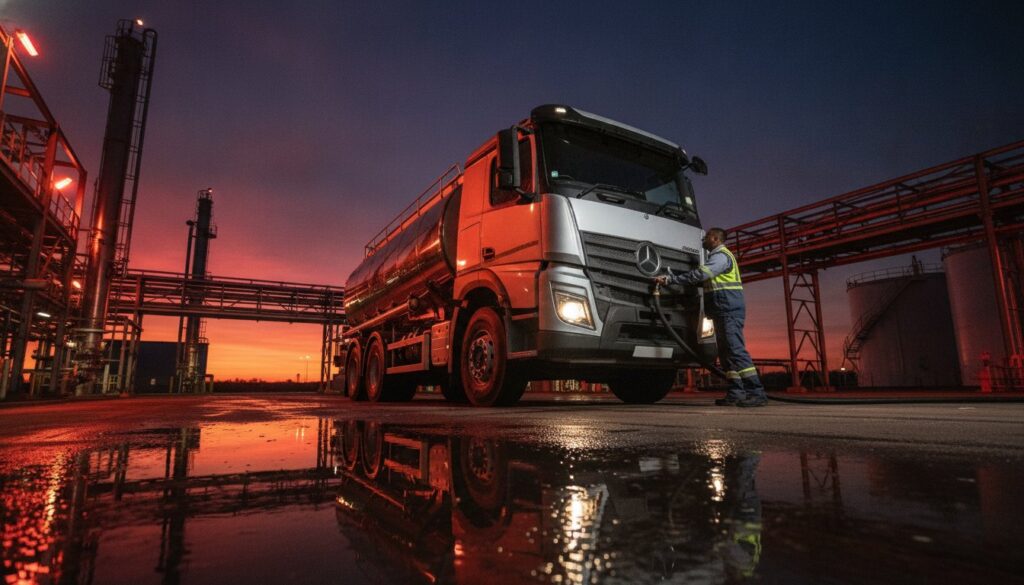
In the high-stakes industrial environment of 2026, heavy duty engine oil is no longer a mere line item on a maintenance spreadsheet; it’s a strategic asset that dictates the survival of your fleet. Securing the most dependable heavy duty engine oil suppliers South Africa provides is now the primary lever for protecting your machinery against the friction of both mechanical wear and market volatility. You likely recognise that whilst premium lubricants are vital, unreliable delivery windows and fluctuating petroleum costs often threaten your operational continuity.
This guide empowers you to identify a partner capable of shielding your assets through logistical precision and technical expertise, ultimately reducing your total cost of ownership. We’ll explore the shift toward API PC-12 standards, the implications of the latest SARS import permits, and how a unified approach to fuel and lubricant procurement creates a seamless foundation for long-term growth. By moving from a transactional mindset to a strategic partnership, you ensure that your operations remain resilient in an increasingly demanding economic landscape.
Key Takeaways
- Understand why South Africa’s unique climate and terrain demand lubricants with superior thermal stability and soot handling to protect critical industrial infrastructure.
- Navigate the 2026 regulatory landscape by identifying lubricants that meet the latest API PC-12 and ACEA 2024 performance benchmarks for modern diesel engines.
- Evaluate heavy duty engine oil suppliers South Africa based on their national logistical resilience and their ability to provide 24/7 technical support.
- Optimise your operational budget by shifting focus from simple price-per-litre metrics to a comprehensive Total Lubrication Cost analysis.
- Discover the strategic advantages of a consolidated supply chain where bulk diesel and lubricant logistics are managed through a single, steadfast partner.
The Strategic Significance of Heavy Duty Lubricants in South Africa’s Industrial Sector
In the high-output sectors of mining and transport, lubricants are far more than mere maintenance requirements. They function as the silent, structural backbone of South Africa’s industrial infrastructure. High-performance engine oils aren’t just consumables; they’re a critical investment in asset protection, especially where machinery operates under continuous, heavy loads. Reliable heavy duty engine oil suppliers South Africa relies upon provide the essential barrier between operational success and catastrophic mechanical failure.
Choosing a superior lubricant directly influences the total cost of ownership for heavy machinery. Whilst a lower-tier product might seem cost-effective on a procurement spreadsheet, the long-term reality is often different. Substandard oils lead to increased friction, higher fuel consumption, and accelerated wear. By prioritising quality, businesses shift from a reactive maintenance model to a proactive asset management strategy. It’s a transition that ensures machinery remains in peak condition for longer, protecting the capital investment of the enterprise.
Addressing the South African Operational Environment
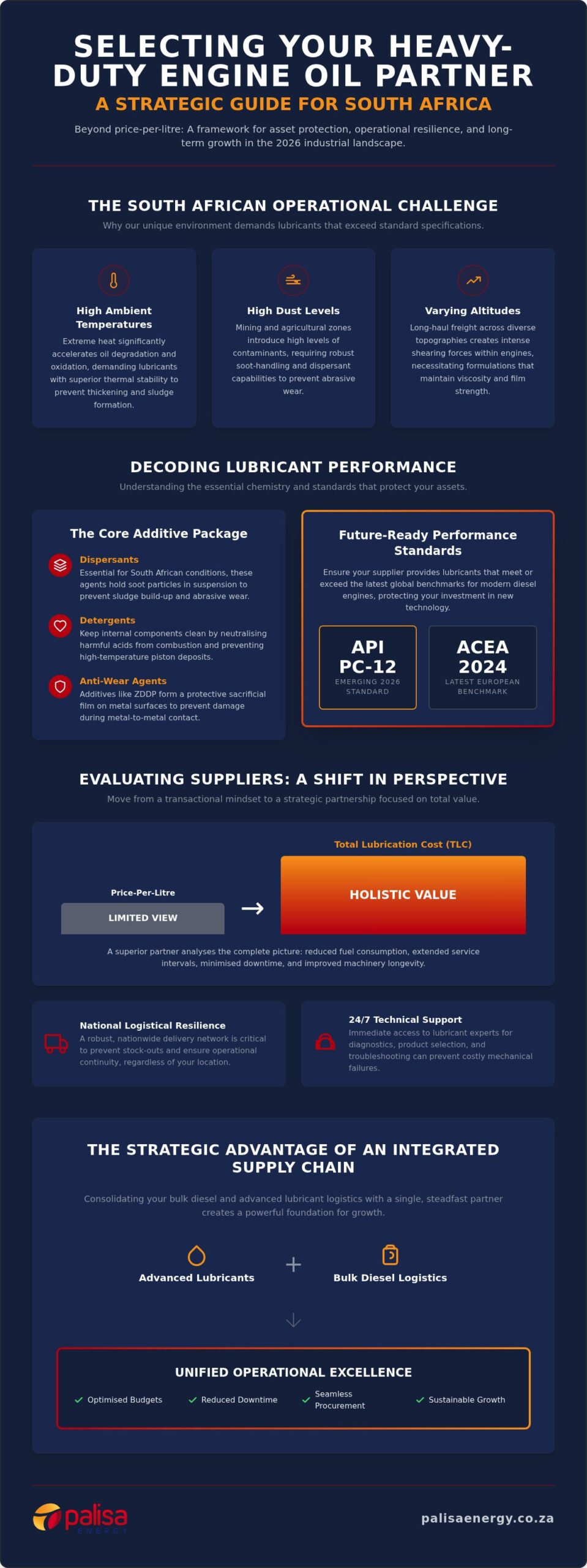
The South African landscape is notoriously unforgiving on internal combustion engines. High ambient temperatures, combined with significant dust levels in mining and agricultural zones, significantly accelerate oil degradation rates. These conditions demand lubricants with exceptional thermal stability and soot-handling capabilities. Without robust oxidation control, oil thickens prematurely, leading to sludge formation and reduced flow. For long-haul road freight, where vehicles cover thousands of kilometres across varying altitudes and temperatures, local operators require formulations that surpass basic technical benchmarks for heavy duty engine oils. Only high-specification products can withstand the intense shearing forces found in these environments.
Economic Impact of Machinery Longevity
Downtime is the most significant hidden cost in any industrial operation. In manufacturing, a single day of halted production can result in millions of Rands in lost revenue. Premium engine oils mitigate this risk by extending service intervals and preventing unexpected breakdowns. Beyond mechanical protection, these oils contribute to improved fuel efficiency. Modern formulations reduce internal engine drag, which translates to lower fuel consumption across a large fleet. As environmental regulations tighten in 2026, the role of high-grade lubricants in reducing emissions becomes even more vital. Partnering with established heavy duty engine oil suppliers South Africa trusts allows companies to support sustainable industrial growth whilst maintaining a competitive edge in a volatile market.
Technical Benchmarks for Heavy Duty Engine Oils: Standards and Performance Metrics
Heavy Duty Engine Oil (HDEO) is a lubricant specifically engineered for high-load, high-temperature diesel and petrol engines. These formulations must withstand the extreme pressures of industrial applications whilst maintaining their chemical integrity over extended service intervals. For fleet managers, the technical specification of a lubricant is the primary indicator of its ability to protect capital assets. Leading heavy duty engine oil suppliers South Africa provides must offer products that align with the most recent international performance classifications to ensure machinery longevity.
The effectiveness of an engine oil depends heavily on its additive package. Modern HDEOs utilise sophisticated chemistry to combat the byproducts of combustion. You should look for formulations rich in:
- Detergents: These keep internal engine components clean by neutralising acids and preventing the formation of high-temperature deposits.
- Dispersants: Essential for South African conditions, these agents hold soot particles in suspension to prevent sludge and abrasive wear.
- Anti-wear agents: Typically containing Zinc Dialkyldithiophosphate (ZDDP), these additives form a protective film on metal surfaces during metal-to-metal contact.
Understanding API and ACEA Classifications
The regulatory landscape for lubricants is currently undergoing a significant transition. Whilst API CK-4 remains the prevailing standard for modern fleets, the American Petroleum Institute opened its licensing portal for the next-generation PC-12 standard on 1 June 2026. This prepares the industry for the CL-4 and FB-4 categories arriving in early 2027. Similarly, the ACEA 2024 standards became mandatory for all new performance claims after 1 October 2025. These European benchmarks, such as E8-24 and E11-24, are vital for South African operators using European-manufactured machinery to maintain warranty compliance. Aligning your procurement with specialised bulk petroleum distributors ensures your fleet utilises oils that meet these evolving OEM requirements.
The Role of Viscosity and Thermal Stability
Viscosity remains the most critical physical property of any lubricant. Whilst 15W-40 has long been the staple for heavy duty engines in South Africa, there’s a growing shift toward 10W-30 and 5W-30 grades. These thinner oils offer improved fuel economy and better cold-start protection without sacrificing high-temperature shear stability. Shear stability is non-negotiable; it’s the oil’s ability to resist permanent viscosity loss under the intense mechanical stress of a heavy-duty engine. Advanced semi-synthetic and fully synthetic base oils provide superior oxidation resistance compared to traditional mineral oils. This thermal stability is crucial for preventing oil thickening in the high ambient temperatures common amongst South African industrial sites. Choosing the correct base oil technology ensures that your heavy duty engine oil suppliers South Africa partners provide consistent protection throughout the entire drain interval.
Key Criteria for Selecting Heavy Duty Engine Oil Suppliers in South Africa
Procurement of industrial lubricants requires a rigorous evaluation of a provider’s operational infrastructure. It isn’t enough to simply supply a product; the partner must act as a steadfast guardian of your machinery. Reliable heavy duty engine oil suppliers South Africa relies upon must demonstrate a seamless integration of supply chain management and technical proficiency. This ensures that your assets are protected against the twin threats of mechanical failure and supply chain disruption in a volatile 2026 market.
A dependable supplier also provides 24/7 technical support and emergency supply capabilities to mitigate unforeseen operational risks. BEE compliance and local ownership are also vital factors in procurement sustainability. Choosing a South African-owned entity that balances corporate scale with a dedicated strategic approach ensures that your investment supports local economic growth whilst benefiting from global technical standards. This stability is essential when managing the high-stakes requirements of the energy and transport sectors.
National Distribution and Logistical Capability
Industrial operations often exist far from primary economic hubs. A supplier’s national footprint determines their ability to sustain your operations in remote mining or agricultural zones. Real-time monitoring of deliveries provides the transparency required to manage inventory levels with precision. A partner who masters the complexity of fuel logistics South Africa can synchronise the delivery of both diesel and lubricants, reducing the administrative burden on your procurement team. This logistical resilience is the difference between a productive shift and costly machinery downtime. Your supplier must possess the agility to navigate national infrastructure challenges without compromising on delivery schedules.
Quality Assurance and Technical Expertise
Authenticity is paramount when handling bulk lubricants. You must verify that your supplier conducts rigorous batch-testing and maintains strategic partnerships with global oil majors for consistent quality assurance. As of March 2026, new SARS import permits for mineral oils require suppliers to maintain meticulous documentation for every litre moved. On-site technical audits and lubrication surveys offer a deeper layer of value; they identify specific areas where oil performance can be optimised. Every delivery should be accompanied by comprehensive safety and technical data documentation to ensure regulatory compliance. By partnering with heavy duty engine oil suppliers South Africa trusts, you ensure that every drop of oil meets the precise specifications required by your Original Equipment Manufacturer (OEM).
Sourcing Strategies for Bulk Lubricants: Efficiency and Cost Management
Effective procurement in the energy sector requires a shift from transactional purchasing to strategic asset management. When evaluating heavy duty engine oil suppliers South Africa, looking beyond the initial price-per-litre is essential. This is known as the Total Lubrication Cost (TLC) model. TLC accounts for the holistic impact of a lubricant on your operation, including maintenance intervals, component life, and energy efficiency. High-quality oils might command a higher upfront cost, but they significantly reduce the total cost of ownership by preventing unscheduled machinery downtime and premature engine wear.
Long-term supply contracts offer a vital buffer against the price volatility seen throughout 2026. With crude oil prices fluctuating between $91 and $95 per barrel in late August, securing fixed-margin agreements provides the financial predictability required for large-scale industrial budgeting. Implementing fuel security for business South Africa through diversified sourcing ensures that your lubricant supply remains as resilient as your fuel reserves. This stability allows you to focus on core operational growth rather than reacting to market shifts.
Consolidated Procurement Models
Consolidating your supply chain by partnering with integrated bulk diesel suppliers South Africa creates significant administrative efficiencies. Instead of managing multiple vendors, a single-point-of-contact distribution model reduces logistical friction and simplifies invoice reconciliation. This approach allows you to leverage combined bulk buying power, often securing more competitive industrial rates for both fuel and lubricants. It’s a methodical way to streamline operations whilst ensuring that every engine in your fleet receives the precise grade of protection it requires. To optimise your supply chain resilience, contact our expert logistics team for a comprehensive procurement assessment.
Risk Management in the Petroleum Supply Chain
Industrial continuity depends on a supplier’s ability to navigate national logistical disruptions. Risk management involves more than just selecting a product; it requires fuel infrastructure planning South Africa to ensure on-site lubricant storage is sufficient and safe. Strategic storage mitigates the impact of intermittent supply chain bottlenecks, providing a ‘steadfast guardian’ effect for your daily operations. As SARS has updated its prohibited and restricted imports list as of March 2026, working with a supplier who manages these regulatory complexities is non-negotiable. Proper planning ensures that your mineral oil and lubricant products are always available when your machinery demands them most.
Palisa Energy: Delivering Excellence through Integrated Lubricant and Fuel Logistics
Palisa Energy operates as a formidable corporate entity, positioned at the forefront of South Africa’s industrial advancement. We recognise that the energy sector is a high-stakes environment where precision isn’t just a preference but a necessity for survival. Our “steadfast guardian” approach defines our role as a proactive guide, managing the intricate layers of petroleum logistics so our clients don’t have to. Amongst the most reliable heavy duty engine oil suppliers South Africa provides, we distinguish ourselves through a 24/7 commitment to operational excellence. This unwavering support ensures that your machinery remains protected, regardless of the time or location of your operations, reflecting our role as a dedicated strategic partner in your long-term growth.
Our identity as a BEE-aligned, South African-owned entity informs every aspect of our service delivery. We strike a balance between being a large-scale industrial force and a focused enabler of local business success. By integrating diesel supply with comprehensive lubricant distribution, we create a synergy that reduces the complexity of your supply chain. This holistic approach doesn’t just provide products; it provides the stability and forward momentum required to navigate the challenges of the 2026 market. We take pride in our operational standards, ensuring that integrity and safety remain the foundation of every partnership we build.
Our National Distribution Network
Stability in the industrial sector is built upon a foundation of logistical resilience. We’ve developed a comprehensive distribution network that reaches across the entire country, ensuring that critical lubricants and diesel are available even in the most remote mining and agricultural territories. Our execution is methodical and intentional; we utilise real-time monitoring for all bulk deliveries to provide the transparency required for modern fleet management. This precision is vital for the road freight and manufacturing sectors, where any disruption in supply can lead to significant financial repercussions. By coordinating nationwide logistics with such rigour, we ensure that your infrastructure remains operational and your growth stays on track.
Strategic Partnerships and Quality Assurance
Excellence in lubrication is only possible through uncompromised product standards. We leverage strategic partnerships with major global oil companies to ensure that every litre of industrial-grade lubricant we supply meets the highest technical benchmarks. These collaborations allow us to provide formulations that align with the latest API and ACEA standards, ensuring your equipment benefits from the most advanced chemical protection available. Beyond performance, we’re deeply committed to environmental responsibility. We actively support the Extended Producer Responsibility (EPR) requirements, ensuring that the entire lifecycle of our products is managed with integrity. Contact Palisa Energy for a strategic lubrication consultation to discover how our integrated energy solutions can optimise your operational longevity.
Securing Your Industrial Future through Strategic Lubrication
The industrial landscape of 2026 requires a transition from transactional procurement to a holistic energy strategy. By aligning your fleet with the latest API PC-12 and ACEA performance standards, you ensure that your machinery withstands the extreme thermal and mechanical stresses of South African operations. Identifying the most reliable heavy duty engine oil suppliers South Africa provides is the primary lever for reducing your total cost of ownership whilst maintaining peak efficiency. This proactive approach to asset management transforms maintenance from a recurring expense into a strategic investment in longevity.
Palisa Energy serves as a dedicated strategic partner, offering the stability and precision of an independent South African-owned reseller. Our commitment to 24/7 industrial support and nationwide fuel and lubricant distribution ensures that your operations never lose momentum. Secure your industrial supply with Palisa Energy’s nationwide logistics to fortify your infrastructure against market volatility. We look forward to supporting your progress with unwavering integrity and technical excellence, ensuring your enterprise remains a formidable force in the national economy.
Frequently Asked Questions
What defines a heavy duty engine oil compared to standard passenger vehicle oil?
Heavy Duty Engine Oil (HDEO) is distinguished by its robust additive package, which contains significantly higher levels of detergents and dispersants than passenger vehicle lubricants. These additives are essential for neutralising acids and holding soot in suspension, a critical requirement for high-displacement diesel engines. Whilst passenger oils focus on friction reduction for fuel economy, HDEOs prioritise wear protection and thermal stability under continuous, high-load industrial conditions typical in the transport and mining sectors.
How do I choose the right viscosity grade for machinery operating in South Africa?
Selecting the correct viscosity requires balancing OEM requirements with the harsh South African climate. Whilst 15W-40 remains a reliable standard for many heavy-duty applications, modern fleets are increasingly adopting 10W-30 or 5W-30 grades to improve fuel efficiency. You must ensure the chosen oil maintains high shear stability to resist thinning at high ambient temperatures. Partnering with heavy duty engine oil suppliers South Africa trusts ensures you receive technical guidance tailored to local operational stresses.
What are the benefits of sourcing lubricants from bulk petroleum resellers?
Sourcing from bulk petroleum resellers like Palisa Energy allows for the strategic integration of fuel and lubricant procurement. This model reduces administrative overhead through a single-point-of-contact for all energy needs whilst leveraging bulk buying power for more competitive industrial rates. Additionally, these resellers provide national logistical resilience, ensuring that your critical supplies reach remote sites through a coordinated distribution network that minimises the risk of operational disruptions or machinery downtime.
Can I use the same heavy duty oil for both diesel and petrol engines in my fleet?
You can use a single heavy duty oil for mixed fleets only if the product carries dual ratings for both diesel and petrol engines, such as API CK-4 and API SN. This consolidation simplifies inventory management and reduces the risk of misapplication. However, it’s vital to verify that the lubricant meets the specific performance benchmarks and viscosity requirements for every vehicle in your fleet to avoid compromising manufacturer warranties or engine longevity.
How often should oil analysis be performed on heavy industrial equipment?
Oil analysis should ideally be performed at every scheduled drain interval or every 250 to 500 operating hours, depending on the machinery’s duty cycle. This predictive maintenance tool identifies internal component wear, fuel dilution, and coolant leaks before they cause catastrophic failure. Regular testing allows you to optimise oil drain intervals safely, which reduces the total cost of ownership whilst providing a clear record of asset health for long-term operational planning.
What environmental regulations govern the storage of bulk lubricants in South Africa?
Bulk lubricant storage is governed by the National Environmental Management: Waste Act, specifically the Extended Producer Responsibility (EPR) scheme implemented in recent years. This regulation requires importers and distributors to manage the entire lifecycle of the product, including safe disposal. Additionally, the National Building Regulations and SANS standards mandate specific bunding and spill containment measures to prevent soil and water contamination. Compliance is essential to avoid significant legal penalties and environmental damage.
Why is 24/7 supplier support critical for the South African mining sector?
The mining sector operates on a continuous, 24/7 basis where any interruption in the supply chain leads to immediate and substantial revenue loss. Access to 24/7 support from heavy duty engine oil suppliers South Africa ensures that emergency technical assistance and urgent deliveries are available to prevent machinery downtime. This level of unwavering support acts as a steadfast guardian for high-stakes operations, allowing mining companies to maintain production targets without the risk of logistical bottlenecks.