

Could your enterprise survive a fourteen-day total cessation of refined fuel deliveries? With South Africa now importing 81% of its refined petroleum products, the margin for logistical error has vanished. Establishing robust fuel security for business South Africa is no longer a mere procurement line item; it’s a fundamental pillar of operational resilience. You likely recognise that the transition from a refining nation to a net importer has introduced unprecedented volatility into your supply chain, where even minor global disruptions ripple through local operations.
This article delivers a comprehensive analysis of the strategic trends shaping the energy sector through 2026. We’ll show you how to insulate your enterprise from supply chain shocks whilst aligning with the latest regulatory mandates, including the proposed mandatory fourteen-day refined product reserves for wholesalers. We begin with a high-level overview of the current import landscape and move into specific strategies to safeguard your industrial continuity against the threat of operational paralysis.
Key Takeaways
- Analyse the strategic shift from domestic refining to a net-import model and its direct implications for maintaining fuel security for business South Africa in a volatile global market.
- Evaluate the intersection of availability, accessibility, and fuel quality to ensure that your machinery remains operational and protected from the risks of sub-standard supply.
- Navigate the complexities of the 2027 ‘Cleaner Fuels 2’ regulatory transition whilst leveraging digitalisation to enhance your predictive consumption capabilities.
- Implement robust strategic frameworks, such as expanded on-site storage and fixed-volume procurement, to insulate your enterprise from sudden supply chain shocks.
- Discover the operational advantages of aligning with a dedicated energy partner who manages logistical complexity and infrastructure compliance on your behalf.
The Evolving Landscape of Fuel Security for South African Business
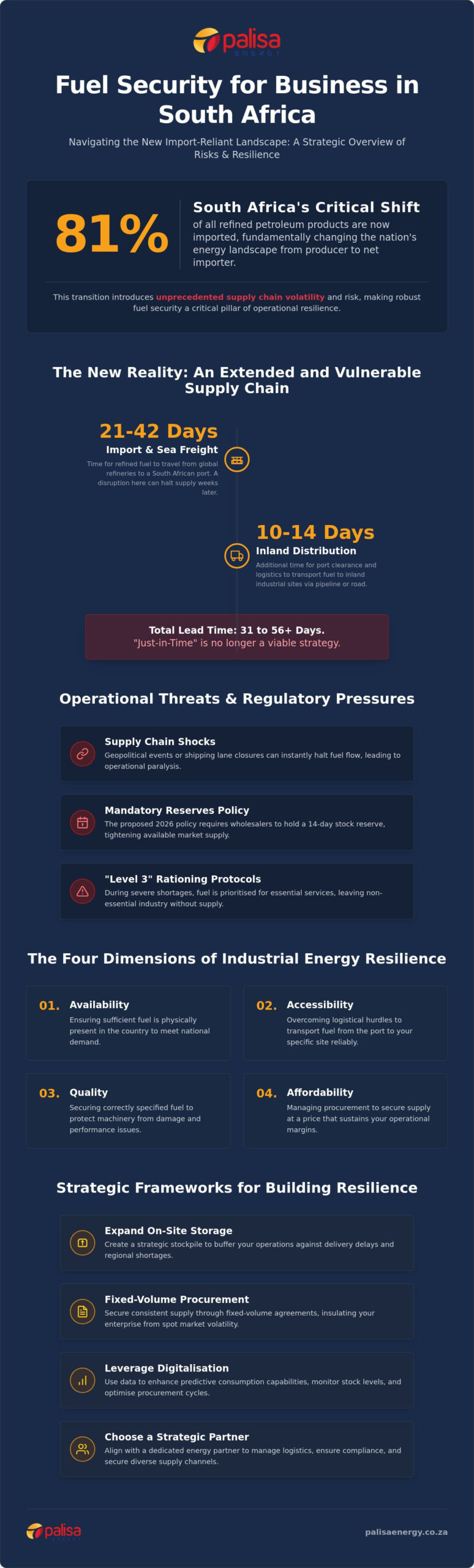
Industrial productivity rests upon a foundation of liquid energy. For decades, South Africa operated as a crude-importing and refining nation, but the structural foundations of South Africa’s energy sector have shifted fundamentally. By mid-2026, the transition to a net-import model is complete. This shift exposes enterprises to a new category of risk. Local fuel availability is no longer a matter of domestic production capacity but a complex equation of global shipping lanes, port efficiency, and geopolitical stability. When global supply chains tighten, the impact is felt immediately at the local level, making fuel security for business South Africa a primary executive concern.
Traditional procurement methods, once reliant on steady domestic output, are failing to provide adequate protection. Relying on “just-in-time” deliveries in an environment where 81% of refined fuel is imported creates a precarious vulnerability. A single disruption in the Atlantic Basin can ripple through a local supply chain within weeks. Establishing resilience requires a departure from reactive buying toward a model of strategic stockpiling and logistical redundancy. Without this shift, businesses remain exposed to the high cost of operational downtime during periods of national or regional shortage. This necessity for logistical robustness is universal; for instance, eCommerce enterprises often partner with 3PL specialists like Pik Pak Logistics to ensure their delivery networks remain resilient against global supply chain fluctuations.
Refinery Closures and the Import Reality
The closure and conversion of major facilities like SAPREF and Engen into import terminals have altered the national logistics map. Lead times have expanded significantly. It now takes between 21 and 42 days for imported fuel to reach a port, with an additional 10 to 14 days required for inland distribution. This extended timeline means that a disruption in Asia or West Africa can paralyse a local operation long after the initial event. Businesses must partner with resellers who maintain diverse procurement channels and robust infrastructure to mitigate these geographical risks effectively; for those interested in the maritime expertise required at key global transit points, check out Adimar Shipping, Inc..
Regulatory Pressures and Rationing Protocols
The Department of Mineral and Petroleum Resources has responded to these vulnerabilities with the Draft Strategic Petroleum Stock Policy of 2026. This policy introduces mandatory emergency reserves, requiring wholesalers to hold 14 days of refined stock. For industrial players, understanding “Level 3” shortage protocols is vital. Under these conditions, fuel is prioritised for essential services, which can leave non-essential industrial operations without supply. Preparing for these contingencies, alongside the 2027 transition to “Cleaner Fuels 2” standards, is the only way to ensure long-term operational viability.
Defining Multi-Dimensional Fuel Security in an Industrial Context
True energy resilience is far more complex than securing a favourable wholesale rate. For industrial stakeholders, fuel security for business South Africa represents the critical intersection of availability, accessibility, and affordability. Whilst price volatility often dominates executive discussions, a shortfall in any of these three dimensions can result in immediate operational paralysis. Securing a reliable diesel supply requires a holistic understanding of the entire value chain, from the terminal to the tank. It is about more than just the liquid; it is about the certainty that the liquid will be where you need it, when you need it, at a price that sustains your margins.
Logistics serves as the ‘last mile’ of true enterprise energy security. It’s the mechanism that converts a theoretical supply into a functional asset. Without a sophisticated approach to fuel logistics South Africa, your business remains vulnerable to localised bottlenecks and distribution failures. This is not merely about transportation. It involves the precise management of complex supply networks to ensure your machinery never stops. A robust logistics framework acts as a buffer against the unpredictability of the national grid and the regional transport network.
Physical Availability vs. Logistical Accessibility
Stock at the port does not equate to stock at your site. As highlighted by the Fuels Industry Association of South Africa, coordinated industry efforts are essential to maintain supply chain infrastructure and prevent bottlenecks. Geographic hurdles, such as the vast distances between coastal terminals and inland industrial hubs, demand real-time monitoring and proactive distribution strategies. Visibility is power. Knowing exactly where your fuel is at any given moment allows you to anticipate delays before they impact your production schedule. We manage these complexities so you don’t have to, ensuring that physical availability translates into operational readiness.
Quality Assurance and Industrial Grade Standards
Security is compromised when fuel quality is overlooked. Contaminated or sub-standard diesel can lead to catastrophic equipment failure, effectively creating a shortage through machinery downtime. Every litre must meet stringent SANS specifications to ensure industrial compatibility. High-grade lubricants and clean diesel are the silent guardians of your energy-intensive assets. Ensuring this standard requires a partner who treats quality as a non-negotiable metric. Safeguarding your equipment through precision-managed diesel supply is a strategic investment in long-term machinery longevity. Reliability is not just about quantity; it is about the integrity of every drop that enters your engines.
Emerging Trends Shaping Fuel Supply Risk Management in 2026
The landscape of industrial risk management is undergoing a profound transformation. As we move through 2026, the convergence of regulatory deadlines and technological advancement is redefining what it means to be energy-secure. Strategic leaders no longer view fuel as a simple commodity; they see it as an integrated component of a broader digital and hybrid ecosystem. This evolution is particularly critical when addressing fuel security for business South Africa, where the margin for operational error continues to narrow. Success now depends on the ability to anticipate market shifts before they manifest as supply disruptions. Understanding the common misconceptions that undermine planning is equally important, and our analysis of uninterrupted fuel supply South Africa myths reveals how pervasive misinformation can be just as damaging as a genuine shortage.
Hybrid energy models are becoming the standard in mining and manufacturing. Whilst renewable sources like solar and wind provide cost-effective power, diesel supply remains the steadfast guardian of industrial continuity. It provides the necessary baseload and backup that intermittent sources cannot match. Integrating sustainable energy solutions amongst traditional liquid fuels creates a resilient, multi-layered energy strategy. This approach reduces carbon footprints whilst ensuring that the core of the operation remains immune to grid instability or weather-related energy shortfalls.
The 2027 Transition: Preparing Your Fleet Today
The “Cleaner Fuels 2” mandate represents the most significant regulatory shift in a generation. By 2027, the entire industry must align with international low-sulphur standards. This isn’t just a refinery issue; it’s a fleet management priority. Older industrial engines often require specific lubrication profiles that legacy high-sulphur diesel provided. You must begin technical audits now to determine if your assets require additives or mechanical adjustments to maintain performance. Organising your on-site infrastructure to handle multiple fuel grades during the phase-out ensures you aren’t caught with incompatible equipment or obsolete stock.
Data-Driven Procurement and Consumption Analysis
Digitalisation has turned fuel tanks into critical data points. Integrating IoT sensors allows for a shift from reactive, last-minute ordering to a proactive replenishment model. By analysing historical consumption data, you can predict peak demand periods and secure volumes before spot-price spikes occur. This level of precision does more than just ensure supply; it directly improves the bottom line by eliminating shrinkage and optimising delivery schedules. Real-time monitoring provides the total visibility required to manage a fragmented supply chain with absolute confidence. Proactive replenishment is the only way to stay ahead of the curve.
Strategic Frameworks for Ensuring Uninterrupted Fuel Supply
Resilience is not a passive state. It is an engineered outcome. To achieve true fuel security for business South Africa, enterprises must transition from reactive procurement to a structured framework of physical and contractual safeguards. This involves a fundamental re-evaluation of how energy is stored and sourced. By moving beyond the “just-in-time” delivery model, which was identified earlier as a significant vulnerability in an import-heavy market, businesses can insulate themselves from the inherent volatility of the global supply chain. This emphasis on logistical robustness is mirrored in other sectors; for example, businesses managing international trade often rely on Parcel International to ensure their global shipping operations remain resilient and efficient.
Strategic frameworks require a dual-track approach: investing in physical infrastructure and securing high-integrity partnerships. This ensures that even during periods of national supply strain or port congestion, your operation remains shielded from the immediate impact of logistics failures. A robust framework doesn’t just manage risk; it provides a competitive advantage by ensuring your production lines remain active whilst competitors struggle with shortages.
On-Site Storage as a Strategic Buffer
Expanding on-site storage capacity is the most direct method of mitigating supply chain risk. It transforms a business from a price-taker into a strategic buyer. Calculating the ideal capacity requires a deep analysis of operational criticality. If your machinery cannot stop, your buffer must account for the potential 14-day distribution delays that often follow global supply shocks. Designing these depots involves navigating complex safety and environmental codes to ensure full compliance.
A compliant, well-engineered fuel depot provides the financial flexibility to execute bulk purchases during price dips. For instance, the significant price decreases seen in July 2026 offered a prime opportunity for businesses with adequate storage to lock in lower costs before the next cycle of market volatility. Turnkey infrastructure planning ensures that your storage solutions are not only safe but also optimised for your specific consumption patterns.
Contractual Security and Supply Partnerships
Contractual integrity is the second pillar of a resilient framework. Moving away from “cowboy” suppliers toward established, independent resellers is essential for long-term stability. When evaluating a bulk diesel suppliers South Africa agreement, look for clauses that guarantee volume priority and transparent pricing structures. These agreements act as a safeguard against the “spot market” chaos that erupts during genuine shortages.
True partnerships provide more than just a delivery; they offer 24/7 support and emergency replenishment capabilities. In a scenario where supply is rationed, having a partner who manages nationwide distribution and infrastructure planning becomes your greatest operational asset. This level of support ensures that your enterprise is never left stranded by a single point of failure in the distribution chain. To secure your operational future and begin your infrastructure audit, partner with Palisa Energy today for a comprehensive energy security assessment.
Securing Your Operational Future with Strategic Energy Partnerships
In the complex energy landscape of 2026, isolation is a vulnerability. No industrial enterprise can afford to navigate the intricacies of a net-import market without a partner who acts as a steadfast guardian of their continuity. Fuel security for business South Africa has evolved beyond the simple exchange of commodities; it now demands a sophisticated alliance built on trust, precision, and shared vision. We don’t just deliver diesel. We orchestrate a resilient energy ecosystem that allows your leadership team to focus on core growth whilst we manage the volatility of the global supply chain.
Establishing comprehensive fuel security for business South Africa requires a shift from transactional procurement to strategic integration. This partnership model ensures that your operational needs are met with a sense of urgency and industrial authority. By aligning with a dedicated energy partner, you gain the stability required to weather geopolitical shocks and domestic logistical hurdles. Reliability is our primary metric. We take pride in our role as the silent engine behind your success, ensuring that every litre of fuel is a building block for your enterprise’s longevity.
Comprehensive Logistics and Infrastructure Planning
Precision is our standard. We leverage an extensive nationwide distribution network to guarantee that your supply remains uninterrupted, regardless of your geographic location. This goes beyond transportation. We provide turnkey support that encompasses the entire lifecycle of your energy infrastructure. From the initial design of high-capacity fuel depots to the final commissioning and compliance auditing, our team manages the technical complexity so you don’t have to. Our 24/7 support for industrial customers ensures that help is always available, providing a critical safety net during emergency replenishment scenarios.
A Vision Followed by Execution
Palisa Energy is committed to a future where industrial progress and environmental responsibility coexist. As we approach the 2027 regulatory milestones, we prioritise the delivery of cleaner fuels and high-grade lubricants that protect both your machinery and our shared environment. Our approach is methodical: we start with a broad vision for your energy resilience and follow it with flawless execution. This commitment to excellence and inclusive growth makes us more than a supplier; we’re a dedicated strategic partner in your industrial journey. To secure your operational future and begin a comprehensive audit of your 2026 fuel strategy, contact Palisa Energy today.
Architecting Industrial Resilience for 2026 and Beyond
The transition toward a net-import energy model has permanently altered the South African industrial landscape. You’ve seen how physical storage buffers and data-driven procurement are no longer optional luxuries but essential safeguards against a volatile global supply chain. As the 2027 regulatory deadlines approach, the pressure to align your infrastructure with international standards will only intensify. Achieving absolute fuel security for business South Africa requires a move away from fragmented, reactive buying toward a holistic, integrated energy strategy. It’s about building a system that doesn’t just survive disruptions but thrives amongst them.
Success in this environment depends on the strength of your alliances. We stand ready to serve as your steadfast guardian, providing the precision and reliability your operations demand. Precision is our standard. With our 24/7 dedicated industrial support and nationwide logistical reach, we manage the complexities of supply so you don’t have to. From turnkey infrastructure solutions to expert compliance auditing, we provide the foundation for your long-term stability. Partner with Palisa Energy for resilient fuel security and ensure your business remains a force of progress in the years ahead. Your operational future is secure when you build it on a foundation of reliability and expert foresight.
Frequently Asked Questions
What are the primary threats to fuel security for businesses in South Africa?
The primary threats involve South Africa’s structural reliance on imported refined products and the resultant vulnerability to global shipping disruptions. Since the country now imports 81% of its refined fuel, businesses face extended lead times and potential supply chain shocks. Domestic logistical bottlenecks at ports and on the national road network further complicate the consistent delivery of energy supplies to inland industrial hubs.
How does the 2027 fuel transition affect my current diesel generators?
The 2027 “Cleaner Fuels 2” mandate necessitates a technical audit of your existing diesel generators to ensure compatibility with low-sulphur standards. Older industrial engines often require specific lubrication profiles that legacy fuels provided. You must determine if your assets require mechanical recalibration or specialised additives to prevent asset degradation and maintain operational efficiency during the phase-out of traditional fuel grades.
What is the benefit of on-site fuel storage for an industrial site?
On-site storage functions as a critical operational buffer against supply chain shocks and distribution bottlenecks. It decouples your enterprise from “just-in-time” delivery risks, providing the necessary reserve to weather fourteen-day distribution delays. Additionally, having significant storage capacity allows you to capitalise on bulk purchasing opportunities when market prices decrease, effectively turning energy storage into a strategic financial asset.
How can a business manage fuel cost volatility in 2026?
Enterprises manage cost volatility through fixed-volume contracts and strategic stockpiling during price decreases. By moving away from the spot market and utilising historical data to predict peak demand, you can secure favourable rates before global events trigger price spikes. This proactive approach ensures that your operational margins remain protected from the monthly fluctuations inherent in the South African fuel price structure.
What should I look for in a bulk fuel distribution partner?
A distribution partner must demonstrate nationwide logistical reach and provide 24/7 industrial support to ensure fuel security for business South Africa. You should prioritise partners who offer turnkey infrastructure planning and compliance auditing rather than simple transactional delivery. A reliable partner acts as a steadfast guardian of your continuity, managing complex procurement channels and ensuring that every litre meets stringent SANS quality specifications.
Are there specific regulations for building a private fuel depot in South Africa?
Building a private fuel depot requires strict adherence to SANS safety standards and environmental compliance protocols. These regulations govern everything from tank construction and containment bunding to fire safety and spill prevention measures. Professional management and expert auditing are essential to navigate the licensing requirements and ensure that your infrastructure remains fully compliant with the latest Department of Mineral and Petroleum Resources guidelines.
How does real-time monitoring improve fuel supply chain security?
Real-time monitoring provides total visibility over fuel consumption and stock levels, effectively eliminating shrinkage and unauthorised usage. By integrating IoT sensors into your storage tanks, you can implement proactive replenishment models that trigger orders before stock reaches critical levels. This data-driven approach removes the risk of human error in stocktaking and ensures that your supply chain remains resilient and transparent at all times.
What happens if there is a national fuel shortage emergency?
A national shortage triggers government-mandated rationing protocols that prioritise essential services over non-essential industrial operations. Under “Level 3” shortage conditions, businesses without their own strategic reserves may face mandatory supply reductions. This reality underscores the necessity of establishing robust fuel security for business South Africa through private storage and long-term partnerships that guarantee volume priority during periods of national strain.

One Response