


In the high-stakes environment of South African heavy industry, treating gear oil as a mere maintenance commodity is a strategic error that often results in catastrophic mechanical failure. When a primary gearbox seizes, the financial impact extends far beyond the immediate repair bill; it ripples through your entire supply chain. You recognise that maintaining operational momentum requires more than just a routine top-up. It demands a sophisticated understanding of how specific lubricants behave under the unique pressures of local mining, manufacturing, and agricultural sectors.
Navigating the technical complexities of API GL-4 versus GL-5 ratings whilst attempting to secure a reliable bulk supply often feels like an uphill battle. This reference provides the clarity you need to master the technical essentials of gear oil, allowing you to protect your critical assets and drive industrial efficiency. We will explore the precise specifications that safeguard your machinery, discuss methods for reducing maintenance costs, and outline how a steadfast distribution partner ensures your operations never grind to a halt. By the end of this guide, you will possess the insights required to transform your lubrication strategy into a pillar of stability.
Key Takeaways
- Protect your critical machinery by understanding how high-viscosity lubricants mitigate friction and wear under extreme industrial pressures.
- Decipher API and SAE ratings to ensure you select the correct gear oil specification required for the stability of your heavy-duty assets.
- Evaluate the performance profiles of synthetic versus mineral-based lubricants to optimise the cost-to-performance ratio of your fleet.
- Implement proactive maintenance schedules and oil analysis programmes to prevent catastrophic mechanical failure and minimise operational downtime.
- Streamline your procurement process by integrating high-quality lubricants into your existing bulk diesel supply and nationwide logistics framework.
Understanding Gear Oil: The Essential Lubricant for Industrial Longevity
Industrial machinery represents a massive capital investment. Protecting that investment requires more than a casual approach to maintenance. Gear oil is the definitive solution for this protection, acting as a high-viscosity barrier within gearboxes, differentials, and transfer cases. Its core function involves the drastic reduction of friction whilst ensuring that moving parts remain shielded even when subjected to extreme pressure and high-torque environments.
Industrial gearboxes operate under mechanical stresses that far exceed those found in standard passenger vehicles. Whilst automotive applications focus on fuel economy and smooth shifting, industrial formulations prioritise load-carrying capacity and thermal stability. This distinction is the foundation of operational excellence. By selecting a lubricant designed for heavy-duty endurance, you ensure that your operations achieve a level of reliability that supports long-term growth and stability. In the context of South African mining and manufacturing, where machinery often runs 24/7 in harsh environments, the choice of lubricant becomes a strategic decision rather than a clerical one. Citing a comprehensive gear oil overview reveals that the viscosity and additive requirements are fundamentally different for these high-stakes environments.
The Critical Role of Additives in Gear Protection
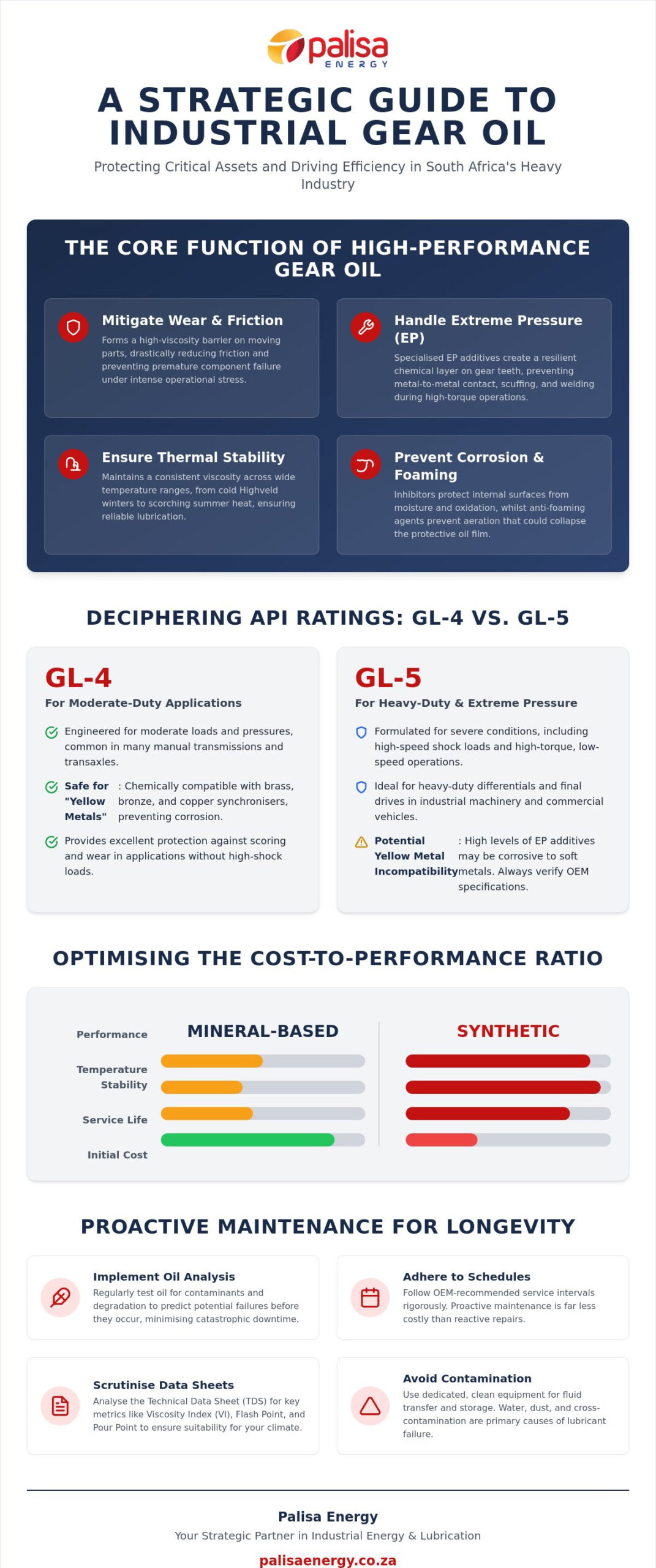
Chemical additives dictate the performance and reliability of an industrial lubricant. Extreme Pressure (EP) additives are perhaps the most crucial, as they create a protective chemical layer on gear teeth to prevent scuffing and welding under intense loads. High-speed operations also necessitate the use of anti-foaming agents; these prevent the aeration of the oil, which could otherwise lead to a collapse of the protective film. In the varied South African climate, rust and corrosion inhibitors are essential. They protect internal surfaces from moisture and oxidation, effectively extending the service life of the equipment even during periods of inactivity. The high humidity of KwaZulu-Natal or the dusty, arid conditions of the Northern Cape present unique challenges that only high-quality inhibitors can successfully mitigate.
Gear Oil vs. Transmission Fluid: Clearing the Confusion
Engineers must distinguish between manual gear lubricants and automatic transmission fluid (ATF) to avoid costly errors. The former is characterised by a thick consistency and the ability to manage the heavy sliding loads found in industrial gear sets. ATF, however, is a much thinner fluid designed for the hydraulic demands and cooling requirements of automatic transmissions. Using a low-viscosity ATF where a heavy lubricant is required will lead to immediate film breakdown. This error results in rapid wear, overheating, and the eventual catastrophic failure of the gearbox, underscoring the need for precision in fluid selection.
Deciphering Technical Specifications: API Ratings and Viscosity Grades
Technical literacy is the primary line of defence against equipment degradation. Interrogating a Technical Data Sheet (TDS) allows you to move beyond marketing claims and understand the physical properties of a lubricant. You must specifically scrutinise the flash point, pour point, and the Viscosity Index (VI), which measures how much the oil’s thickness changes with temperature. A high VI suggests the lubricant remains stable across the broad thermal ranges typical of South African operations, from the freezing winters of the Highveld to the scorching summers of the interior.
Selecting the correct gear oil requires a delicate balance between load requirements and environmental factors. For operations managing large-scale fleets, aligning these specifications with a reliable industrial energy partner ensures that every litre of lubricant delivered meets the exact technical demands of your machinery. This precision eliminates guesswork and reinforces the structural integrity of your mechanical systems.
GL-4 vs. GL-5: Choosing the Right Protection Level
API ratings define the chemical capability and intended application of the lubricant. GL-4 oils are engineered for moderate loads and are chemically compatible with “yellow metals” like brass or bronze often found in synchronisers and bushings. Conversely, GL-5 is formulated with high concentrations of sulphur-phosphorus additives designed to protect hypoid gears under high-speed, high-torque conditions. You must exercise caution; using GL-5 in a gearbox specifically requiring GL-4 can lead to the chemical corrosion of yellow metal components. In this context, a “higher” rating does not signify a superior product, but rather a different chemical profile.
Viscosity Matters: From 75W-90 to 85W-140
Viscosity is the oil’s resistance to flow at specific temperatures. The SAE numbering system, such as 75W-90, identifies both cold-start and operating temperature performance. The “W” stands for Winter, indicating the oil’s behaviour in cold conditions. Multi-grade oils provide exceptional versatility for mobile plant equipment, but stationary industrial gearboxes often benefit from single-grade oils where operating temperatures remain constant. In regions where temperatures fluctuate significantly, a 75W rating ensures immediate lubrication upon start-up, whereas an 85W-140 provides the robust film strength necessary for heavy-duty mining equipment operating in intense heat.
Mineral vs. Synthetic Gear Oil: Selecting the Optimal Performance Profile
The choice between mineral and synthetic base stocks is a pivotal decision that directly impacts the lifecycle of your industrial assets. Whilst mineral lubricants provide a reliable foundation for many legacy systems, the introduction of synthetic alternatives has redefined the boundaries of mechanical endurance. This choice is rarely about which product is “better” in isolation; it’s about which performance profile aligns with your specific operational demands and fiscal objectives. Precision matters. A well-informed selection ensures that your gear oil strategy contributes to a lower total cost of ownership rather than becoming a recurring overhead.
Molecular stability distinguishes these two categories. Synthetic oils are engineered at a molecular level to be uniform, which provides a consistent film thickness and superior shear stability. In contrast, mineral oils are refined from crude petroleum and contain a broader range of molecular sizes. This inherent variance makes mineral oils more susceptible to breakdown under high-heat or high-load conditions. For modern South African operations, particularly in the mining and energy sectors, the shift toward synthetics is often driven by the need for unwavering reliability in environments where equipment failure is not an option.
Sustainability also plays an increasingly prominent role in procurement. Modern synthetic formulations offer a reduced environmental footprint by lasting significantly longer than their mineral counterparts. This longevity results in less waste oil generation and fewer disposal requirements. For organisations seeking a middle-ground solution, semi-synthetic lubricants offer a balanced profile. These blends combine the cost-effectiveness of mineral oil with the enhanced protection of synthetic additives, providing a versatile option for diverse industrial fleets. Understanding how to select the correct oil lubricant for your specific machinery requirements is essential to maximising the return on your lubrication investment.
The Advantages of Synthetic Formulations
Synthetic lubricants excel in high-stakes industrial applications where thermal stability is paramount. They resist oxidation far more effectively than mineral oils, preventing the formation of sludge and varnish that can clog internal components. This chemical resilience allows for:
- Extended drain intervals: Reducing the frequency of oil changes directly lowers labour costs and minimises machinery downtime.
- Extreme temperature performance: Synthetics maintain their flow characteristics in the cold whilst providing robust protection in the intense heat of deep-level mining or heavy manufacturing.
- Enhanced energy efficiency: Reduced internal friction leads to lower operating temperatures and improved power transmission.
When Mineral Oil Remains the Practical Choice
Mineral oil remains a cornerstone of industrial lubrication for several practical reasons. In legacy machinery, the seal materials—such as older nitrile or neoprene compounds—may be incompatible with the aggressive detergent packages found in some synthetics. Using a mineral-based gear oil in these instances prevents seal shrinkage and subsequent leaks. Additionally, mineral oil is the logical choice for “total loss” lubrication systems where the oil is not recirculated. In these scenarios, the high cost of synthetics cannot be justified by performance gains, making the traditional mineral option the most cost-effective path for maintaining operational stability.
Best Practices for Industrial Gearbox Maintenance and Management
Achieving mechanical longevity requires a shift from reactive repairs to a rigorous framework of proactive care. Whilst selecting the correct gear oil is a critical first step, the subsequent management of that lubricant determines the ultimate lifespan of your gearboxes. A structured maintenance schedule prevents the sudden, catastrophic failures that disrupt production cycles and inflate operational costs. By treating lubrication as a continuous process rather than a periodic task, you secure the stability of your heavy-duty machinery and ensure your operations remain competitive in a demanding market.
This philosophy of proactive care should also extend to the human element of your operations. Just as machines require specific lubricants, your personnel can maintain their own physical performance and resilience through premium supplements from My Whey.
Implementing an Oil Analysis Programme
Oil analysis serves as the diagnostic heart of predictive maintenance. Regular sampling allows your technical team to detect microscopic metal shavings, which indicate early gear wear, before they escalate into mechanical failure. Monitoring for moisture levels and particulate contamination is equally vital, as these elements can drastically reduce the load-carrying capacity of the lubricant. This data-driven approach enables you to transition from arbitrary, time-based oil changes to condition-based interventions. By replacing the fluid only when its chemical integrity is actually compromised, you optimise your maintenance spend and reduce unnecessary waste.
Storage and Contamination Control
Improper storage often introduces contaminants before the lubricant even reaches the machinery. In the South African climate, bulk drums stored outdoors are susceptible to thermal breathing; this occurs when temperature fluctuations cause the drum to expand and contract, drawing in moisture-laden air through the bungs. You should store drums horizontally in a climate-controlled environment or utilise desiccant breathers to mitigate this risk. Implementing colour-coded dispensing equipment is another essential step. This simple visual system prevents the cross-contamination of different lubricant grades, which could otherwise lead to chemical incompatibility and film failure. Maintaining a sterile transfer process from bulk storage to the gearbox is non-negotiable for preserving the purity of your gear oil supply.
Safety protocols must remain a priority throughout the handling and disposal process. Personnel should always consult Safety Data Sheets (SDS) and utilise appropriate personal protective equipment to mitigate the risks associated with chemical exposure and environmental contamination. Maintaining clean workspaces and spill-response kits is essential for upholding the high operational standards expected in the energy and mining sectors. For operations requiring a dependable partner to manage these complex logistical and technical requirements, you can partner with Palisa Energy for your industrial lubricant and bulk energy requirements.
Strategic Procurement: Integrating Quality Lubricants into Your Fuel Logistics
Procurement of industrial lubricants shouldn’t be an isolated administrative task; it’s a strategic component of your energy ecosystem. By integrating your gear oil requirements into a broader logistics framework, you eliminate supply chain fragmentation. Palisa Energy simplifies this complexity by bundling high-performance lubricants with leading bulk diesel suppliers South Africa. This holistic approach ensures that your machinery is protected by the correct technical specifications whilst your primary energy source is delivered with the same level of precision. We provide the stability your business needs to scale with confidence.
Reliability is the currency of the industrial sector. Managing multiple vendors for different petroleum products often creates unnecessary logistical bottlenecks and increases the risk of stockouts. Choosing a single partner for nationwide fuel logistics South Africa provides a consolidated view of your operational needs. We act as a steadfast guardian of your supply chain, offering 24/7 support and technical expertise to assist with lubricant selection. This partnership allows you to focus on core production activities whilst we manage the intricate details of distribution and quality assurance across your entire footprint.
The Benefits of Bulk Lubricant Distribution
Scaling your operations requires a procurement strategy that rewards volume and ensures uniformity. Bulk distribution offers tangible advantages for large-scale mining and manufacturing fleets. When these assets require relocation, engaging a specialist such as AutoPlex Transport Company ensures that your heavy-duty vehicles are transported with the same care you apply to their maintenance. Wholesale procurement significantly reduces unit costs, providing a direct boost to your bottom line. It also guarantees consistent quality across all operational sites nationally. This ensures that a gearbox in a remote mining centre receives the same standard of protection as one in a major industrial hub. Furthermore, a single petroleum partner streamlines your administrative processes, reducing the complexity of invoicing and contract management. This efficiency allows for better resource allocation and improved financial forecasting.
Future-Proofing Your Operations with Palisa Energy
Efficient lubricant management is not a static goal but an evolving standard. Professional infrastructure planning ensures that your storage facilities and dispensing systems are optimised for both safety and performance. As the industry moves toward more sustainable energy solutions, choosing a partner committed to environmental responsibility becomes a competitive advantage. We provide the stability and expertise needed to manage these transitions without compromising on operational momentum. Our focus on longevity and unwavering support ensures your business remains resilient in a changing economic landscape. Contact Palisa Energy today to optimise your industrial lubricant supply.
Securing Operational Stability through Technical Precision
Mastery of your lubrication strategy is the primary safeguard against the high costs of mechanical degradation. We’ve explored how precise API and SAE specifications, coupled with proactive oil analysis, transform maintenance from a burden into a competitive advantage. Selecting the correct gear oil ensures that your heavy-duty machinery operates at peak efficiency whilst navigating the thermal extremes of the South African industrial landscape. These technical choices are the pillars of long-term mechanical integrity.
The principle of choosing high-quality inputs for peak efficiency applies to human performance as well. For those in the industrial sector who maintain an active lifestyle, muscleworks.co.za offers professional-grade sports nutrition to support strength and recovery.
Achieving this level of operational excellence requires a partner with the scale and expertise to support your vision. Palisa Energy provides nationwide petroleum distribution and 24/7 industrial support, leveraging strategic partnerships with major oil companies to deliver unwavering reliability. We act as the steadfast guardian of your supply chain, managing complex logistics with precision so you don’t have to. Our commitment to excellence ensures that your operations maintain forward momentum without interruption.
Secure Your Industrial Lubricant Supply with Palisa Energy. Your commitment to technical precision today ensures a more stable and prosperous industrial future.
Frequently Asked Questions
What is the most common gear oil for heavy-duty industrial gearboxes?
ISO VG 220 and ISO VG 320 are the most frequently utilised viscosity grades for heavy-duty industrial gearboxes across South Africa. These specific grades provide the necessary film strength to protect gear teeth under substantial loads whilst maintaining chemical stability at high operating temperatures. Selecting the correct grade depends on the torque requirements and ambient conditions of your site, ensuring that the lubricant remains effective throughout its intended service life.
Can I mix different brands of gear oil if the viscosity is the same?
Mixing different brands is generally discouraged even when the viscosity ratings are identical. Each manufacturer utilises a proprietary blend of additives that may react negatively when combined, potentially leading to chemical instability or reduced protection levels. To maintain the structural integrity of your machinery, it’s best to perform a full flush and refill when switching suppliers, ensuring that the gear oil performs exactly as engineered without interference.
How often should gear oil be changed in a commercial fleet?
Commercial fleet change intervals should primarily follow the original equipment manufacturer (OEM) guidelines or be determined through a structured oil analysis programme. Whilst some mineral-based oils require changes every 1,000 to 2,000 operating hours, high-performance synthetics can often extend these intervals significantly. Implementing a predictive maintenance schedule allows you to monitor the actual condition of the lubricant, ensuring that you only replace the fluid when its protective properties begin to diminish.
What is the difference between GL-4 and GL-5 gear oil?
The primary distinction lies in the concentration of Extreme Pressure (EP) additives and their intended application. GL-4 is engineered for moderate loads and is safe for use with yellow metals like bronze or brass. GL-5 contains significantly higher levels of sulphur and phosphorus for high-load hypoid gears, but these additives can be corrosive to yellow metal components. You must verify your equipment’s requirements to prevent chemical damage to internal bushings and synchronisers.
Why is gear oil so much thicker than engine oil?
Gear lubricants require higher viscosity to withstand the intense sliding and rolling pressures found within industrial gear sets. Unlike engine oil, which must circulate rapidly through narrow passages, gear oil must maintain a robust physical barrier between heavy metal surfaces under extreme torque. This thickness ensures that the protective film doesn’t collapse, effectively preventing metal-to-metal contact and the subsequent heat generation that leads to mechanical seizure or premature wear.
How does South Africa’s climate affect gear oil selection?
South Africa’s diverse climate necessitates lubricants with a high Viscosity Index (VI) to manage extreme temperature fluctuations. Operations on the Highveld require oils that flow readily during freezing winter mornings, whereas equipment in the arid interior must maintain film strength in scorching summer heat. Multi-grade lubricants are often the preferred choice for mobile machinery, providing the versatility needed to ensure consistent protection across various geographical regions and seasonal changes.
What are the signs that my gear oil needs to be replaced immediately?
Immediate replacement is necessary if you detect a burnt odour, significant discolouration, or a milky appearance indicating water contamination. The presence of visible metal particles in the oil or a sudden increase in mechanical noise and operating temperature also signals a critical failure of the lubricant’s protective barrier. Addressing these symptoms promptly through a full fluid change and system inspection prevents minor wear from escalating into a catastrophic and costly mechanical failure.
Is synthetic gear oil worth the extra cost for industrial applications?
Synthetic lubricants represent a superior long-term investment for modern industrial operations due to their exceptional thermal stability and oxidation resistance. Whilst the initial procurement cost is higher than mineral alternatives, the ability to extend drain intervals and improve energy efficiency results in a lower total cost of ownership. For high-stakes environments where reliability is paramount, the enhanced protection provided by synthetics significantly reduces the risk of unplanned downtime and expensive repairs.