

What if the most significant risk to your plant’s 2026 production schedule isn’t the volatility of global energy markets, but the hidden instability of a fragile supply chain? For many industrial leaders, the search for a reliable heavy fuel oil supplier South Africa often starts as a quest for the lowest price; however, it quickly evolves into a battle against plant downtime and fluctuating fuel quality. You understand that in a high-stakes environment where fuel unavailability can cost the national economy approximately R1 billion per day, procurement is never just a transaction. It’s a strategic commitment to operational continuity and industrial precision.
This guide empowers you to master the complexities of HFO procurement by aligning your operations with SANS compliance and logistical excellence. We promise to provide the technical insights necessary to ensure uninterrupted industrial performance, even as the sector navigates the draft Strategic Petroleum Stock Policy and the shift toward more rigorous fuel standards. We will explore the critical intersection of high-viscosity fuel handling, infrastructure planning, and the uncompromising quality controls that separate a mere vendor from a dedicated strategic partner.
Key Takeaways
- Grasp the fundamental distillation processes that position Heavy Fuel Oil as a superior, cost-effective energy source for high-demand industrial thermal applications.
- Identify the precise logistical requirements for managing high-viscosity fuels, focusing on the essential role of temperature control in maintaining fluid mobility.
- Establish a rigorous framework for selecting a heavy fuel oil supplier South Africa that offers the nationwide reach and 24/7 support necessary for uninterrupted production.
- Navigate the evolving regulatory landscape, including SANS 1314 requirements, to ensure your fuel procurement and storage infrastructure remain fully compliant.
- Discover how strategic infrastructure planning and proactive auditing can transform your energy supply chain into a foundation for long-term industrial growth.
Understanding Heavy Fuel Oil (HFO) in the South African Context
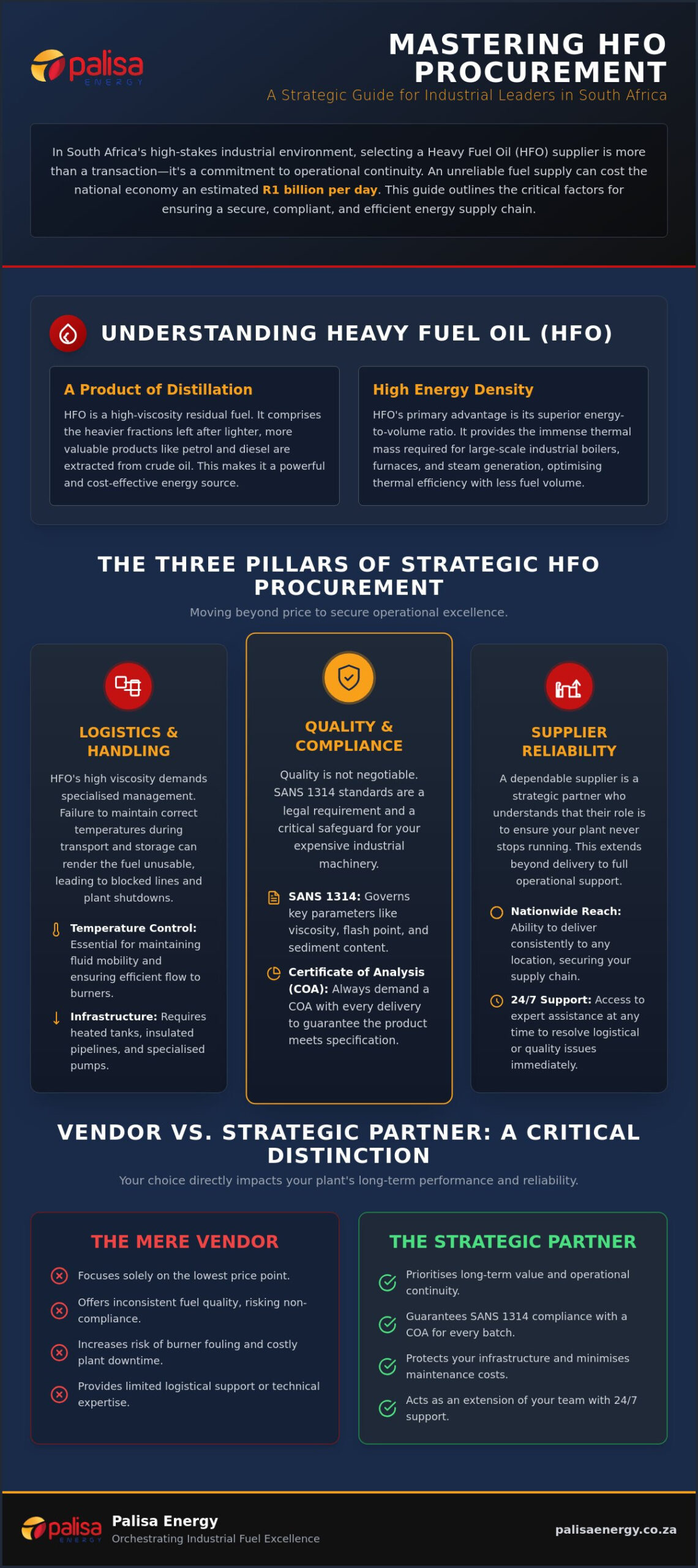
In the high-output world of South African manufacturing and power generation, energy is the pulse of every operation. Heavy Fuel Oil (HFO) represents the most robust end of the petroleum distillation spectrum. As a high-viscosity residual fuel, it consists of the heavier fractions remaining after lighter components like petrol and diesel are extracted from crude oil. Whilst it’s often viewed through a purely technical lens, HFO is fundamentally a strategic asset. For an industrial enterprise, selecting the right heavy fuel oil supplier South Africa is a decision that balances raw caloric power with the intricate demands of high-viscosity fluid logistics.
The distillation process naturally positions HFO as a cost-effective alternative to lighter distillates. Because it requires less intensive refining than automotive-grade fuels, it retains a high energy density at a lower price point. This makes it the primary choice for large-scale boilers and furnaces that can accommodate its specific handling requirements. Industrial players distinguish between residue-based fuels and distillate-based oils; residue-based HFO provides the sheer thermal mass needed for heavy-duty steam generation, provided the supply chain is managed with precision.
The Technical Composition of HFO
The hydrocarbon structure of HFO is complex, primarily composed of long-chain molecules rich in carbon and hydrogen. It also contains varying levels of sulphur, which necessitates careful monitoring to meet environmental standards. The calorific value of the fuel is its most vital metric, as this determines the total heat release during combustion. A higher calorific value ensures that your plant achieves maximum thermal efficiency with less fuel volume. Heavy Fuel Oil is defined as a hydrocarbon liquid fuel designed for high-heat applications per SANS 1314.
Regulatory Standards and SANS 1314 Compliance
Quality in the South African energy sector isn’t subjective. It’s governed by the South African National Standards (SANS) 1314. This framework ensures that the fuel you receive meets strict parameters for viscosity, flash point, and sediment content. Adhering to these standards is not merely a legal formality; it’s a safeguard for your infrastructure. Substandard fuel can lead to burner fouling, increased maintenance costs, and catastrophic plant downtime.
Procurement managers must act as the steadfast guardians of their facility’s integrity by demanding a Certificate of Analysis (COA) with every delivery. This document serves as a guarantee that the product matches the required specification. Integrating these quality controls into your procurement strategy is a foundational step in achieving long-term fuel security for business South Africa. When your heavy fuel oil supplier South Africa provides transparent, data-backed quality assurance, they transition from a vendor to a dedicated strategic partner in your industrial growth.
The Strategic Role of HFO in Industrial Energy Generation
Energy density defines industrial potential. For large-scale operations, the caloric output of a fuel dictates the efficiency of the entire production line. Whilst a paraffin supplier South Africa provides essential solutions for medium-duty applications, HFO remains the undisputed heavyweight for massive thermal requirements. It offers a superior energy-to-volume ratio, allowing plants to generate immense heat without the prohibitive costs associated with lighter, more refined distillates. This economic logic is why HFO is the preferred choice for heavy-duty industrial processes across the continent.
Choosing a heavy fuel oil supplier South Africa involves more than comparing price points. It’s about securing a partner that understands the high-stakes nature of heat release. Large-scale steam and heat generation rely on the consistent viscosity and flash point of the fuel to maintain burner stability. Any deviation in quality disrupts the delicate balance of the combustion chamber, leading to inefficient energy transfer. Strategic procurement managers also consider the environmental impact of HFO, ensuring their supply chain adheres to modern standards whilst maximising industrial output.
Primary Applications: Boilers, Furnaces, and Marine Engines
Industrial boilers are the workhorses of the South African economy. HFO provides the sustained thermal mass required to convert water into high-pressure steam for food processing, textile manufacturing, and chemical production. In metallurgical furnaces and manufacturing kilns, the intense, radiant heat of HFO is essential for smelting and curing processes. Additionally, stationary units and large, slow-speed compression ignition engines utilise this fuel to drive heavy machinery where torque and longevity are paramount.
HFO in the Mining and Manufacturing Sectors
South African mining operations face unique energy demands, often in remote locations where supply chain resilience is tested daily. Continuous manufacturing cycles in high-volume facilities cannot afford a single hour of fuel-related downtime. This necessitates a heavy fuel oil supplier South Africa that possesses the logistical infrastructure to deliver bulk quantities without fail. When you align with a partner that prioritises 24/7 support and nationwide distribution, you’re not just buying fuel; you’re investing in a steadfast guardian of your operational continuity. This level of reliability is the bedrock of national infrastructure and industrial progress.
Navigating HFO Logistics: Viscosity, Storage, and Temperature Control
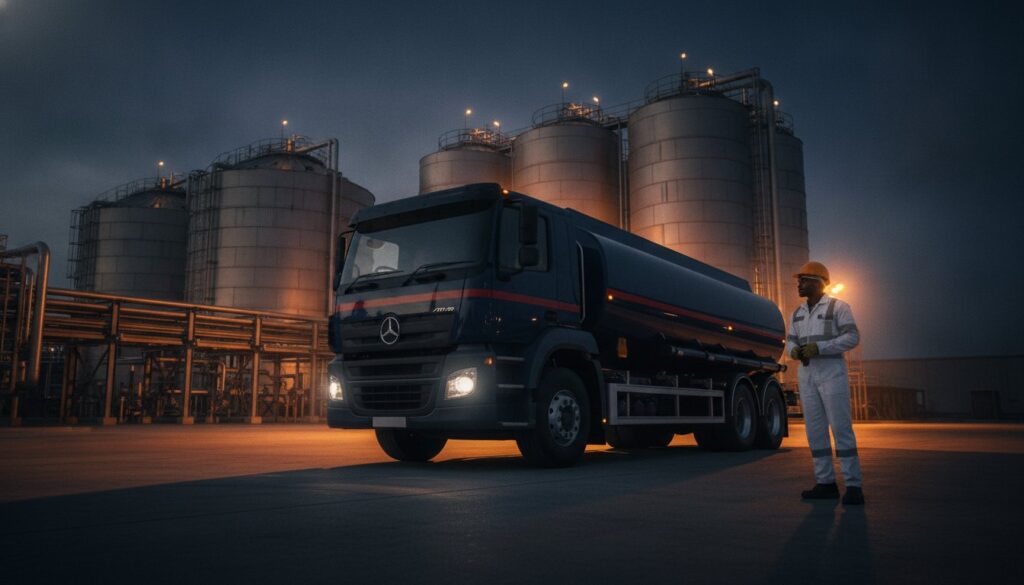
Whilst standard bulk diesel suppliers South Africa manage relatively stable, low-viscosity fluids, the logistics of heavy fuel oil require a significantly more sophisticated approach. HFO is not a commodity that can be simply “dropped and forgotten.” It’s a temperature-sensitive commitment. At ambient temperatures in many parts of South Africa, HFO can reach a consistency similar to molasses or even semi-solid bitumen. This physical state makes standard pumping and filtration impossible. A professional heavy fuel oil supplier South Africa must therefore operate a specialised fleet of heated tankers equipped with thermal insulation and internal heating coils. These units ensure the product arrives at your facility at a temperature that permits immediate offloading and integration into the plant’s fuel system.
Failure to maintain these thermal thresholds leads to “waxing” or the fuel reaching its pour point, where it ceases to flow entirely. This doesn’t just delay a delivery; it can cause extensive damage to pumps and piping networks. Adhering to South African energy regulations requires meticulous record-keeping and safety protocols during these complex transfers. When the logistics chain is managed with precision, the inherent risks of handling high-viscosity fuels are mitigated, ensuring that your production schedule remains undisturbed by supply chain friction.
The Criticality of Viscosity Management
Viscosity is the internal friction of the fuel, and for HFO, it’s inversely proportional to temperature. To remain pumpable and ensure efficient atomisation at the burner tip, the fuel must be pre-heated. The “pour point” is the lowest temperature at which the oil will continue to flow; if the storage temperature drops below this level, the fuel becomes a solid mass within the tanks. HFO must typically be maintained at specific temperatures to remain pumpable and avoid catastrophic blockages.
Infrastructure Requirements for On-Site Storage
Successful HFO utilisation requires more than just a storage vessel. It demands a heated infrastructure. Tanks must be fitted with steam coils or electric immersion heaters, and all transfer lines must be lagged with high-grade insulation to prevent heat loss. Regular maintenance is non-negotiable to prevent the accumulation of heavy sludge at the bottom of the tanks, which can restrict flow and damage equipment. Designing these systems requires the deep technical insight found in specialised fuel logistics South Africa services. Without this expertise from your heavy fuel oil supplier South Africa, even the highest quality fuel can become an operational liability that threatens plant efficiency.
Strategic Procurement: Selecting a Reliable HFO Supplier
In an era defined by supply chain volatility, the role of a heavy fuel oil supplier South Africa transcends simple logistics. It becomes a pillar of your industrial risk management strategy. Procurement managers must look beyond the immediate invoice to assess the holistic value of a partnership. This evaluation framework should prioritise suppliers who demonstrate a deep-seated commitment to nationwide distribution and supply chain resilience. Long-term contracts play a vital role here; they serve as a shield against the unpredictable price fluctuations of the global oil market, providing the fiscal stability required for multi-year industrial planning.
A partner’s ability to provide 24/7 technical and logistical support is non-negotiable. Industrial burners and boilers operate on precise cycles, and any deviation in fuel delivery or quality requires immediate resolution. You need a “steadfast guardian” who monitors the supply chain in real-time, ensuring that even remote mining or manufacturing sites receive consistent support. When your heavy fuel oil supplier South Africa combines technical expertise with a proactive service model, they safeguard your plant from the hidden costs of downtime.
Sulphur Levels and Environmental Compliance
The global industrial landscape is shifting toward more stringent Environmental, Social, and Governance (ESG) standards. Traditionally, standard HFO contains approximately 3% sulphur. However, the transition to Low Sulphur Fuel Oil (LSFO), which contains 1% or less, is gaining momentum amongst forward-thinking South African enterprises. Whilst standard grades remain cost-effective, LSFO reduces sulphur dioxide emissions and can significantly extend the lifespan of your combustion equipment by reducing corrosive acid buildup. Choosing the right grade is a strategic balance between immediate operational costs and the long-term requirements of environmental compliance.
Evaluating Supplier Reliability and Logistics
When vetting a heavy fuel oil supplier South Africa, the strength of their upstream partnerships is a primary indicator of reliability. A supplier with established ties to major oil companies ensures a continuity of supply that smaller, independent entities cannot always guarantee. You should verify their capability for real-time monitoring and their physical reach across all nine provinces to ensure regional supply hurdles don’t impact your output.
Safety track records and operational excellence are the final benchmarks. A supplier who treats safety as a core value rather than a checkbox will protect your facility from the reputational and physical risks associated with complex fuel handling. To secure your industrial future with a partner who understands these high-stakes complexities, partner with Palisa Energy for comprehensive fuel solutions.
Palisa Energy: Orchestrating Industrial Fuel Excellence
Operational stability is the foundation of industrial growth. In a landscape where energy procurement is often fraught with logistical friction and quality inconsistencies, Palisa Energy emerges as a dedicated strategic partner rather than a mere vendor. We function as a steadfast guardian of your supply chain, managing the inherent complexities of high-viscosity fuel handling so your executive team can focus on core production objectives. Our approach is built upon a high degree of professional authority and a deep commitment to the South African industrial sector. We don’t just deliver fuel; we provide a holistic energy solution that integrates supply, logistics, and long-term infrastructure planning into a single, seamless operation.
Precision is our baseline. By maintaining a 24/7 support model, we ensure that high-stakes operations never face the risk of plant downtime due to supply gaps. We understand that in the manufacturing and mining sectors, a single hour of lost production has significant fiscal implications. Therefore, our service rhythm is designed to be proactive and intentional, moving from a broad strategic vision to the micro-details of temperature-controlled deliveries and real-time monitoring. This methodical flow builds unwavering trust in our ability to deliver on every promise made to our partners.
Nationwide Distribution and Supply Security
Securing a reliable heavy fuel oil supplier South Africa requires a partner with a robust upstream network. Palisa Energy leverages established partnerships with major oil companies to fortify our procurement capabilities, ensuring that our clients are shielded from regional supply hurdles. This nationwide distribution network is not just about reach; it’s about resilience. We utilise a sophisticated logistical framework to navigate the geographical challenges of the South African landscape, ensuring that bulk HFO arrives at your facility with its chemical integrity fully intact. Whilst we focus on industrial output, we remain deeply committed to environmental responsibility by providing the technical guidance necessary to transition toward more sustainable energy practices without compromising on performance.
Turnkey Infrastructure and Compliance Consulting
The transition to bulk HFO storage requires more than just a tank. It demands a rigorous engineering approach. Palisa Energy distinguishes itself by offering professional services for fuel depot design and comprehensive compliance auditing. We help businesses scale their operational capacity by designing heated storage systems and insulated piping networks that meet the highest SANS standards. Our team conducts detailed audits to ensure your facility remains a benchmark for safety and efficiency. This turnkey approach eliminates the risks associated with fragmented procurement and infrastructure management. We invite stakeholders to secure their energy future by entering a strategic partnership that prioritises longevity, safety, and the relentless pursuit of industrial progress.
Securing Your Industrial Momentum for 2026 and Beyond
The South African industrial landscape demands more than just fuel; it requires a synergy of technical precision and logistical resilience. We’ve explored how the complexities of HFO, from its high-viscosity handling to its vital role in thermal efficiency, necessitate a partner who acts as a steadfast guardian of your operations. By prioritising SANS 1314 compliance and specialised infrastructure planning, you ensure that your plant remains a benchmark of efficiency in a volatile market. As you refine your procurement strategy, remember that a premier heavy fuel oil supplier South Africa must offer more than bulk delivery.
They must provide the 24/7 industrial support and nationwide distribution required to navigate regional supply hurdles without fail. Through our strategic partnerships with leading global oil companies and our rigorous compliance auditing, we’re positioned to orchestrate your fuel excellence. Partner with Palisa Energy for reliable bulk HFO supply and logistics to ensure your operational continuity remains absolute. Let’s build a future of unwavering industrial progress together.
Frequently Asked Questions
What is the difference between HFO and LSFO in the South African market?
Sulphur content is the primary differentiator between these two industrial fuels. Standard HFO typically contains approximately 3% sulphur, whilst Low Sulphur Fuel Oil (LSFO) is refined to contain 1% or less to meet stricter environmental standards. This reduction helps mitigate acid dew point corrosion in industrial stacks and significantly reduces the facility’s overall environmental footprint during high-heat operations.
Does HFO require special storage tanks compared to diesel?
Yes, HFO necessitates heated and insulated storage tanks, whereas diesel is typically stored at ambient temperatures. Because of its high viscosity, HFO must be kept above its pour point using steam coils or electric heaters to remain pumpable. Without these specialised infrastructure components, the fuel would solidify, leading to catastrophic blockages in your facility’s piping and filtration systems.
How does SANS 1314 regulate the quality of heavy fuel oil?
SANS 1314 establishes the mandatory technical parameters for hydrocarbon liquid fuels used in high-heat applications across South Africa. It regulates critical factors such as viscosity, flash point, and sediment content to ensure burner stability and equipment longevity. Adhering to these standards prevents the use of substandard residues that could foul burners or cause unexpected plant downtime at your facility.
Why is temperature control so important for HFO suppliers?
Temperature control is vital because it directly dictates the fuel’s viscosity and flow characteristics. A professional heavy fuel oil supplier South Africa must maintain precise thermal thresholds during transit and offloading to prevent the oil from waxing. If the temperature drops too low, the fuel becomes unpumpable, which disrupts the production cycle and risks damaging sensitive industrial pumping equipment.
Can HFO be used in standard industrial boilers?
HFO is suitable for industrial boilers specifically designed or retrofitted with the necessary pre-heating and atomisation systems. Standard diesel boilers can’t use HFO without significant modifications because the fuel must be heated to approximately 100 degrees Celsius to achieve the correct viscosity for combustion. These specialised systems ensure that the heavy residual oil burns efficiently and cleanly within the furnace.
What are the main factors influencing the price of bulk HFO in South Africa?
Bulk HFO prices are primarily influenced by global crude oil market fluctuations and regional refinery availability. Unlike petrol or diesel, HFO prices aren’t regulated by the government, meaning they’re determined by commercial negotiations and supply-demand dynamics. Factors such as the cost of imported refined products and the logistical expenses of heated transport also play a significant role in final procurement costs.
How does Palisa Energy ensure a reliable supply of HFO during national shortages?
Palisa Energy ensures supply continuity by leveraging strategic partnerships with major global oil companies and maintaining a robust nationwide distribution network. As a leading heavy fuel oil supplier South Africa, we proactively manage logistics to bypass regional supply hurdles and inventory shortages. Our 24/7 support model provides a safety net for high-stakes operations, ensuring that fuel unavailability never compromises your plant’s production schedule.
What safety protocols are essential for handling heavy fuel oil on-site?
Essential safety protocols include the use of high-temperature personal protective equipment (PPE) and the implementation of rigorous spill containment measures. Because HFO is handled at elevated temperatures, personnel must be trained to prevent thermal burns and manage the risks associated with heated fuel vapours. Regular infrastructure audits and tank maintenance are also critical to prevent leaks and ensure the integrity of the heated storage system.