

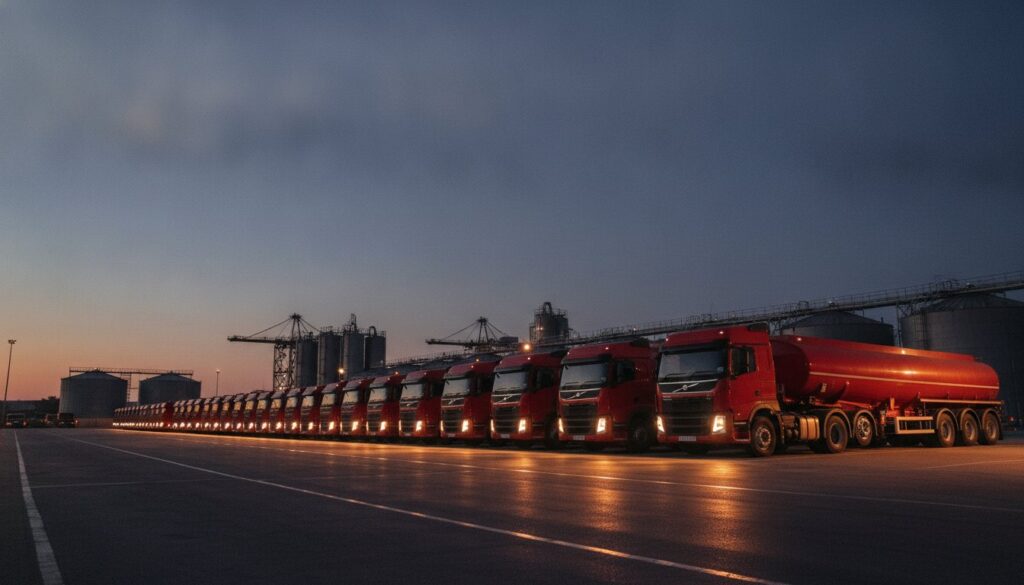
Diesel inventories plummeted to a 40-year low in August 2026, forcing a radical re-evaluation of how industrial operators approach energy security. You have likely navigated the pressure of record-high prices and the persistent threat of supply chain disruptions that can paralyse a national operation in an instant. Managing bulk diesel for fleet management is no longer a routine procurement task. It is a strategic imperative that requires precision, foresight, and a partner committed to your operational resilience. We recognise the necessity of maintaining momentum while eliminating the hidden inefficiencies that erode your profitability.
This guide provides the strategic framework to master the complexities of bulk fuel procurement to safeguard your fleet’s continuity and optimise your bottom line. We will explore the integration of 24/7 supply chains, the value of turnkey infrastructure planning, and the sophisticated logistical frameworks that reduce administrative friction. By following this roadmap, you will gain the clarity needed to lower your total cost of ownership and ensure your fleet remains a formidable force in the competitive landscape. Your journey toward fuel security starts with a commitment to excellence and a focus on long-term sustainability.
Key Takeaways
- Transition from reactive refuelling to proactive energy management to transform fuel procurement into a core driver of fleet ROI.
- Ensure operational continuity by verifying supplier wholesale licences and the robustness of their national distribution networks.
- Balance the immediate benefits of spot-market purchasing against the long-term budget predictability offered by fixed-term supply contracts.
- Optimise bulk diesel for fleet management by integrating on-site storage infrastructure that reduces logistical friction and administrative burdens.
- Build a resilient fuel supply chain through strategic partnerships that offer 24/7 support and nationwide logistical precision.
The Strategic Role of Bulk Diesel in Modern Fleet Management
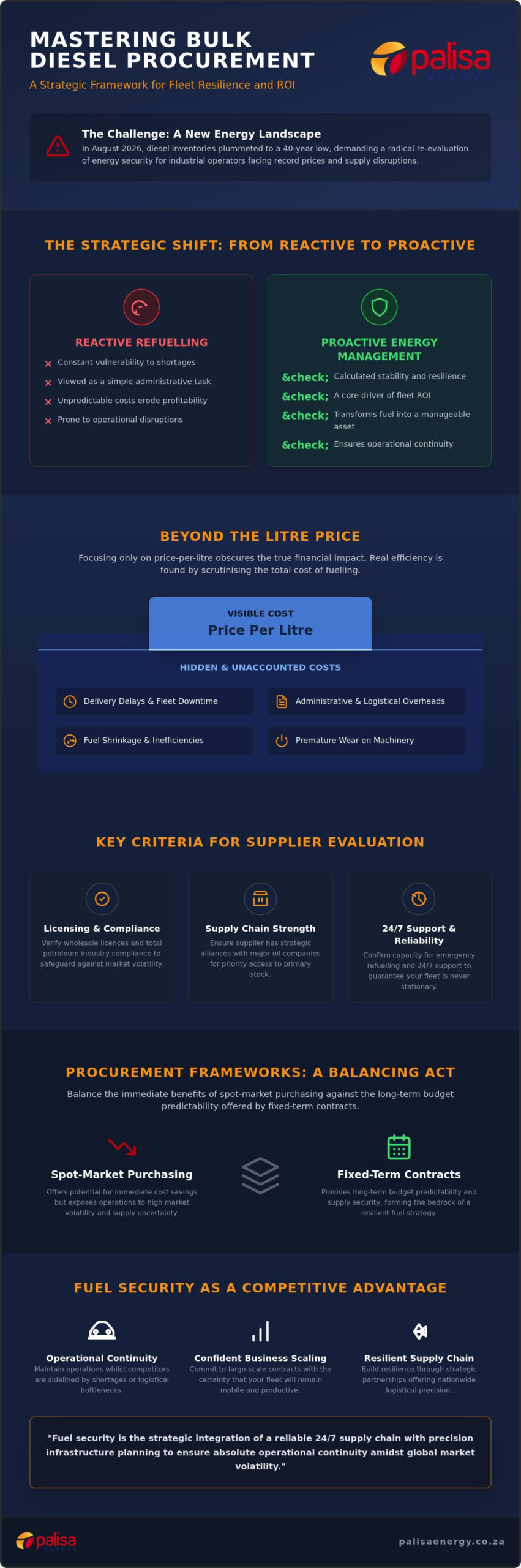
Procuring fuel is no longer a peripheral administrative task. It has evolved into a central pillar of operational excellence. For modern enterprises, bulk diesel for fleet management serves as a primary driver of Return on Investment (ROI), dictating the rhythm of nationwide logistics and the health of the bottom line. Shifting from reactive refuelling to proactive energy management allows organisations to transition from a state of constant vulnerability to one of calculated stability. This transformation is essential in an era where global supply chain disruptions and record-low fuel inventories have become the new baseline for industrial operations.
Reliability starts at the source. High-quality fuel directly correlates with extended machinery life and reduced equipment downtime. Modern engines, particularly those adhering to 2026 emission standards, require precise fuel specifications to maintain peak performance. Contaminated or sub-standard diesel accelerates wear on fuel injectors and sensitive filtration systems, leading to premature maintenance cycles that can derail project timelines. By securing a high-register supply, you protect your capital assets and ensure every litre contributes to productive movement rather than mechanical failure.
Beyond the Litre: Understanding Total Cost of Fueling
Focusing exclusively on price-per-litre is a common trap that obscures the true financial impact of energy procurement. Real efficiency is found by scrutinising the total cost of fueling, which includes delivery delays, administrative overhead, and the silent drain of fuel shrinkage. Sophisticated fuel management systems provide the visibility required to identify these hidden leaks in the budget. Optimising bulk diesel for fleet management requires a transition from simple purchasing to integrated logistics. Implementing real-time monitoring and automated data capture reduces operational waste, ensuring every drop is accounted for and utilised effectively. This holistic approach transforms fuel from an unpredictable expense into a manageable, strategic asset.
Fuel Security as a Competitive Advantage
Continuity is the ultimate currency in the logistics sector. Companies that possess a resilient fuel supply chain can maintain operations whilst competitors are sidelined by shortages or logistical bottlenecks. This stability provides the confidence necessary for aggressive business scaling, allowing you to commit to large-scale contracts with the certainty that your fleet will remain mobile. It’s not merely about having fuel today; it’s about guaranteeing access tomorrow. A steadfast guardian of your supply chain manages these complexities so you can focus on growth.
Fuel security in 2026 is defined as the strategic integration of a reliable 24/7 supply chain with precision infrastructure planning to ensure absolute operational continuity amidst global market volatility.
Evaluating Bulk Diesel Suppliers: Key Criteria for Fleet Security
Selecting a fuel partner is a strategic decision that dictates your operational ceiling. It’s not merely a transaction. You must rigorously verify wholesale licences and ensure total petroleum industry compliance before entering any agreement. A supplier’s legitimacy serves as the first line of defence against the market volatility that characterizes the current energy landscape. Strategic alliances with major oil companies are equally critical. These partnerships ensure that even during global supply squeezes, your provider maintains priority access to primary stock, which is a cornerstone of effective bulk diesel for fleet management.
A supplier’s ability to deliver under pressure is the true measure of their value. Ask specific questions regarding their contingency plans during national shortages and their history of fulfilment during peak demand. A provider that manages its own logistics with precision allows you to focus on your core business objectives without the constant fear of a dry tank. This reliability is built on a foundation of 24/7 support and the capacity for emergency refuelling, ensuring that your fleet never remains stationary when it should be in motion.
Vetting Logistics and Distribution Capabilities
Distribution networks must be assessed with industrial precision. When vetting a supplier, scrutinise their fleet reliability and the age of their delivery equipment. Real-time tracking has become an essential tool for verifying delivery volumes and timing, eliminating the ambiguity that often plagues fuel logistics. For enterprises with a national footprint, nationwide coverage is essential. It allows for seamless scaling without the administrative burden of managing multiple regional vendors. If you require a partner that prioritises these standards, consider how nationwide bulk diesel supply can fortify your logistics.
Compliance and Safety Standards
Safety and environmental stewardship are non-negotiable in the energy sector. Your supplier must demonstrate a commitment to rigorous safety audits and ISO certifications. Whilst global benchmarks such as federal regulations for diesel fuel storage outline high-level safety expectations, local compliance ensures your operations remain within the law. Regular compliance auditing and infrastructure planning are not just about avoiding fines. They are about protecting your workforce and the environment whilst ensuring the longevity of your storage assets. Transparent reporting and detailed documentation build the trust necessary for a long-term, sustainable partnership.
Procurement Frameworks: Spot Pricing versus Fixed-Term Contracts
Procurement strategies represent a fundamental choice between immediate opportunistic savings and long-term financial stability. Spot-market purchasing offers the allure of lower prices when global demand dips, but it leaves your operation exposed to the brutal swings of geopolitical instability. In contrast, fixed-term contracts provide a shield of budget predictability. These agreements ensure that your bulk diesel for fleet management remains a stable cost centre rather than a source of fiscal anxiety. Relying on the spot market often means competing for remaining stock during shortages, whereas a contract secures your place at the front of the queue.
Many executives fear that long-term commitments are too restrictive. This is a misconception. A well-structured agreement isn’t a cage; it’s a guarantee of priority. During periods of extreme scarcity, contract holders receive their allocations whilst spot buyers are often left stranded or forced to pay exorbitant premiums. This resilience is the true value of a strategic partnership. It allows for precise financial forecasting and ensures that your capital is not tied up in reacting to market spikes. Stability is the foundation upon which aggressive business scaling is built.
Managing Price Volatility in the South African Market
The South African energy sector is uniquely susceptible to currency fluctuations and global supply chain disruptions. Mitigating these risks requires more than just watching the ticker. It involves leveraging bulk volumes to secure wholesale industrial rates that are insulated from retail price spikes. Organisations that understand these nuances can maintain their margins even when the market is in turmoil. For a deeper analysis of these dynamics, refer to the strategic guide to bulk diesel supply in South Africa 2026. Proactive energy management is the only way to neutralise the impact of external volatility on your domestic operations.
Contractual Flexibility for Growing Fleets
Growth demands agility. Designing agreements that scale with your operational requirements ensures that your fuel supply never becomes a bottleneck for expansion. Service-level agreements (SLAs) play a pivotal role here, codifying performance expectations and delivery timelines. By adopting sophisticated Fuel Management Strategies for Government Fleets and large-scale industrial operations, you transition from managing a simple vendor to collaborating with a strategic partner. This relationship ensures that your logistics framework evolves alongside your business. It provides the unwavering support necessary for national leadership, allowing you to commit to new projects with total operational confidence.
Optimising Operations through On-Site Infrastructure and Logistics
Integrating on-site storage provides a formidable advantage in fleet operations. It eliminates the reliance on external retail networks and streamlines the refuelling process. By hosting your own supply, you gain total control over fuel quality and availability. This is a critical component of bulk diesel for fleet management, as it allows for the seamless integration of supply and consumption. Turnkey solutions simplify this transition, managing everything from initial design to final commissioning so your operation can scale without delay. Precision is the hallmark of a market leader, and on-site infrastructure is the tool that enables it.
Strategic Fuel Infrastructure Planning
Designing a depot requires a balance of operational efficiency and environmental responsibility. A well-planned facility minimises the risk of spills and ensures that your storage meets rigorous national standards. Compliance auditing is not a one-time event; it’s an ongoing commitment to safety and integrity. For a comprehensive look at these requirements, explore strategic fuel infrastructure planning in South Africa 2026. Precise infrastructure planning reduces long-term fuel costs by eliminating logistical bottlenecks and preventing environmental liabilities that can lead to significant financial penalties.
Technology and Monitoring Integration
Real-time monitoring bridges the gap between the storage tank and the vehicle’s engine. Remote sensors provide the visibility needed to prevent fuel theft and unauthorised use, which are common drains on fleet profitability. This data-driven approach also improves delivery scheduling and accuracy. When your supplier has visibility into your stock levels, they can optimise delivery routes and ensure you never face a dry tank scenario. This level of coordination transforms your energy supply into a predictable, high-performance system. A robust bulk diesel for fleet management programme relies on this technological backbone to maintain its competitive edge. If you are ready to secure your supply chain, partner with us for nationwide diesel supply.
Establishing a Resilient Fuel Supply Chain with Palisa Energy
Palisa Energy operates as more than a supplier. We are a strategic partner. Our approach to bulk diesel for fleet management integrates nationwide distribution with precise logistical execution. As an independent reseller, we possess the agility to respond to market shifts whilst maintaining the stability of a formidable corporate entity. This national reach ensures that your operation remains fuelled regardless of regional logistical hurdles. We customise every solution to meet the specific energy requirements of the modern South African enterprise, ensuring that your fuel strategy supports your broader business objectives. We don’t just deliver fuel; we deliver the certainty required to scale your business with confidence.
Downtime is a luxury no fleet can afford. Our 24/7 support model acts as a proactive shield, identifying potential supply gaps before they manifest as operational delays. By managing the end-to-end fuel lifecycle, we provide the unwavering support necessary for sustained industrial growth. This commitment to excellence translates into reduced administrative burdens and a lower total cost of ownership for your fleet. We take pride in our operational standards, ensuring that every delivery meets the high-register quality your machinery demands.
A Strategic Partnership for Industrial Growth
We manage the intricacies of fuel logistics so your leadership team can focus on core competencies. Our established partnerships with leading oil companies guarantee stock priority, even during periods of national supply constraint. This network resilience is vital for navigating the complex energy landscape of 2026. To understand the broader context of these challenges, review our analysis on fuel security for business in South Africa: strategic trends and risk management for 2026. By leveraging these high-level partnerships, we ensure that your supply chain remains robust, reliable, and capable of supporting aggressive expansion.
Getting Started with Your Bulk Diesel Strategy
Designing a strategy for bulk diesel for fleet management begins with a comprehensive assessment of your current onboarding and logistical requirements. We examine your storage capacity, consumption patterns, and distribution needs to design a bespoke procurement framework. Palisa Energy serves as the steadfast guardian of your fleet’s energy needs, ensuring integrity and safety at every touchpoint. We manage the complexity of logistics with precision so you don’t have to. Secure your operational future and optimise your bottom line by engaging with our experts. We invite you to contact us today for a strategic procurement consultation and take the first step toward absolute fuel security.
Securing Your Operational Future Through Strategic Fuel Procurement
Mastering the complexities of energy logistics is no longer optional for the modern enterprise. It is the defining factor in maintaining operational continuity. By transitioning from reactive purchasing to a proactive procurement framework, you transform fuel from a volatile expense into a strategic asset. The integration of on-site infrastructure and real-time monitoring ensures that your fleet remains mobile whilst your competitors are sidelined by market instability. Precision in bulk diesel for fleet management requires a partner who understands the high stakes of the industrial sector.
Operational resilience is built on the foundation of reliability and expert foresight. It’s time to secure your supply chain and protect your bottom line. We invite you to Partner with Palisa Energy for reliable bulk diesel solutions. Our approach combines strategic partnerships with major oil companies and comprehensive 24/7 industrial support to protect your momentum. With our expert infrastructure planning and compliance services, you gain a steadfast guardian for your supply chain. Take control of your energy needs today and drive your business toward long-term, sustainable growth.
Frequently Asked Questions
What are the primary benefits of bulk diesel for fleet management?
Cost efficiency and supply security are the most significant advantages. By purchasing in large volumes, organisations secure wholesale industrial rates that are lower than retail pump prices. It also eliminates the logistical burden of multiple refuelling stops. Managing bulk diesel for fleet management ensures that your operation maintains total control over fuel quality and availability, which is vital for protecting high-value capital assets from sub-standard fuel contamination.
How does on-site fuel storage improve fleet efficiency?
On-site storage eliminates the time wasted by drivers queuing at retail stations and allows for refuelling during off-peak hours. This integration of supply and consumption reduces unproductive engine idling and streamlines logistical scheduling. It provides a dedicated reserve that protects your fleet from external supply chain shocks. When coupled with automated dispensing systems, it also provides granular data on vehicle consumption, allowing for more precise operational forecasting and accountability.
Is it better to buy bulk diesel on the spot market or via contract?
Fixed-term contracts are generally superior for businesses requiring budget predictability and guaranteed stock priority. Whilst the spot market might offer occasional savings during demand dips, it leaves your fleet vulnerable to extreme price volatility and stockouts during national shortages. A supply agreement ensures you remain a priority customer, which is a critical advantage during global energy crises. Contracts provide the financial stability needed for long-term business scaling and precise margin protection.
How can I ensure the quality of the bulk diesel I procure?
Quality assurance depends on selecting a partner with verified wholesale licences and established partnerships with major oil companies. You should request regular certificates of analysis and ensure your supplier adheres to rigorous ISO safety and handling standards. On-site storage also requires regular maintenance and filtration audits to prevent water ingress or microbial growth. These proactive measures ensure that the fuel powering your fleet meets the precise requirements of modern engines.
What compliance standards must be met for on-site fuel storage in South Africa?
South African regulations require adherence to specific environmental and safety protocols, including SANS 10131 for petroleum storage. This involves installing approved tank systems, implementing secondary containment like bunding, and obtaining necessary municipal fire clearances. Compliance auditing is essential to avoid legal penalties and environmental liabilities. A strategic partner provides turnkey infrastructure planning to ensure your depot meets all national safety standards, protecting both your workforce and the surrounding environment from potential hazards.
How does real-time monitoring help in reducing fuel costs?
Real-time monitoring provides absolute visibility into fuel levels and dispensing patterns, which is essential for identifying theft and unauthorised usage. By tracking every litre from delivery to consumption, organisations can eliminate the shrinkage that often erodes profit margins. This data-driven approach also allows for more accurate delivery scheduling, ensuring that your storage tanks are replenished exactly when needed. It’s a vital tool for optimising bulk diesel for fleet management by automating inventory management.
Can bulk diesel suppliers guarantee 24/7 delivery nationwide?
Reliable suppliers like Palisa Energy provide 24/7 support and nationwide distribution through robust logistical networks. This capability is essential for industrial fleets that operate around the clock and cannot afford any downtime. National coverage ensures that your supply chain remains intact regardless of where your equipment is deployed. By partnering with an independent reseller that has priority access to primary stock, you gain the assurance that your fuel needs will be met consistently.
What should I look for in a bulk petroleum logistics partner?
Prioritise a partner that offers a holistic approach, encompassing fuel supply, infrastructure planning, and 24/7 support. They must possess valid wholesale licences and demonstrate a commitment to safety through regular compliance auditing. Look for a steadfast guardian that manages the complexity of logistics with precision, allowing your team to focus on core business growth. A partner with national reach and established oil company alliances provides the resilience required to navigate the volatile energy landscape.