


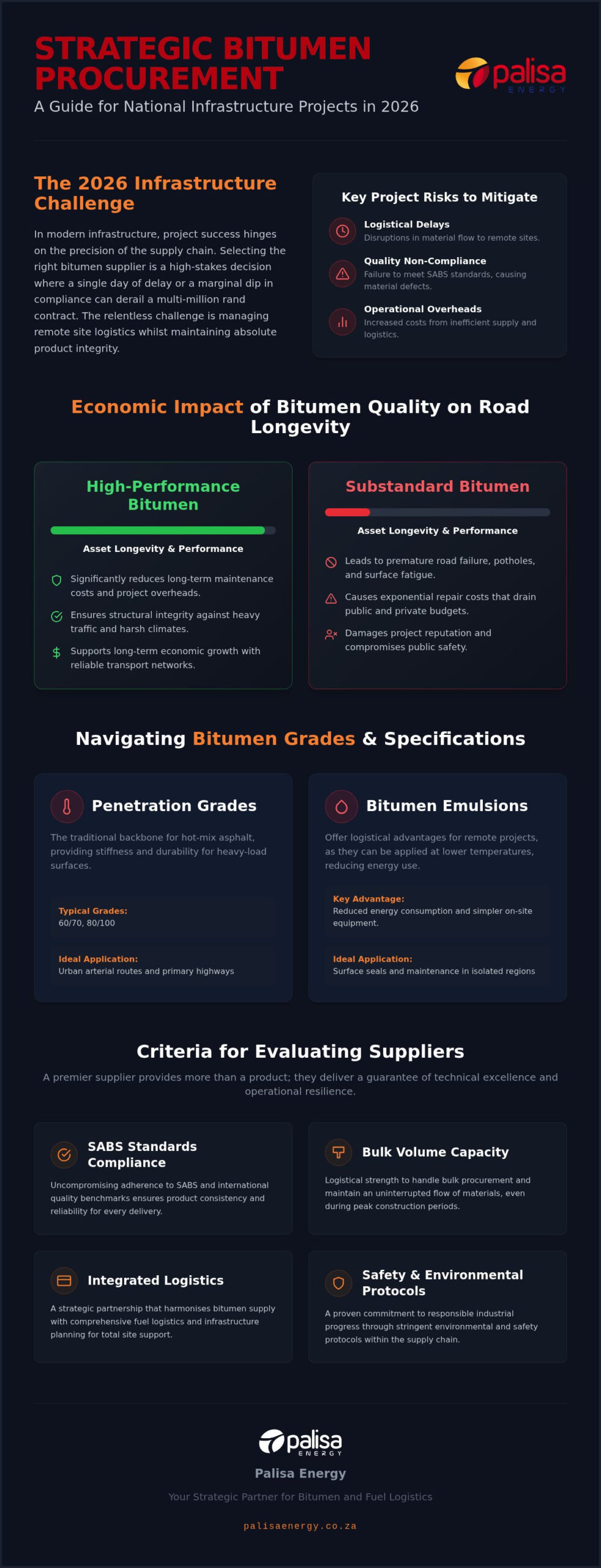
In 2026, the success of a national infrastructure project no longer rests on the quality of the asphalt alone, but on the invisible precision of the supply chain that delivers it. Selecting the right bitumen for road surfacing suppliers has become a high-stakes decision where a single day of delay or a marginal dip in SABS compliance can derail a multi-million rand contract. You recognise that managing remote site logistics whilst maintaining product integrity is a relentless challenge. It requires a strategic partner who views your timeline as an absolute commitment.
This guide empowers you to master the complexities of bitumen procurement and logistics to ensure your road construction projects are delivered with uncompromising quality and reliability. We will examine how to secure an uninterrupted supply of penetration grade bitumen and reduce your operational overhead through turnkey distribution models. From technical specification compliance to the strategic integration of fuel infrastructure planning, you’ll discover the blueprint for a resilient procurement strategy that supports long-term national growth.
Key Takeaways
- Understand the economic impact of bitumen quality on road longevity to significantly reduce long-term maintenance costs and project overheads.
- Identify high-performance bitumen for road surfacing suppliers by evaluating their nationwide distribution capacity and ability to secure bulk volumes.
- Master the technical nuances between penetration grade bitumen and emulsions to ensure uncompromising compliance with SABS standards.
- Implement proactive supply chain strategies to mitigate common logistical bottlenecks and maintain an uninterrupted flow of materials to remote sites.
- Discover the advantages of a strategic partnership that harmonises bitumen supply with comprehensive fuel logistics and infrastructure planning.
The Critical Role of Bitumen in Modern Road Infrastructure
Bitumen acts as the fundamental binder that ensures the structural integrity of our national transport networks. The Critical Role of Bitumen extends beyond mere surfacing; it is the resilient core of asphalt concrete that withstands heavy-duty traffic and harsh environmental conditions. For project managers and infrastructure planners, the selection of bitumen for road surfacing suppliers isn’t a routine procurement task. It’s a strategic investment in the longevity of the nation’s assets. In the current 2026 landscape, South African infrastructure planning prioritises materials that offer maximum durability to support long-term economic growth.
Economic stability depends on reliable road networks. High-quality bitumen directly correlates with reduced maintenance cycles and lower long-term expenditure. When binders fail prematurely, the resulting potholes and surface fatigue lead to exponential costs that drain public and private budgets. With the global bitumen market reaching an estimated US$ 16.1 Billion in 2026, the competition for high-performance binders has intensified. This focus on lifecycle value makes the choice of supplier a pivotal decision for any large-scale development project.
What Defines a Leading Bitumen Supplier?
A premier supplier provides more than just a product in a drum. They offer a guarantee of technical excellence and operational resilience. Leading bitumen for road surfacing suppliers must demonstrate several core competencies:
- Rigorous compliance with SABS standards and international quality benchmarks to ensure product consistency.
- The logistical strength to handle bulk procurement and maintain consistent volume availability, even during peak construction periods.
- Integration of stringent environmental and safety protocols within the supply chain, reflecting a commitment to responsible industrial progress.
This holistic approach ensures that the materials delivered to your site are both reliable and ethically sourced, protecting your project from the risks of substandard materials or delivery failures.
The Versatility of Bituminous Binders
Bitumen adapts to diverse engineering requirements, from the construction of new arterial highways to the delicate rehabilitation of existing urban streets. It’s the primary choice for creating sustainable, weather-resistant surfaces that can endure the intense heat and heavy rainfall typical of the South African climate. Bitumen is a high-viscosity petroleum product essential for asphalt production. Modern binders now incorporate technologies that allow for lower application temperatures, reducing energy consumption whilst enhancing the workability of the mix on site. This versatility ensures that bituminous solutions remain at the forefront of sustainable infrastructure development through 2026 and beyond.
Navigating Bitumen Grades and Performance Specifications
Procurement excellence relies on a deep understanding of binder chemistry and its interaction with local environments. Selecting the right grade is a precision exercise. Bitumen for road surfacing suppliers must offer more than just volume; they must provide technical alignment with your specific project requirements. Whether you are surfacing a primary highway or a rural access road, the choice between penetration grades, emulsions, and modified binders determines the lifespan of the asset. In 2026, the shift towards more resilient infrastructure demands a rigorous approach to material selection.
Penetration Grades vs. Emulsions
Standard penetration grades, such as 60/70 or 80/100, remain the traditional backbone of hot-mix asphalt applications. They provide the necessary stiffness and durability for heavy-load bearing surfaces. In contrast, bitumen emulsions offer significant logistical advantages for remote infrastructure projects. Because they can be applied at lower temperatures, they reduce energy consumption and simplify the equipment requirements on site. Whilst penetration grades excel in urban arterial routes, emulsions are often the superior choice for surface seals and maintenance in isolated regions where heating logistics are complex.
Quality Assurance in Bitumen Procurement
Reliability in road construction is built on rigorous Bitumen performance specifications. Every batch must undergo stringent testing to ensure it meets both SABS standards and the specific performance criteria of the project. Substandard binders are the primary cause of premature road failure, leading to the rapid development of potholes and surface stripping. By ensuring that your supplier provides certified test results from the refinery, you protect your project from the high costs of remedial work. It’s a matter of operational integrity.
For high-traffic zones, specifying Polymer Modified Bitumen (PMB) is a strategic move to enhance resilience. PMB binders are engineered to resist rutting and cracking under extreme temperature fluctuations. This level of technical precision is why many contractors choose to partner with a strategic petroleum reseller who understands the intersection of product quality and national infrastructure planning. Selecting the right grade for varied South African topographies ensures that every kilometre of road is fit for purpose, regardless of the local climate or traffic volume.
Criteria for Evaluating Bitumen Road Suppliers
Selecting bitumen for road surfacing suppliers requires a fundamental shift in procurement perspective. Whilst technical compliance with SABS standards is a prerequisite, the true measure of a strategic partner lies in their operational resilience and industrial foresight. You need a supplier who demonstrates the financial stability required to secure bulk volumes and the technical depth to provide meaningful infrastructure consulting. It’s about moving beyond a simple transaction to establish a partnership built on transparency, precision, and a shared commitment to national development.
Logistics: The Backbone of Bitumen Supply
In the high-stakes environment of national road construction, delays are not merely inconveniences; they’re significant financial liabilities. A robust logistical framework is essential for maintaining project momentum across diverse topographies. This requires sophisticated real-time monitoring and advanced fleet management to ensure that materials arrive exactly when they’re needed, regardless of site location. Effective fuel logistics South Africa wide ensures that the synergy between binder delivery and site machinery remains uninterrupted. 24/7 operational support is a non-negotiable requirement for projects operating on tight, time-sensitive schedules where every hour of downtime carries a heavy price tag.
The Reseller Advantage: Flexibility and Reach
Independent resellers occupy a unique and vital position in the supply chain by bridging the gap between major refineries and regional contractors. This model offers unparalleled flexibility that traditional refinery-direct channels often lack. By maintaining a diverse partnership network with leading oil companies, a strategic reseller can mitigate local supply shortages that might otherwise halt your progress. They act as a proactive guide through the complexities of bulk procurement, managing the intricate coordination of transport and storage so your team can focus on the physical execution of the build.
Strategic procurement serves as a powerful tool for long-term cost management. Transparency in pricing and delivery lead times allows for more accurate budgeting and resource allocation. When you evaluate bitumen for road surfacing suppliers, look for those who offer holistic solutions rather than isolated products. A partner who understands the broader economic landscape and infrastructure goals will provide the stability needed for sustainable project success. This level of dedication ensures that your projects are not only completed on time but are built to endure the rigours of future traffic demands.
Mitigating Supply Chain Risks in Infrastructure Projects
Operational success in the road construction sector is frequently threatened by the inherent volatility of the global energy market. Identifying common bottlenecks in bitumen distribution is the first step toward building a resilient project timeline. Refinery maintenance schedules, port congestion, and seasonal demand spikes often converge to create supply deficits. To navigate these hurdles, bitumen for road surfacing suppliers must be evaluated on their ability to anticipate disruptions before they impact the site. Strategic foresight is the difference between a project that remains on schedule and one that suffers from costly, compounding delays.
Peak construction seasons demand an uncompromising approach to supply security. Relying on spot-market availability is a high-risk strategy that rarely pays off when demand across the country surges simultaneously. When selecting bitumen for road surfacing suppliers, the emphasis must be on their capacity for bulk procurement and their network of regional depots. Securing long-term supply contracts provides a necessary buffer against both volume shortages and the price fluctuations typical of petroleum-based products. With Brent crude trading at approximately $95.63 per barrel in late 2026, managing these costs requires a partner who understands the deep linkage between global oil prices and local bitumen availability.
Contingency Planning for Nationwide Projects
A proactive approach to risk management involves developing a resilient fuel supply chain South Africa wide. This resilience is achieved by utilising real-time data to monitor transport hurdles and adjusting delivery routes dynamically. It’s about maintaining total control over the movement of materials from the refinery to the remote project site. By integrating advanced logistics with reliable volume commitments, contractors can focus on execution whilst their supply partner manages the complexities of the broader economic landscape.
Infrastructure Planning and Compliance
On-site storage capacity is a critical lever for scaling operational capacity during intensive build phases. Establishing compliant bitumen and fuel storage depots allows for the accumulation of strategic reserves, protecting the project from short-term refinery outages. Comprehensive fuel infrastructure planning South Africa ensures that these facilities are positioned for maximum efficiency. Infrastructure auditing ensures all storage facilities meet rigorous safety and environmental standards. This level of compliance reduces project risk and ensures that all operations align with national regulatory frameworks.
Managing complex industrial logistics requires more than just a delivery vehicle; it requires a partner dedicated to your long-term success. If you are looking to fortify your project against supply chain disruptions, contact Palisa Energy to discuss our bulk supply solutions and strategic planning services.
Palisa Energy: Your Strategic Partner for Bitumen and Fuel Logistics
Palisa Energy stands as a formidable strategic partner in the South African energy sector, providing the stability and precision required for high-stakes infrastructure development. We recognise that civil engineering projects demand more than just a vendor; they require a visionary enabler capable of managing complex industrial logistics. As one of the premier bitumen for road surfacing suppliers, we offer a holistic suite of solutions that integrates diesel, petrol, and bituminous binders into a single, streamlined partnership. This consolidated approach reduces administrative friction and ensures that every component of your site’s energy and material needs is managed with uncompromising excellence.
A Vision for Sustainable Industrial Growth
Our commitment to national progress is reflected in how we integrate modern innovation with traditional reliability. We operate as a steadfast guardian of your supply chain, managing the intricate coordination of transport and site delivery so your executive team can focus on broader project objectives. By supporting large-scale civil engineering through comprehensive fuel sales and binder distribution, we empower industrial growth across the country. Our nationwide distribution network is built on established partnerships with leading oil companies. This ensures that your project remains fuelled and surfaced regardless of geographical challenges. Safety remains our core priority; we maintain rigorous operational standards that protect both your personnel and the surrounding environment during every delivery.
Securing Your Supply Chain for 2026
The transition from a transactional vendor to a strategic partner is essential for maintaining a competitive edge in 2026. National infrastructure projects operate on relentless schedules that do not pause for logistical failures or supply shortages. We provide 24/7 operational support to ensure that your bitumen and fuel requirements are met with total reliability. This unwavering support allows for a more resilient procurement strategy, shielding your project from the volatility of the spot market. Our expertise in infrastructure planning ensures that your site’s storage and distribution systems are optimised for maximum efficiency.
To gain a broader understanding of how integrated energy procurement can benefit your operations, you may wish to consult our bulk diesel suppliers South Africa guide. By aligning your binder needs with a comprehensive fuel strategy, you create a robust foundation for long-term project success. We take pride in our role as a proactive guide within the energy landscape, delivering the materials and the logistical precision that allow your infrastructure visions to become reality. Choosing the right bitumen for road surfacing suppliers is the first step toward a partnership built on integrity, safety, and the pursuit of excellence.
Building Resilient National Networks
Success in the 2026 infrastructure landscape hinges on the synergy between technical precision and logistical resilience. We’ve examined how mastering bitumen grades and mitigating supply chain risks are essential for ensuring project longevity and operational efficiency. Choosing the right bitumen for road surfacing suppliers is no longer just about the product in the drum; it’s about securing a partner who manages complex distribution with absolute precision so your team remains focused on construction. This strategic alignment protects your budget from the hidden costs of delays and substandard materials.
Palisa Energy provides this stability through our nationwide South African distribution network and established partnerships with leading oil companies. We offer comprehensive 24/7 logistical support to ensure your site never faces an avoidable delay, even in the most remote locations. By integrating bitumen supply with holistic fuel infrastructure planning, we empower you to deliver projects that endure the rigours of modern traffic demands. Partner with Palisa Energy for your nationwide bitumen and fuel requirements to solidify your procurement strategy. Together, we can build the foundations of a stronger, more connected industrial landscape.
Frequently Asked Questions
How is bitumen for road surfacing typically transported in South Africa?
Bitumen is typically transported across South Africa in specialised heated tankers, often referred to as bitumen distributors, to maintain the product’s viscosity for immediate application. For smaller projects or remote locations where bulk tankers are impractical, bitumen is delivered in cold-form steel drums. This logistical flexibility ensures that materials remain stable and ready for use upon arrival at the construction site, regardless of the distance from the refinery.
What are the main differences between penetration grade bitumen and bitumen emulsions?
Penetration grade bitumen is a hot-mix binder classified by its hardness, making it ideal for heavy-duty structural layers in arterial roads. Bitumen emulsions are liquid mixtures of bitumen and water that can be applied at ambient temperatures. These emulsions are preferred for surface treatments and cold-mix applications, offering a safer and more energy-efficient alternative in environments where heating facilities are limited or environmental regulations are particularly stringent.
Can Palisa Energy provide bitumen for remote road construction projects?
Palisa Energy provides comprehensive support for remote road construction projects through our nationwide distribution network. We specialise in managing the complex logistical coordination required to reach isolated sites whilst ensuring that product quality remains uncompromised. As one of the leading bitumen for road surfacing suppliers, our 24/7 operational support allows contractors to maintain strict build schedules by providing a reliable flow of materials, even when traditional supply chains face local bottlenecks.
What quality standards must bitumen suppliers adhere to in South Africa?
Bitumen for road surfacing suppliers must adhere to the rigorous standards set by the South African Bureau of Standards (SABS), specifically the SANS 4001 series. These regulations govern the technical properties of penetration grades and emulsions to ensure they meet the durability requirements of national infrastructure. Compliance auditing and batch testing are essential practices that protect projects from premature road failure caused by substandard binders that don’t meet industrial benchmarks.
How does bitumen pricing fluctuate with global oil market trends?
Bitumen pricing is intrinsically linked to the global crude oil market because it’s a direct byproduct of the refining process. As Brent crude prices fluctuate, the cost of production and transport follows a similar trajectory. In late 2026, with Brent crude trading at approximately $95.63 per barrel, securing long-term contracts helps businesses mitigate the risks associated with these volatile price shifts. This foresight ensures project budgets remain stable despite global economic pressure.
Why is infrastructure planning important for on-site bitumen storage?
Strategic infrastructure planning is vital for on-site storage to ensure that all depots meet safety and environmental compliance standards. Proper design allows for the management of bulk volumes, which acts as a buffer against supply chain disruptions during peak construction seasons. By auditing storage facilities, businesses can scale their operational capacity whilst reducing the risk of material degradation or hazardous leaks that could halt project progress and lead to costly remedial works.
Does Palisa Energy offer technical support for bitumen application?
Palisa Energy offers extensive technical support through our infrastructure planning and consulting services. We assist clients in designing compliant storage solutions and managing the complex logistics of nationwide distribution. Whilst we focus on the supply and procurement of bulk products, our consultancy ensures that your project’s energy and material framework is optimised for maximum efficiency and adherence to national industrial safety benchmarks, ensuring every litre of binder is utilised effectively.
How do I secure a long-term bitumen supply contract for a multi-year project?
Securing a long-term supply contract involves transitioning from a transactional vendor relationship to a strategic partnership with a dependable reseller. This process begins with an assessment of your multi-year project requirements and volume forecasts. By establishing a formal agreement, you gain priority access to bulk volumes and more predictable pricing structures. This provides the project security needed to execute large-scale civil engineering works without the constant threat of spot-market volatility or supply shortages.