

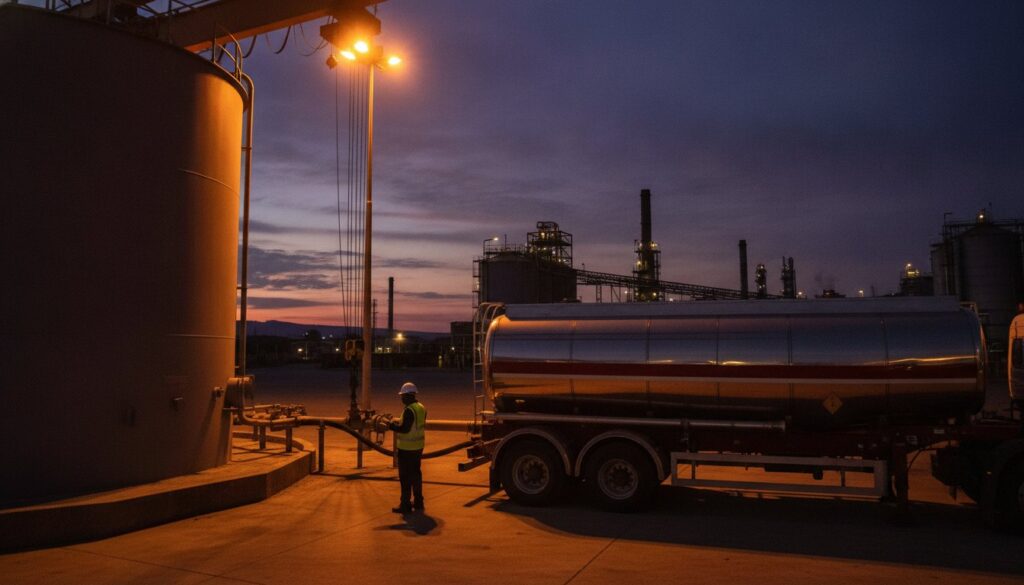
In an industrial landscape where a single hour of halted production can haemorrhage millions in lost revenue, waiting for a delayed fuel truck isn’t just an inconvenience; it’s a strategic failure. You likely recognise that the stability of your operations hinges on a fuel supply chain that remains unshakable even when the national grid falters. Securing reliable emergency bulk diesel delivery South Africa requires more than a simple phone call during a crisis; it demands a sophisticated approach to logistics that anticipates volatility before it strikes.
This guide empowers you to master the complexities of high-volume fuel procurement, ensuring your facility remains powered whilst competitors struggle with empty tanks. We’ll explore how to navigate the current wholesale market, where 50ppm diesel sits at R25.47 per litre, and how to maintain rigorous compliance standards during urgent refills. You’ll gain a comprehensive roadmap for vetting secondary suppliers and establishing the industrial resilience necessary to eliminate operational downtime across the country.
Key Takeaways
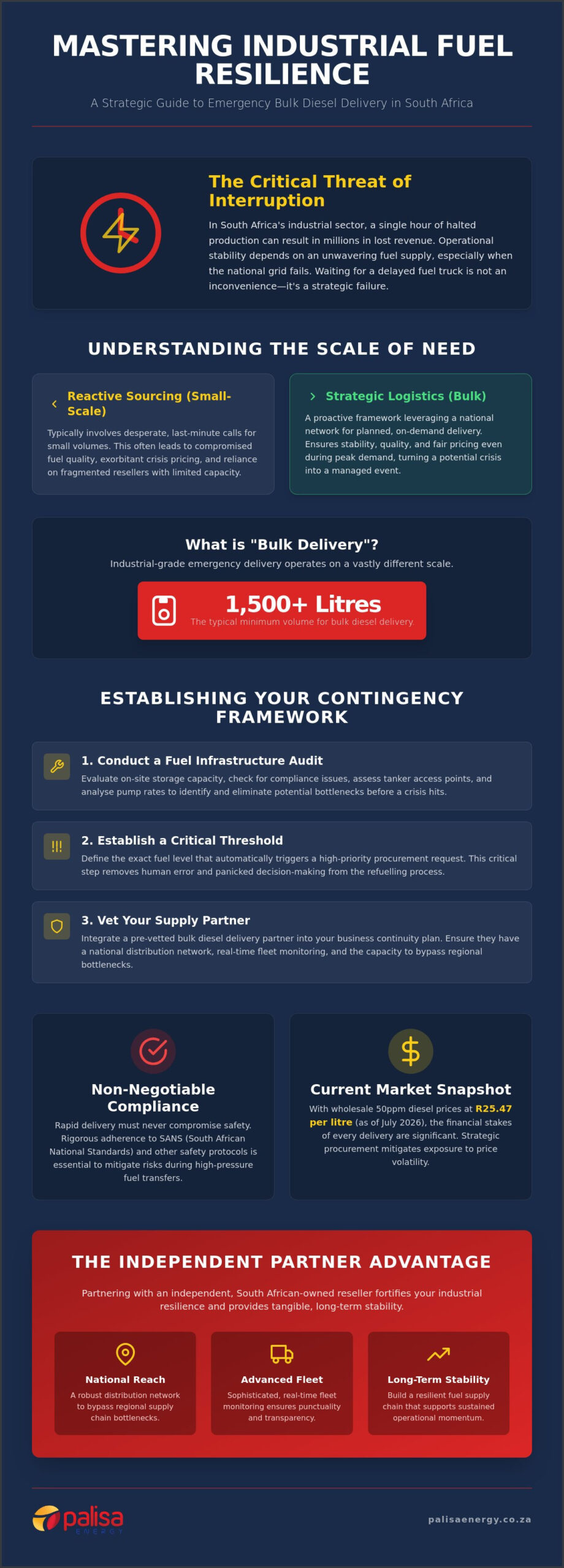
- Learn why defining bulk volumes, typically exceeding 1,500 litres, is critical for transitioning from reactive sourcing to strategic, on-demand logistics.
- Discover how to establish a proactive procurement framework that ensures emergency bulk diesel delivery South Africa remains seamless during peak demand periods.
- Understand the impact of real-time fleet monitoring and sophisticated distribution networks on ensuring punctuality from the moment of procurement to on-site discharge.
- Explore the non-negotiable safety protocols and SANS compliance standards required to mitigate risks during high-pressure, rapid fuel deliveries.
- Identify the strategic advantages of partnering with an independent, South African-owned reseller to fortify your industrial fuel resilience and long-term stability.
Defining Emergency Bulk Diesel Delivery in the South African Context
In the high-stakes environment of South African industry, the term “bulk” represents a specific operational threshold. Whilst consumer-facing services might focus on roadside assistance for stranded motorists, industrial-grade emergency bulk diesel delivery South Africa operates on a vastly different scale. We define bulk delivery as the rapid distribution of Diesel fuel in volumes typically exceeding 1,500 litres. This distinction is vital. It moves the conversation from simple refuelling to complex industrial logistics that sustain national enterprises.
Strategic on-demand logistics shouldn’t be confused with desperate, reactive sourcing. A reactive approach often leads to compromised fuel quality or exorbitant premiums during peak demand. Conversely, a strategic framework leverages a national distribution network to ensure stability. Local, fragmented resellers often lack the fleet capacity or storage reserves to perform when supply chains tighten. A national partner provides the necessary gravitas and reach to bypass regional bottlenecks, turning a potential crisis into a managed logistical event.
Several factors drive the immediate need for high-volume diesel. Persistent loadshedding remains the primary catalyst, forcing heavy machinery and backup generators to run for extended durations. Supply chain volatility and seasonal peaks in sectors like agriculture also create sudden, intense demand. Relying on a robust partner ensures that these external pressures don’t translate into internal failures. With wholesale prices for 50ppm diesel sitting at R25.47 per litre as of July 2026, the financial stakes of every litre delivered are higher than ever.
The Critical Role of Fuel in Industrial Continuity
Fuel is the lifeblood of South Africa’s core economic sectors. For mining operations, manufacturing plants, and large-scale agriculture, a dry tank is a precursor to catastrophic operational downtime. This downtime isn’t merely a pause in production. It represents a tangible financial haemorrhage that affects shareholder value and labour stability. Emergency diesel serves as the ultimate safeguard, ensuring that backup power generation systems remain primed to bridge the gap when the national grid fails. It’s the difference between a productive shift and a total site evacuation.
Ensuring continuity in these sectors involves more than just fuel; it requires a reliable supply of technical inputs. For instance, JAS Global Industries provides the speciality chemical solutions that mining and water treatment facilities need to maintain their operational integrity and efficiency.
Bulk vs. Mobile Fueling: Understanding the Scale
Understanding the scale of delivery is essential for executive planning. Small-scale mobile refuelling is designed for convenience, but heavy-duty bulk distribution requires specialised infrastructure. To receive these volumes, enterprises must maintain compliant on-site storage tanks and discharge points capable of handling high-flow transfers. Whilst mobile bowsers serve smaller equipment, bulk delivery orchestrates the movement of thousands of litres via heavy tankers. This scale allows for greater efficiency and ensures that even the most energy-intensive facilities maintain their operational momentum without interruption.
Establishing a Strategic Contingency Framework for Fuel Supply
Industrial resilience isn’t forged in the heat of a crisis. It’s established through a proactive procurement mindset that treats energy as a strategic asset rather than a mere utility. Considering the documented South Africa’s energy sector challenges, enterprise leaders must transition from reactive sourcing to long-term contingency planning. Integrating fuel logistics into your broader business continuity plan ensures that when the grid fails, your operations don’t. This framework requires a pre-vetted emergency bulk diesel delivery South Africa partner who understands the high-stakes nature of your production cycles.
Conducting a Fuel Infrastructure Audit
Precision begins with an internal assessment. You must evaluate your current on-site storage capacity and verify that all equipment adheres to the latest safety and environmental compliance codes. Bottlenecks often hide in the details, such as restricted tanker access or inefficient pump rates that slow down the discharge process. Establishing a “critical threshold” is the most vital step of this audit. This is the specific fuel level that automatically triggers a high-priority procurement request, removing human error and panic from the equation.
The Value of Long-Term Partner Vetting
Selecting the right distributor involves more than comparing price points. Independent resellers often offer superior flexibility compared to major oil companies, especially when local shortages occur. These partners possess the agility to reroute supply chains and prioritise loyal clients during periods of national scarcity. You should seek a reliable fuel supplier South Africa enterprises can depend on, with established relationships across multiple major oil companies to guarantee volume security. Verifying their national reach and logistics monitoring capabilities is essential for maintaining oversight of your fuel spend. For comprehensive insights into optimising these relationships, refer to The Strategic Guide to Bulk Diesel Supply in South Africa 2026.
Operational stability is a choice, not a matter of chance. By aligning with a dedicated strategic partner, you ensure that your facility remains a centre of productivity regardless of external volatility. If you’re ready to fortify your supply chain, consider how a partnership with Palisa Energy can safeguard your industrial momentum.
Navigating the Logistics of Rapid Bulk Diesel Distribution
Efficient fuel distribution is an orchestration of timing, geography, and technical precision. Once the strategic framework is in place, the physical movement of fuel requires a sophisticated logistics network capable of responding to immediate industrial needs. Executing an emergency bulk diesel delivery South Africa involves more than just dispatching a vehicle. It requires a comprehensive understanding of the national road infrastructure, real-time traffic dynamics, and the specific technical requirements of the discharge site.
Step-by-Step: Requesting an Emergency Bulk Delivery
The transition from a critical fuel threshold to a replenished tank follows a rigorous four-stage process. This methodical approach ensures that speed never compromises safety or fuel integrity.
- Initiating the Request: The client provides exact volume requirements and site-specific technical data, including tanker access constraints and coupling types.
- Grade and Quantity Verification: The supplier confirms the availability of specific fuel grades, such as 50ppm or 500ppm, ensuring the product meets SANS requirements.
- Logistical Coordination: Dispatchers calculate the most efficient route from national distribution points, providing a firm ETA based on current road conditions.
- On-site Preparation: The facility prepares the discharge area, ensuring that safety perimeters are established and receiving tanks are ready for high-volume transfer.
Real-Time Monitoring and Supply Chain Visibility
Modern industrial fuel logistics rely on advanced telematics rather than simple consumer-grade applications. These systems provide granular visibility into the fleet’s movement, allowing the logistics centre to monitor fuel security and driver behaviour in real time. Transparent communication remains the cornerstone of this process. Clients receive proactive updates, allowing them to synchronise their operations with the tanker’s arrival. This level of oversight is particularly critical when managing “last-mile” challenges in remote mining locations or congested industrial zones where traditional navigation often fails.
Meticulous route planning serves as a secondary safeguard against operational delays. Navigating South Africa’s national road network under time pressure requires an intimate knowledge of high-risk corridors and seasonal congestion patterns. By avoiding known bottlenecks and high-risk areas, a national partner ensures that the delivery remains on schedule. This proactive orchestration transforms a high-pressure replenishment into a controlled, predictable event, maintaining the industrial momentum established in your contingency framework.
Evaluating Compliance and Safety Standards During Urgent Deliveries
Operational urgency is never a valid justification for a lapse in safety protocols. In the high-pressure context of an emergency bulk diesel delivery South Africa, the temptation to bypass standard procedures can lead to catastrophic environmental and physical consequences. We maintain that industrial excellence is defined by the ability to execute rapid logistics whilst upholding the most rigorous South African National Standards (SANS). Compliance isn’t a hurdle. It’s the framework that ensures your facility remains operational and your personnel remain safe. A steadfast guardian of industrial continuity never sacrifices safety for speed.
The belief that “emergency” implies a reduction in fuel quality is a dangerous fallacy. Reputable suppliers utilise the same high-grade reserves for urgent requests as they do for scheduled contracts. By sourcing exclusively from major oil company partners, you guarantee that the diesel fuel entering your tanks meets SANS specifications for viscosity, lubricity, and sulphur content. Quality testing is a standard component of the procurement journey, protecting your expensive backup generators from the long-term damage caused by contaminated or sub-standard fuel. Integrity remains the non-negotiable anchor of every transaction.
Essential Safety Protocols for On-Site Discharge
High-volume fuel transfers carry inherent risks that demand methodical mitigation. Fire safety requirements, including the establishment of clear exclusion zones and the presence of certified fire-fighting equipment, are non-negotiable. Every discharge must be overseen by certified technicians who understand the complexities of heavy-duty pumping systems. Verifying equipment integrity is a critical prerequisite for every drop. This includes inspecting hoses for wear, ensuring valves are seated correctly, and confirming that earthing systems are securely attached to prevent static discharge. A single spark in an industrial environment can undo years of safety records.
Fuel Quality Assurance and Compliance Auditing
Adhering to SANS 10131 is essential for the legal and safe storage of fuel on-site. This standard dictates the infrastructure requirements for handling flammable liquids, ensuring that your facility remains on the right side of regulatory audits. Beyond the fuel itself, environmental contingency plans must be robust. This involves the deployment of spill management kits and the training of staff to handle accidental discharge. Responsibility for the environment is shared between the supplier and the receiver. It ensures that South Africa’s industrial growth doesn’t come at an ecological cost. Maintaining these standards requires a partner who values integrity as much as speed. If you need to fortify your operations with compliant, high-grade fuel, contact Palisa Energy for reliable diesel supply today.
Partnering with Palisa Energy for Enterprise Fuel Resilience
Palisa Energy functions as the steadfast guardian of your industrial fuel supply chain. We recognize that in a market characterized by significant price fluctuations and complex government levy adjustments, stability is your most valuable currency. As an independent South African-owned reseller, we possess the agility to navigate regional bottlenecks whilst maintaining the logistical reach of a national market leader. Our role is to manage the intricate details of procurement and distribution with absolute precision, allowing you to focus on your core enterprise objectives without the looming threat of energy scarcity.
Our approach to emergency bulk diesel delivery South Africa is rooted in the belief that industrial growth requires unwavering support. We don’t merely act as a passive service provider. Instead, we serve as a proactive guide that takes pride in maintaining the highest operational standards. By aligning our national distribution network with your specific on-site requirements, we ensure that your facility maintains its momentum even when the broader energy market faces unprecedented volatility. Integrity is the anchor of our operations, and our commitment to excellence is reflected in every litre we move.
Comprehensive Fuel Logistics and Infrastructure
We integrate high-volume distribution with long-term infrastructure planning to create a seamless energy ecosystem. This holistic method ensures that your on-site storage and handling systems are not just compliant with SANS regulations, but are truly optimised for high-flow throughput. Understanding the unique challenges of the South African energy landscape, including the fragile electrical grid and the implementation of the Emergency Fuel Supply Arrangement, allows us to anticipate disruptions before they impact your production line. We provide the stability necessary for your business to pursue ambitious growth, regardless of global oil price shifts or local supply chain constraints. To understand how this approach delivers real-world results, explore our case study on what it means to be a reliable fuel supplier in South Africa that industrial operations can genuinely depend on.
Securing Your Supply Chain for 2026 and Beyond
Securing your supply chain for the coming years requires a decisive shift from reactive panic to strategic foresight. The transition begins with a commitment to proactive vetting and rigorous infrastructure auditing. By establishing a partnership today, you eliminate the compliance risks and costly operational delays associated with rushed procurement during periods of peak demand. We manage the complexity so you don’t have to. We invite you to take the final, most critical step in your contingency planning to ensure your operations remain unshakable. Organise a consultation with Palisa Energy for your bulk diesel needs and fortify your industrial future with a partner who values progress above all else.
Fortifying Your Industrial Momentum
Mastering the logistics of rapid fuel sourcing transforms energy volatility from a threat into a managed operational variable. You’ve seen that industrial resilience depends on a proactive framework where SANS compliance and rigorous infrastructure audits serve as the bedrock of your contingency plan. By prioritising strategic vetting over reactive panic, you ensure that your facility remains powered whilst others face the costly consequences of a dry tank. Securing emergency bulk diesel delivery South Africa is ultimately about maintaining total control over your production cycles regardless of external grid instability.
Success in the energy sector requires a partner that acts as a steadfast guardian of your supply chain. As an independent South African-owned reseller with a nationwide distribution network and partnerships with leading oil companies, we provide the 24/7 industrial support your enterprise demands. We manage the complex logistics so your team can focus on sustainable growth and operational excellence. Contact Palisa Energy for reliable bulk diesel logistics across South Africa and take the first step toward absolute fuel security. It’s our mission to power your progress and ensure your operational continuity remains unshakable.
Frequently Asked Questions
How quickly can emergency bulk diesel be delivered across South Africa?
Delivery times are determined by your facility’s proximity to our strategic distribution points and current road conditions. We utilise advanced route planning to accelerate the journey and restore your operational momentum as quickly as possible. Our real-time monitoring systems allow us to navigate regional bottlenecks effectively. This ensures that every emergency bulk diesel delivery South Africa request is handled with the urgency your production cycle requires.
What is the minimum volume required for an emergency bulk diesel delivery?
Bulk diesel deliveries typically begin at volumes of 1,500 litres to suit industrial and commercial requirements. This threshold allows for the efficient deployment of heavy-duty tankers and specialised discharge equipment. Maintaining this scale ensures that we can provide the high-volume support necessary for mining and manufacturing sectors. For smaller requirements, we suggest reviewing your on-site storage capacity to accommodate these larger, more efficient replenishments.
Can Palisa Energy deliver diesel during high-level loadshedding stages?
Our logistics network is built to remain operational throughout all loadshedding stages to support national industrial continuity. We maintain the necessary resilience to bypass grid-related failures, ensuring your backup generators remain fuelled during periods of intense demand. Our role as a strategic partner is to provide stability when the national grid falters. We prioritise your facility’s uptime to prevent costly production halts regardless of the current power status.
What information do I need to provide for an urgent bulk fuel request?
You need to provide the required volume, the specific fuel grade (such as 50ppm), and clear site-access instructions. Technical details regarding your storage tank capacity and coupling requirements are also vital for a safe transfer. Providing this data upfront allows our dispatchers to coordinate the logistics with precision. It ensures the delivery process remains smooth and free from technical delays upon arrival at your site.
Are emergency bulk diesel deliveries compliant with SANS safety regulations?
All our deliveries adhere strictly to SANS 10131 and other relevant national safety regulations for the handling of flammable liquids. We ensure that every tanker is correctly earthed and that discharge is managed by certified personnel to prevent operational accidents. Safety is never sacrificed for speed. Our commitment to these standards protects your personnel and the surrounding environment from the risks associated with high-pressure fuel transfers.
How does Palisa Energy ensure the quality of diesel during rapid distribution?
We source our fuel exclusively from leading oil company partners to ensure every drop meets SANS quality specifications. This protects your expensive machinery from the damage caused by contaminated or sub-standard fuel grades. We maintain a transparent supply chain that avoids the risks of fragmented secondary markets. Quality assurance is a non-negotiable component of our procurement process, ensuring long-term equipment reliability even during urgent refills.
Does Palisa Energy provide 24/7 support for industrial fuel emergencies?
We provide the steadfast support required to manage high-stakes industrial fuel emergencies across the country. Our logistical framework is built to respond to the urgent needs of sectors like mining and large-scale manufacturing that operate around the clock. You can depend on our team to provide the professional authority and guidance needed during critical supply shortages. We focus on maintaining your industrial momentum through every stage of the procurement process.
Can bulk diesel be delivered to remote mining or agricultural sites?
Our national distribution network is engineered to reach remote mining, agricultural, and industrial sites across South Africa. We utilise a fleet capable of navigating diverse terrain and complex site layouts to ensure no facility is left without power. This reach allows us to support the country’s core economic sectors regardless of their geographical location. We bring industrial-grade fuel solutions directly to your site, no matter how remote your operations might be.
In these isolated environments, maintaining employee morale is as crucial as maintaining power; many remote facilities choose to enhance their recreational spaces with arcade entertainment from Arcade Fundi.