


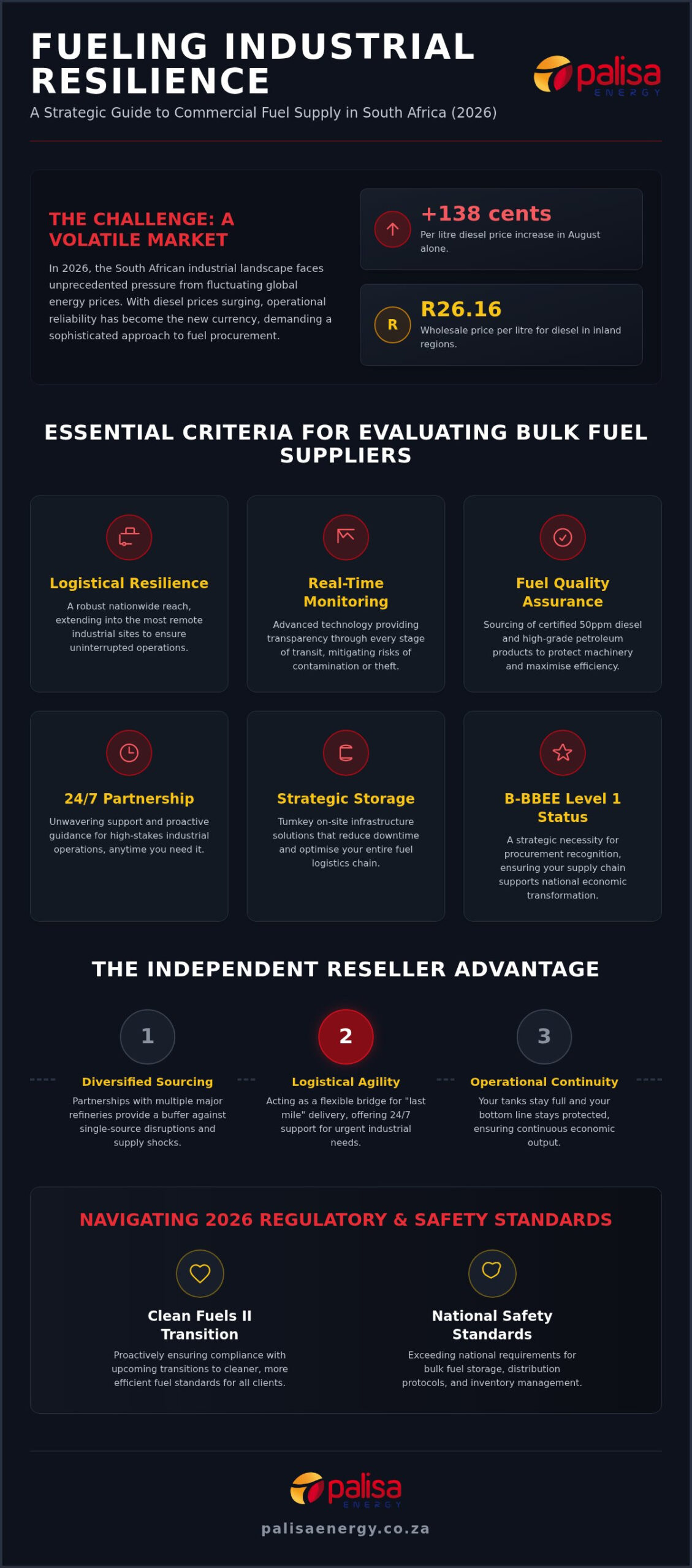
In the high-stakes industrial landscape of 2026, treating energy procurement as a mere line item is a risk that few South African enterprises can afford. Reliability is the new currency. With diesel prices surging by over 138 cents per litre in August alone, the margin for operational error has effectively vanished. Selecting the right commercial fuel suppliers South Africa offers is no longer just a procurement task; it’s a foundational pillar of national industrial resilience. You’ve likely felt the pressure of fluctuating Brent Crude prices and the weight of the Strategic Petroleum Stock Policy, which demands a more sophisticated approach to inventory than ever before.
We understand that your primary objective is to maintain momentum whilst navigating a complex regulatory environment that includes the upcoming Clean Fuels II transition. This guide provides an authoritative framework for evaluating bulk distributors based on their logistical precision, infrastructure capabilities, and commitment to 24/7 operational support. We will examine how a strategic partnership can transform your fuel supply from a source of volatility into a streamlined asset, ensuring your site remains compliant, your tanks stay full, and your bottom line stays protected against global supply chain shocks.
Key Takeaways
- Understand the shifting industrial energy market and the critical role independent resellers play in maintaining a flexible national supply chain.
- Learn the essential criteria for vetting commercial fuel suppliers South Africa, focusing on logistical reach, real-time monitoring, and fuel quality assurance.
- Discover how turnkey on-site infrastructure and strategic storage solutions significantly reduce downtime and optimise fuel logistics.
- Gain a comprehensive understanding of the 2026 regulatory requirements to ensure your bulk fuel storage and distribution protocols exceed national safety standards.
- Identify the strategic value of a 24/7 partnership model that provides unwavering support and proactive guidance for high-stakes industrial operations.
The Landscape of Commercial Fuel Suppliers in South Africa
The industrial energy sector in 2026 is defined by a fundamental shift in how power is procured and managed. As South Africa transitions more heavily into its status as a net importer of petroleum products, the demand for bulk diesel and petrol has evolved from a simple transaction into a complex logistical challenge. Industrial stakeholders now face a market where global supply shocks directly impact local operational viability. Reliable commercial fuel suppliers South Africa businesses partner with must offer more than just delivery; they must provide a buffer against the unpredictability of international energy corridors. This new reality has placed operational continuity at the very centre of procurement strategies. Businesses can’t afford to wait for the next shipment when production lines are at a standstill. A robust nationwide distribution network is the only safeguard against regional supply bottlenecks.
Understanding the Role of Independent Resellers
Independent resellers serve as a vital, flexible bridge between large-scale refineries and the specific, often urgent needs of industrial end-users. Whilst PetroSA, the national oil and gas company of South Africa, and other major oil companies maintain the primary infrastructure, independent resellers provide the agility required for 24/7 support. In sectors like mining and manufacturing, where a four-hour delay in diesel supply can result in millions of Rands in lost productivity, this responsiveness is non-negotiable. By maintaining strategic partnerships with multiple major producers, these resellers ensure a diversified supply chain that remains robust even when a single refinery faces maintenance or operational disruption. They act as a proactive guide, managing the complex logistics of the “last mile” so that industrial leaders can focus on their core operations.
Market Volatility and Fuel Security
Navigating the current climate requires a deep understanding of price mechanics and global trends. With diesel wholesale prices reaching R26.16 per litre in inland regions as of August 2026, the financial stakes have reached a historic peak. Industrial players are increasingly moving away from spot-market purchases in favour of structured, long-term supply agreements that mitigate the risk of sudden price spikes. These contracts provide a level of cost predictability that is essential for maintaining margins in a volatile economy. Fuel security in the South African industrial context is defined as the guaranteed, uninterrupted access to high-grade petroleum products at predictable price points to ensure continuous economic output. Achieving this requires a partner that integrates innovation with traditional reliability to protect your energy supply against external shocks.
Critical Criteria for Evaluating Bulk Fuel Distributors
Selecting a partner from the pool of commercial fuel suppliers South Africa offers requires a rigorous evaluation framework that prioritises operational integrity over mere cost. In 2026, a supplier’s B-BBEE status is no longer just a checkbox; it’s a strategic necessity for procurement recognition and corporate compliance. A Level 1 black-owned distributor provides the necessary credentials whilst ensuring that your supply chain supports national economic transformation. Beyond compliance, quality assurance remains paramount. Sourcing certified 50ppm diesel and high-grade petroleum products ensures that your machinery operates at peak efficiency, preventing the costly degradation often caused by sub-standard fuels. It’s about protecting your assets with the same precision you apply to your production outputs.
Logistical Resilience and Distribution Reach
Distribution is the arterial system of your operation. A supplier must demonstrate a robust nationwide reach that extends into the most remote industrial sites. This capability is underpinned by real-time monitoring technology, which provides transparency through every stage of the transit process. It ensures that deliveries are sealed, tracked, and arrive on schedule, mitigating the risks of fuel contamination or theft. For a deeper understanding of these complexities, industrial stakeholders should consult our strategic guide on fuel logistics in South Africa. This level of precision allows for a “just-in-time” inventory model, reducing the capital tied up in excessive on-site storage whilst guaranteeing that your production lines never falter.
Product Diversification: Beyond Diesel and Petrol
A holistic energy partner manages more than just your primary fuel source. The strategic integration of industrial paraffin, jet fuel, and heavy fuel oil (HFO) into a single procurement stream simplifies administrative overhead and strengthens your supply chain resilience. This is particularly relevant given the recent shifts in fuel import sources, which have necessitated a more diversified approach to energy security. Incorporating industrial-grade lubricants into your supply agreement ensures that mechanical components are protected by products designed for heavy-duty applications. All products must strictly adhere to the latest South African Bureau of Standards (SABS) requirements to maintain equipment warranties and operational safety. Consolidating your energy needs through reputable commercial fuel suppliers South Africa businesses trust creates a unified front against market volatility. If you’re looking to streamline your procurement, you can explore our comprehensive diesel supply solutions to see how a consolidated model benefits your bottom line.
Fuel Infrastructure Planning: A Strategic Necessity
Energy security in 2026 demands a shift from passive procurement to active asset management. Leading commercial fuel suppliers South Africa businesses partner with are no longer just delivery agents; they are architects of industrial resilience. Establishing a turnkey on-site storage solution provides a critical buffer against the logistical delays inherent in a volatile energy market. By moving from a delivery-on-demand model to a structured depot system, enterprises can exert total control over their fuel inventory. This transition significantly reduces the operational friction caused by external supply chain disruptions whilst providing the foundation for more aggressive cost management strategies. Infrastructure is the silent engine of growth.
Turnkey Depot Design and Construction
A modern industrial fuel depot must balance three core pillars: safety, capacity, and accessibility. Designing these facilities requires a deep understanding of hazardous substance regulations and the specific traffic flow requirements of heavy machinery. Professional construction management ensures that these depots are integrated into existing sites with minimal operational disruption. Investing in on-site fuel storage typically yields a rapid return on investment by allowing large-scale fleets to bypass retail premiums and eliminate the hidden costs of off-site refuelling detours. This infrastructure acts as a steadfast guardian of your operational tempo, ensuring that fuel is always available exactly where and when it is needed. It is a commitment to longevity and unwavering support.
Scaling Storage to Meet Industrial Demand
Scaling storage capacity is a nuanced process that begins with a comprehensive audit of existing infrastructure and a projection of future industrial requirements. For stakeholders in the mining and aviation sectors, these facilities must meet the most rigorous global standards for containment and filtration to ensure fuel integrity. Professional consulting is essential for addressing the complex web of fuel infrastructure compliance, ensuring that every expansion project is both legally sound and operationally efficient. For a detailed breakdown of construction management and compliance frameworks, consult our comprehensive guide on strategic fuel infrastructure planning. By proactively scaling storage today, industrial leaders can secure their competitive advantage in an increasingly energy-conscious market. Precision in planning translates directly to stability in execution.
Navigating Regulatory Compliance and Safety Standards
Compliance in the energy sector is the bedrock of industrial stability. For stakeholders, understanding the legal framework governing bulk fuel storage is not merely about avoiding penalties; it’s about protecting the integrity of the entire operation. The Petroleum Products Act and the Occupational Health and Safety Act provide the primary structure for these operations, demanding rigorous adherence to safety and environmental protocols. Leading commercial fuel suppliers South Africa businesses rely on must demonstrate an unwavering commitment to these standards. This involves a holistic approach to risk management that encompasses environmental protection, site safety, and the meticulous handling of hazardous materials at every stage of the supply chain.
Essential Fuel Compliance Auditing
A comprehensive fuel audit is a proactive measure that identifies vulnerabilities before they escalate into operational crises. These audits cover critical areas including leak detection, tank integrity, fire safety systems, and adherence to the latest South African Petroleum Industry Association (SAPIA) standards. For industrial sites, the frequency of these audits is determined by the volume of storage and the sensitivity of the surrounding environment. Maintaining a rigorous auditing schedule is a core component of achieving long-term fuel security for business. It provides the documented assurance that your infrastructure is safe, efficient, and fully compliant with national regulations, which is essential for maintaining insurance coverage and operating licences.
Operational Excellence and Safety Protocols
Safety-centric delivery protocols are the hallmark of an elite distributor. This begins with extensive training for all personnel involved in high-volume fuel logistics, ensuring they are equipped to handle complex offloading procedures without incident. We implement a “zero-harm” approach that prioritises the safety of your site and staff above all else. Real-time safety monitoring across the distribution network allows for immediate intervention should any anomaly occur during transit or delivery. Environmental responsibility is also a key factor, particularly as the industry prepares for the Clean Fuels II regulations set for implementation in July 2027. Managing the environmental footprint of bulk petroleum operations requires precise spill prevention measures and a commitment to sustainable distribution practices. If you require assistance in aligning your site with national standards, you can consult with our compliance experts to ensure your operations remain hazard-free and legally sound.
Palisa Energy: Your Strategic Partner for Industrial Growth
Palisa Energy functions as a proactive guide within the South African energy landscape, offering far more than basic diesel supply. We act as a steadfast guardian for our clients, managing the intricate complexities of procurement and logistics so that industrial leaders can focus on their core mandates. By integrating infrastructure planning with reliable distribution, we provide a single, cohesive strategy that eliminates the friction often found when dealing with multiple vendors. Enterprise clients choose us because we understand that in the energy sector, stability is the foundation of growth. It’s about building a partnership that values integrity, safety, and the relentless pursuit of progress above all else.
A Bespoke Approach to Fuel Logistics
Our model is built on the inherent flexibility that only an independent reseller can provide. We tailor delivery schedules and volumes to match specific industrial cycles, ensuring that your tanks are replenished exactly when demand peaks. This agility allows us to offer competitive industrial rates whilst maintaining the high standards expected from elite commercial fuel suppliers South Africa businesses require. Our nationwide network serves as a guarantee of product reliability, ensuring that even the most remote operations receive the same level of precision and support as those in major industrial hubs. We manage the “last mile” with absolute precision, providing you with the peace of mind that your energy supply is in total control.
Securing the Future of South African Industry
Operational excellence is not a static goal but a continuous pursuit that defines our role in the wider economic landscape. We are committed to providing 24/7 support, a model that ensures uninterrupted industrial operations regardless of the hour or the challenge. This unwavering support is what distinguishes a mere vendor from a dedicated strategic partner. As the industry moves towards the Clean Fuels II standards of 2027, we provide the visionary leadership needed to navigate these transitions with confidence. We take pride in our role as a visionary enabler, managing complex logistics so the client doesn’t have to. We invite stakeholders to partner with us for long-term resilience and sustainable growth. You can enquire about our bulk fuel and infrastructure solutions today to secure your operational future and drive your enterprise forward.
Driving Industrial Resilience into 2026 and Beyond
Success in the South African industrial sector now depends on a transition from reactive procurement to a model of strategic energy management. By prioritising robust on-site infrastructure and maintaining absolute regulatory compliance, enterprises can insulate themselves from the volatility of global petroleum markets. A partnership with established commercial fuel suppliers South Africa trusts provides the necessary stability to scale operations with confidence. It’s about more than just delivery; it’s about securing a foundation for long-term economic momentum.
Palisa Energy stands ready to act as your steadfast guardian in this high-stakes landscape. With our nationwide distribution network and 24/7 industrial support, we ensure your production lines never falter. Our turnkey infrastructure consulting further empowers your business to manage energy assets with total precision. We invite you to Partner with Palisa Energy for Reliable Bulk Fuel Supply and take control of your industrial future. Together, we can navigate the complexities of the energy sector to ensure your enterprise remains a leader in national growth.
Frequently Asked Questions
How do I choose the right commercial fuel supplier for my business in South Africa?
Selecting the ideal partner requires a rigorous evaluation of their logistical resilience, B-BBEE status, and infrastructure support capabilities. It is essential to prioritise a distributor that offers 24/7 industrial support rather than a mere delivery service. You should verify their strategic partnerships with major oil companies to ensure a diversified and reliable national supply, which protects your operations against refinery shutdowns or localised supply chain bottlenecks.
What are the benefits of using an independent fuel reseller over a major oil company?
Independent resellers provide the agility and personalised service that large corporate entities often lack. By acting as a flexible bridge between refineries and end-users, they can tailor delivery schedules to match specific industrial cycles whilst maintaining competitive rates through volume procurement. This model allows for a more responsive, proactive partnership where the reseller functions as a steadfast guardian of your energy security rather than a passive vendor.
Can a commercial fuel supplier help with on-site storage and infrastructure planning?
Elite suppliers provide turnkey infrastructure solutions that encompass the design, construction, and compliance auditing of on-site fuel depots. Integrating these services into your supply agreement ensures that your storage capacity scales alongside your industrial growth. Professional consulting in this area is vital for navigating complex hazardous substance regulations and ensuring that your facility meets the most rigorous national safety and environmental standards.
What safety certifications should a bulk fuel distributor hold?
A reputable distributor must strictly adhere to the standards established by the South African Bureau of Standards (SABS) and the South African Petroleum Industry Association (SAPIA). These certifications provide documented assurance that all petroleum products are handled and transported according to precise hazardous material protocols. Furthermore, compliance with the Occupational Health and Safety Act is non-negotiable for protecting your personnel and maintaining your operational licence.
How does real-time monitoring improve the reliability of fuel deliveries?
Real-time monitoring technology provides total transparency by tracking shipments from the point of origin to the final offloading site. For commercial fuel suppliers South Africa businesses rely on, this data-driven approach ensures that deliveries remain sealed and arrive exactly on schedule. It effectively prevents fuel contamination and unauthorised tampering, providing the precision required for high-stakes inventory management and significantly reducing the risk of costly operational downtime.
Does Palisa Energy provide nationwide distribution for all petroleum products?
Yes, we leverage a robust nationwide distribution network to supply bulk diesel, petrol, paraffin, jet fuel, and lubricants to industrial clients across the country. Our national reach ensures that even the most remote mining or manufacturing sites receive the same level of unwavering support and product reliability. By maintaining strategic partnerships with major oil companies, we guarantee a consistent supply chain that supports industrial growth on a national scale.
What is the role of B-BBEE compliance in fuel procurement?
B-BBEE compliance is a strategic necessity for procurement recognition and national economic transformation. Partnering with a Level 1 black-owned supplier allows your enterprise to maximise its procurement points whilst supporting the integration of the local economy. In the 2026 industrial landscape, this status serves as a key indicator of a supplier’s commitment to corporate responsibility and their role as a visionary enabler within the South African energy sector.
How can industrial-grade lubricants be integrated into a fuel supply contract?
Consolidating your lubricants and bulk fuel requirements into a single, holistic contract simplifies administrative overhead and ensures mechanical protection. Industrial-grade lubricants are essential for maximising the lifespan of heavy machinery and reducing maintenance-related downtime. By sourcing these products alongside your primary fuel supply, you create a unified energy strategy that addresses both your power needs and the long-term health of your mechanical assets under one authoritative partnership.