

A fuel supply agreement in the current South African climate isn’t just a purchase order; it’s a strategic shield against systemic industrial risk. You’ve likely felt the strain as inland diesel prices reached R26.39 per litre whilst domestic refinery conversions increased our reliance on complex international imports. Successfully managing fuel supply chain South Africa requirements now demands a sophisticated grasp of the 2026 regulatory environment, including the 14-day stock mandates now enforced for refined products.
We recognise that supply chain fragility and the threat of equipment downtime create unnecessary pressure on your operational budget. This guide shows you how to insulate your industrial operations from market volatility by structuring a robust, professionally managed fuel supply chain. We’ll preview the shift towards index-linked pricing, the impact of the South African National Petroleum Company, and the logistical precision required to guarantee fuel availability regardless of national unrest. By aligning with a partner who understands the nuances of the Upstream Petroleum Resources Development Act, you can transform your energy procurement into a pillar of stability.
Key Takeaways
- Learn why a long-term fuel supply agreement is the definitive solution for volume priority and price stability in a volatile 2026 market.
- Discover the essential frameworks for managing fuel supply chain South Africa operations, including the use of volume tolerance bands to handle seasonal demand fluctuations.
- Identify the critical contractual clauses that protect your enterprise, ranging from precise legal entity definitions to comprehensive nationwide delivery site specifications.
- Understand the hidden financial and operational risks of spot-market procurement, including the high costs of emergency delivery fees and quality inconsistencies.
- Explore how a South African-owned partner integrates turnkey infrastructure support with real-time monitoring to ensure total supply security for your growth.
Understanding the Strategic Value of a Long-Term Fuel Supply Agreement in South Africa
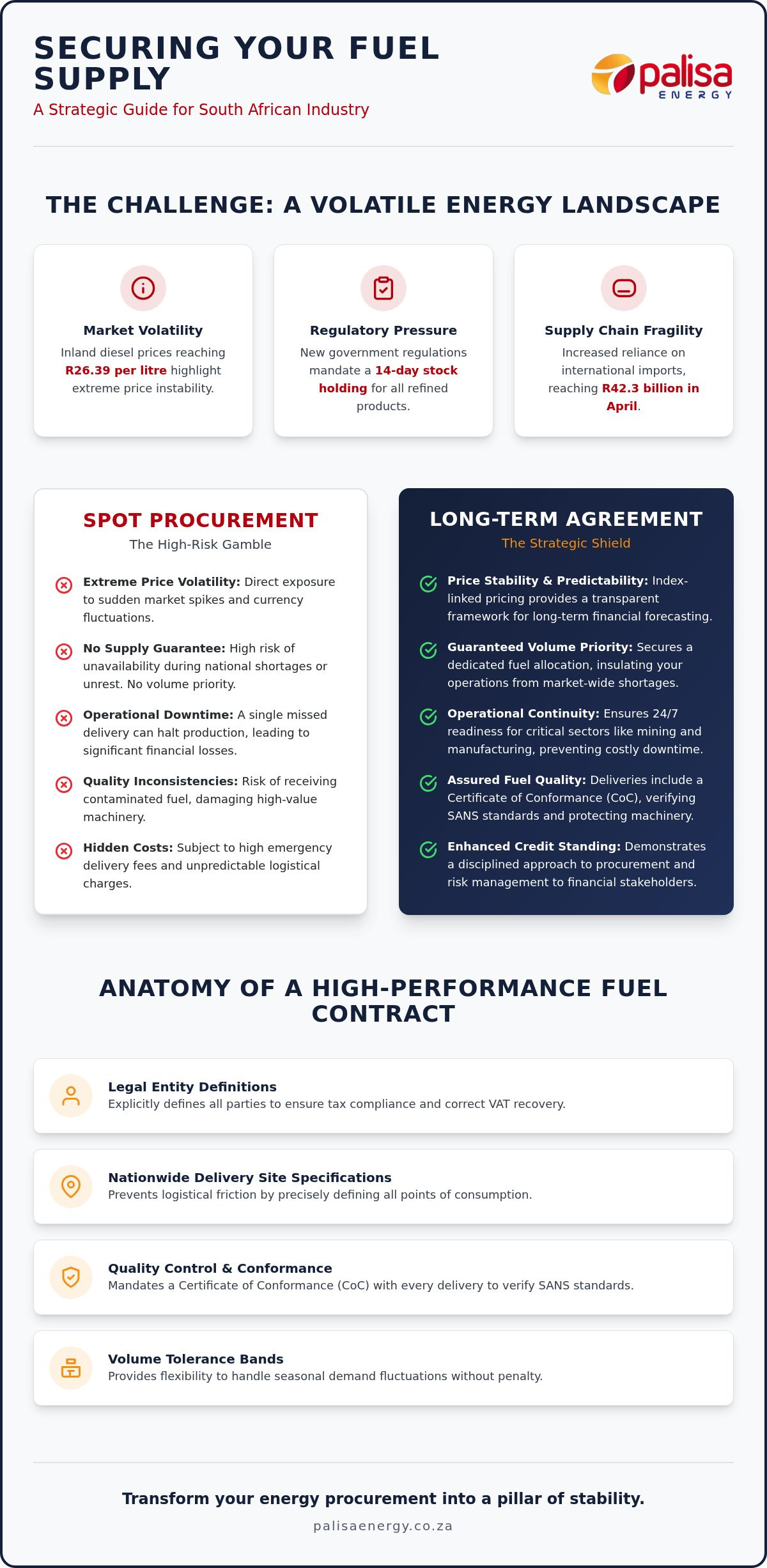
In the current economic climate, a long-term fuel supply agreement is no longer a luxury for South African industry; it’s a fundamental requirement for operational continuity. This strategic commitment ensures volume priority during periods of scarcity and provides a predictable framework for price stability. Effectively managing fuel supply chain South Africa requirements means recognising that the volatility of the 2020s has rendered the spot market a liability rather than an opportunity. By formalising a partnership, enterprises secure a dedicated allocation of Diesel Supply that remains insulated from the sudden spikes in demand that often follow national supply shocks.
These agreements serve as a vital buffer against systemic bottlenecks. When managing fuel supply chain South Africa operations, the ability to bypass the chaos of the spot market is essential for maintaining production schedules. Given that South Africa’s fuel imports reached R42.3 billion in April 2026, the reliance on international refined products has never been higher. A structured contract allows for precision in long-term financial forecasting. It enables executive teams to plan capital expenditure with confidence, knowing that their energy inputs are secured through a transparent, index-linked pricing mechanism that accounts for the 61.38 cents per litre slate levy.
The Shift from Transactional to Strategic Procurement
Local enterprises are rapidly abandoning the “lowest-cost” spot hunting approach in favour of guaranteed supply security. This transition is driven by the reality of South Africa’s logistics infrastructure, where access to primary storage and pipeline networks is tightly controlled. Independent resellers with established infrastructure leases provide a level of reliability that the spot market cannot replicate. A formalised agreement also enhances your operational credit standing amongst energy partners. It demonstrates a disciplined approach to procurement and risk management, which is viewed favourably by financial stakeholders and auditors alike.
Core Objectives of a Robust Fuel Partnership
The primary goal of any industrial energy partnership is ensuring 24/7 readiness for high-stakes sectors such as mining and heavy manufacturing. These industries don’t have the luxury of downtime. A robust partnership mitigates the risks of global oil price shocks and local currency fluctuations, protecting your margins whilst maintaining a steady flow of resources. It creates a framework for mutual growth. The supplier acts as a steadfast guardian of your energy needs, allowing you to focus on your core business objectives without the constant threat of fuel-related interruptions. This stability is the foundation upon which long-term industrial expansion is built.
The Anatomy of a High-Performance Fuel Contract: Essential Clauses for 2026
A contract isn’t a mere formality. It’s a blueprint for industrial survival. In the high-stakes world of energy procurement, transitioning from a generic template to a strategic agreement is the most effective method for managing fuel supply chain South Africa risks. These documents must explicitly define every legal entity involved to ensure tax compliance and accurate VAT recovery on all R-denominated transactions. Precise nationwide delivery site specifications are also required to prevent logistical friction. This clarity ensures that your Diesel Supply reaches the correct point of consumption without administrative delay, maintaining the momentum of your operations.
Quality control remains a non-negotiable pillar of industrial procurement. Every delivery should be accompanied by a Certificate of Conformance (CoC) that verifies adherence to the latest SANS fuel quality standards. This documentation protects your high-value machinery from the catastrophic costs of fuel contamination. Simultaneously, payment terms must be structured to balance enterprise cash flow with the necessity of maintaining supplier trust. Transparent credit arrangements ensure that supply remains uninterrupted even during fiscal fluctuations, providing the stability your business demands.
Pricing Mechanisms and Market Index Referencing
Reliable contracts avoid arbitrary pricing by utilising formulas tied to recognised market indices such as Platts or local regulated benchmarks. Defining a fixed margin that remains stable throughout the contract term provides the predictability necessary for budgetary precision. Effective oversight in managing fuel supply chain South Africa mandates also requires the implementation of fallback pricing mechanisms. These protect the supply chain during rare index outages or extreme market disruptions, ensuring your costs remain grounded in reality even when global markets are in flux.
Force Majeure and Liability Frameworks in the National Context
The South African logistical landscape presents unique challenges that require bespoke legal protection. Force majeure clauses must be tailored to define genuinely unforeseeable events, ranging from systemic infrastructure failures to civil unrest. Official government statements on fuel security often highlight the resilience of our national networks, yet a robust contract must account for supply prioritisation during periods of national scarcity. Setting liability caps that reflect the scale of your industrial operations ensures that risk is shared equitably. When refining these complex legal frameworks, partnering with a specialist in bulk petroleum distribution provides the expertise needed to secure your growth.
Strategic Resilience: Spot Procurement versus Contractual Supply Security
The allure of the spot market often rests on the promise of immediate cost savings. However, this “race to the bottom” pricing frequently conceals systemic vulnerabilities that can cripple an industrial enterprise. When managing fuel supply chain South Africa requirements, relying on uncontracted supply exposes your operations to predatory emergency delivery fees and the significant risk of off-specification fuel. These hidden costs quickly erode any perceived savings from spot hunting. A strategic agreement provides the stability needed to navigate a landscape where domestic production often falls short of demand.
Independent resellers like Palisa Energy serve as the vital link between massive refinery outputs and the granular requirements of the end-user. As a “steadfast guardian” of your supply chain, we manage the logistical burden that major oil companies are often too large to handle with agility. This role is underscored by South Africa’s energy sector overview, which highlights the country’s complex mix of synthetic and refined fuel sources. By securing a partnership, you gain an ally who understands these national nuances and ensures your Diesel Supply is always available.
Risk Mitigation and Cost Control Strategies
Quantifying the value of guaranteed lead times is essential during peak industrial demand cycles. A delay of just a few hours can halt a production line, costing thousands in lost revenue. Long-term agreements facilitate superior fuel cost management South Africa by locking in margins and eliminating the volatility of daily price fluctuations. Precision in managing fuel supply chain South Africa logistics involves three key pillars:
- Real-time monitoring: Advanced tracking systems reduce “shrinkage” and administrative errors across the supply chain.
- Volume security: Contracts ensure you are first in line when national stock levels dip during periods of transit unrest.
- Quality assurance: Every drop is vetted to prevent equipment damage, avoiding the R-denominated losses associated with downtime.
Operational Continuity in High-Stakes Industries
Mining and fleet operations operate on razor-thin margins and strict schedules. They cannot afford the unpredictability of uncontracted supply. Dedicated account management and 24/7 support structures provide the operational peace of mind required to manage nationwide operations effectively. Building resilience through long-term fuel supply contracts in South Africa ensures that your growth is never throttled by energy scarcity. This proactive approach transforms a simple commodity purchase into a strategic asset for enterprise longevity, allowing you to focus on your core mission whilst we handle the complexities of energy distribution.
Implementation Framework: Planning Volume, Quality, and Logistical Execution
Executing a nationwide fuel strategy requires moving beyond simple procurement. It involves a meticulous alignment of supply with physical capacity. When managing fuel supply chain South Africa operations, the first step is integrating your Diesel Supply with strategic fuel infrastructure planning. This synergy ensures that storage tanks are compliant and sized correctly for the logistical rhythm of your industry. Seamless coordination across diverse industrial sites prevents the bottlenecks that often plague unmanaged supply chains, especially as the 2026 Strategic Petroleum Stock Policy mandates stricter refined product reserves for wholesalers.
Successful execution relies on a “vision followed by execution” approach. We orchestrate the complex logistics of nationwide distribution so that your site managers can focus on production. This requires a partner who understands the nuances of the national heartland and industrial hubs generally. To begin orchestrating your nationwide energy strategy, consult with our turnkey infrastructure specialists to ensure your sites are ready for high-volume security.
Determining Volume Commitments and Tolerances
Calculating average consumption is a foundational task. However, static numbers fail in dynamic markets. You must calculate current needs whilst forecasting future industrial growth to avoid supply shortfalls. Volume tolerance bands are essential here. They accommodate seasonal fluctuations without triggering penalties. “Take-or-pay” clauses should be balanced; they provide the supplier with security whilst offering you the flexibility to scale. Negotiating regular review periods is a proactive strategy for expanding manufacturing operations. This flexibility ensures your contract remains an asset rather than a constraint as your enterprise scales.
Quality Assurance and SANS Compliance Procedures
Machinery longevity depends on fuel integrity. Identifying the correct SANS (South African National Standards) for your specific equipment is mandatory. High-precision industrial engines require diesel that strictly adheres to national quality benchmarks to prevent catastrophic injector failure. Establishing a binding sampling procedure is a vital protective measure. It allows for the immediate resolution of quality disputes through independent laboratory analysis before the fuel enters your primary storage. This methodical process maintains high-grade standards and avoids the R-denominated losses associated with equipment downtime and repairs.
Palisa Energy: Securing Your Enterprise Growth Through Bespoke Fuel Partnerships
Palisa Energy operates as a cornerstone of industrial stability within the national energy sector. As a South African-owned independent reseller, we possess the gravitas of a market leader combined with the agility of a dedicated strategic partner. We bridge the gap between the vast production capacities of major oil companies and the specific, high-register requirements of your enterprise. In the complex task of managing fuel supply chain South Africa operations, we serve as the steadfast guardian of your growth. Our wholesale procurement power ensures volume reliability, whilst our logistical precision guarantees that your Diesel Supply is delivered with unwavering support and industrial confidence.
We recognise that true energy security requires more than just a transaction; it demands a visionary enabler who understands the regulatory nuances of the local market. Our role is to manage the intricate details of energy procurement so your business can maintain its forward momentum. By aligning with an authoritative expert, you insulate your operations from the unpredictability of the global market. We take pride in our operational standards, ensuring that every litre delivered contributes to the long-term, sustainable success of your industrial goals.
Nationwide Logistics and Real-Time Monitoring
Operational excellence is not a passive state. It’s a proactive pursuit that requires constant vigilance. Our distribution network is engineered to provide reliable fuel supply across South Africa, reaching the national heartland and industrial hubs with consistent precision. We utilise sophisticated technology for 24/7 real-time monitoring of nationwide deliveries, creating a transparent flow of information from the depot to your site. This level of oversight ensures safety and safety compliance at every point of the journey. By managing the entire logistical burden, we allow your executive team to focus on the broader impact of your services and enterprise scaling.
Comprehensive Infrastructure and Consulting Services
Our commitment to excellence extends beyond the fuel tank. We provide turnkey infrastructure support that includes everything from initial depot design to rigorous compliance auditing. Managing fuel supply chain South Africa logistics effectively requires on-site storage that is both efficient and safe. We help you design infrastructure that maximises operational capacity whilst preparing your business for future energy shifts. This holistic approach integrates innovation with traditional reliability, empowering South African businesses to scale with confidence. Our consulting services ensure that your transition to sustainable energy solutions is managed without compromising your core fuel operations.
Stability is the foundation of progress. We invite stakeholders and executive leaders to engage in a comprehensive consultation to structure a bespoke long-term supply strategy. Let us manage the complexities of energy procurement so you can lead your industry with total control and strategic certainty.
Fortifying Industrial Resilience for the Decades Ahead
Transitioning from reactive spot-market procurement to a structured, long-term Diesel Supply agreement is the definitive step toward operational immunity. By prioritising volume security and integrating infrastructure planning, enterprises can neutralise the risks of price volatility and national logistical bottlenecks. Successfully managing fuel supply chain South Africa requirements in 2026 demands more than just a supplier; it requires a strategic partner who understands the nuances of the national heartland and the complexities of refined product mandates.
As a 100% South African-owned independent reseller, Palisa Energy serves as the steadfast guardian of your growth. We combine nationwide distribution and real-time logistical monitoring with turnkey infrastructure planning and compliance support to ensure your operations never falter. Secure your industrial fuel supply with a strategic partnership from Palisa Energy and transform your energy procurement into a pillar of stability. We are committed to empowering your enterprise to scale with absolute confidence and unwavering support.
Frequently Asked Questions
What is a long-term fuel supply agreement in South Africa?
It’s a strategic commitment between an industrial consumer and a reseller for bulk Diesel Supply over a fixed period. This agreement prioritises your volume needs during national shortages and provides a stable framework for pricing. It moves beyond transactional purchasing to ensure that your operations have a guaranteed energy source, which is essential for managing fuel supply chain South Africa risks effectively in a volatile market.
How are fuel prices typically indexed in an industrial supply contract?
Pricing is usually tied to transparent market benchmarks like Platts or the Basic Fuel Price (BFP) formula. These contracts establish a fixed margin above the index, ensuring that you pay a fair market rate without the arbitrary mark-ups found in the spot market. This indexing allows for precise financial forecasting whilst accounting for local regulatory factors like the slate levy, which was 61.38 cents per litre in August 2026.
What are the benefits of choosing an independent reseller over a direct refinery contract?
Independent resellers offer superior agility and personalised logistical coordination that large refineries often lack. Whilst refineries focus on high-volume production, a dedicated partner like Palisa Energy manages the “last mile” delivery and provides 24/7 support. This approach ensures that nationwide distribution is handled with precision, offering turnkey infrastructure advice and real-time monitoring that helps in managing fuel supply chain South Africa operations more effectively than a standard refinery contract.
Can a fuel supply agreement include infrastructure and storage solutions?
Yes, comprehensive agreements often integrate turnkey infrastructure planning as a standard value-add. This includes the design, installation, and compliance auditing of on-site storage tanks to ensure they meet SANS standards. By bundling infrastructure with supply, you ensure that your physical capacity aligns perfectly with your logistical requirements. This holistic approach reduces the risk of equipment downtime and ensures your site is ready for high-volume diesel deliveries with total safety.
What happens if our fuel volume requirements change during the contract term?
High-performance contracts utilise volume tolerance bands to accommodate seasonal business fluctuations or industrial growth. These clauses allow for a specific percentage of variance from the baseline commitment without triggering penalties. We also implement regular review periods to adjust your allocation as your manufacturing or mining operations expand. This flexibility ensures your energy strategy remains an asset that supports your growth rather than a rigid constraint on your production capacity.
How does Palisa Energy ensure the quality of fuel delivered to remote sites?
We enforce a binding sampling procedure for every delivery to ensure strict adherence to SANS fuel quality standards. Every shipment is accompanied by a Certificate of Conformance (CoC), and we utilise independent laboratory analysis to verify integrity before the fuel enters your storage tanks. This methodical process protects your high-value machinery from contamination and ensures that even the most remote industrial hubs receive premium-grade Diesel Supply without compromise or delay.
What is a force majeure clause in the context of South African fuel logistics?
A force majeure clause defines genuinely unforeseeable events, such as systemic infrastructure failure or national unrest, that prevent a party from fulfilling contractual obligations. In the South African context, these clauses are tailored to address specific logistical challenges like pipeline disruptions or port delays. It establishes a clear framework for liability and supply prioritisation during national emergencies, ensuring that risk is shared equitably between the industrial enterprise and the reseller.
Why is a long-term contract better than buying fuel on the spot market?
A long-term contract provides volume priority and price stability that the spot market cannot match. Spot hunting often leads to “race to the bottom” pricing that ignores hidden costs like emergency delivery fees and quality risks. By formalising a partnership, you insulate your operational budget from sudden price hikes and ensure you are first in line for supply during scarcity. This stability is the foundation of robust enterprise growth and long-term financial predictability.