


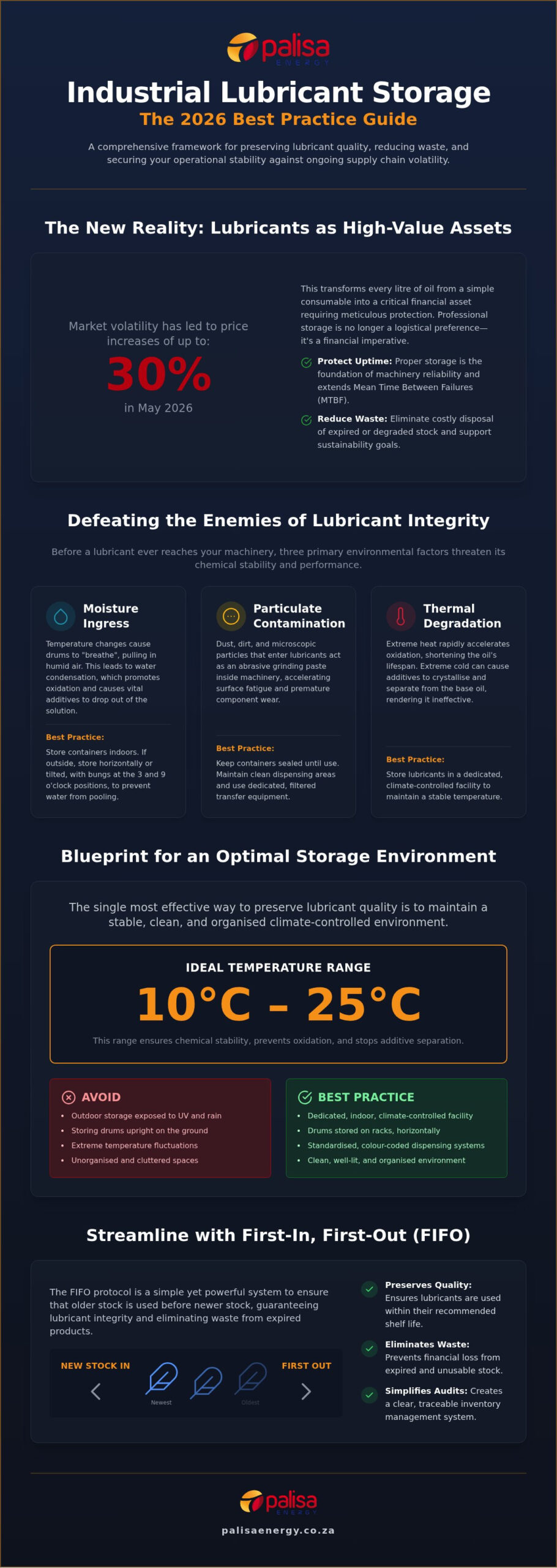
In May 2026, major manufacturers announced lubricant price increases of up to 30 per cent, transforming every litre of oil in your facility from a simple consumable into a high-value asset that requires meticulous protection. Adopting the best practices for industrial lubricant storage is now a financial imperative rather than a mere logistical preference. You likely recognise that your machinery is only as resilient as the fluid that powers it; consequently, maintaining the chemical integrity of your stock is the foundation of operational stability.
This 2026 operational guide provides a comprehensive framework for preserving lubricant quality, from precise climate control to sophisticated inventory tracking. We promise to equip you with the protocols needed to achieve zero contamination incidents whilst maintaining total environmental compliance. We’ll explore how to transition from passive storage to a strategic infrastructure model that reduces waste, extends equipment lifespan, and secures your bottom line against ongoing global supply chain volatility.
Key Takeaways
- Recognise lubricants as high-value liquid assets to safeguard your facility against the significant market volatility and price escalations seen throughout 2026.
- Adopt the best practices for industrial lubricant storage to mitigate the risks of moisture ingress and thermal degradation that frequently lead to costly machinery failures.
- Streamline inventory management through the First-In, First-Out (FIFO) protocol, ensuring lubricant integrity is maintained and waste from expired stock is eliminated.
- Minimise the risk of cross-contamination by establishing dedicated storage environments and implementing standardised, colour-coded dispensing systems across your facility.
- Optimise your operational resilience through professional infrastructure planning and robust logistical support to ensure consistent supply chain integrity and environmental compliance.
The Economic Impact of Strategic Lubricant Storage Standards
Industrial lubricants are far more than simple consumables. They are high-value liquid assets that dictate the health of your machinery and the resilience of your production schedule. In an era where industrial lubricants have seen significant price volatility, treating them as mere warehouse stock is a costly oversight. Every drop represents a strategic investment in operational uptime. When you professionalise your handling, you’re not just storing oil; you’re protecting the heartbeat of your facility.
There is a direct, measurable correlation between storage integrity and machinery Mean Time Between Failures (MTBF). Contaminated or degraded oil is often the silent catalyst behind premature component wear. By implementing the best practices for industrial lubricant storage, you create a defensive barrier that prevents external pollutants from compromising your mechanical systems before they even begin to circulate.
Lubricants as Mechanical Components
Think of oil as a precision-engineered part. Inserting contaminated lubricant into a system is as detrimental as installing a damaged bearing; the microscopic particulates act as grinding paste, accelerating surface fatigue. Poor storage environments often lead to additive depletion, where the vital chemical packages designed to prevent oxidation and foaming lose their potency before they even reach the machine. Lubricant integrity serves as the absolute foundation of machinery reliability. Adopting the best practices for industrial lubricant storage ensures that the fluid’s chemical profile remains exactly as the manufacturer intended, preserving its ability to protect high-tolerance surfaces under extreme pressure.
Quantifying the Cost of Neglect
The financial repercussions of storage failure extend far beyond the price of the oil itself. Consider the hidden costs of contamination: unplanned downtime, emergency labour, and the expedited shipping of replacement parts. A single major engine or gearbox failure can easily dwarf the cost of modernising your storage infrastructure. It’s a matter of proactive risk management versus reactive crisis spending.
Professionalised storage also supports your Environmental, Social, and Governance (ESG) objectives by significantly reducing waste. Proper shelf-life management prevents the disposal of degraded stock, whilst high-quality, clean lubricants reduce internal friction. This improved efficiency leads to lower energy consumption and reduced fuel usage across your fleet. When you eliminate the waste associated with expired or contaminated drums, you aren’t just saving money; you’re demonstrating a commitment to sustainable industrial excellence.
Environmental Control and Contamination Prevention
Environmental factors represent the primary threat to lubricant integrity before the fluid ever reaches a machine. Moisture, particulates, and extreme temperatures are the three main enemies of oil health, each capable of triggering irreversible chemical degradation. In the South African industrial landscape, where diurnal temperature shifts can be significant, sealed drums often undergo a process known as “breathing”. As the air inside a container expands and contracts due to thermal changes, it creates a vacuum that pulls in humid ambient air through the bungs. This moisture eventually condenses into free water, which promotes oxidation and causes vital additives to precipitate out of the solution.
Adhering to OSHA regulations for flammable liquid storage provides a baseline for safety, yet operational excellence demands a more rigorous approach. Establishing specific ISO cleanliness targets for your stored stock ensures that lubricants meet or exceed original equipment manufacturer (OEM) specifications. Maintaining a climate-controlled environment is the most effective way to stabilise these variables and preserve the “as-manufactured” quality of your liquid assets.
Managing Temperature and Thermal Cycling
Extreme heat accelerates the rate of oxidation, whilst excessive cold can cause certain additives to crystallise and drop out of the base oil. Ideally, lubricants should be housed in a dedicated facility maintained between 10°C and 25°C to ensure chemical stability. Outdoor storage should be avoided whenever possible. UV radiation degrades plastic containers, and water pooling on top of drum heads is frequently drawn inside during the breathing cycle. One of the best practices for industrial lubricant storage involves storing drums horizontally on racks. This orientation keeps the bungs submerged in oil, which effectively prevents the intake of air and moisture through the seals.
Moisture and Particulate Filtration
Preventing contamination requires proactive mechanical barriers. Bulk storage tanks should be equipped with high-quality desiccant breathers to neutralise moisture in the headspace before it can contaminate the oil. It’s equally critical to use high-efficiency filtration systems during any fluid transfer, ensuring that no particulates are introduced when moving oil from delivery vehicles to primary storage. Adopting a “clean room” methodology for dispensing and sampling further protects the fluid. For facilities aiming to achieve these standards, infrastructure planning and logistics support can provide the necessary technical framework to secure your supply chain. Implementing these best practices for industrial lubricant storage ensures that your machinery receives only the highest quality, contaminant-free fluids.
Inventory Management: Implementing the FIFO Protocol
Effective inventory management is the logistical counterpart to environmental control. Whilst climate stability preserves the fluid’s chemistry, rigorous stock rotation ensures that no product degrades through simple obsolescence. Implementing a First-In, First-Out (FIFO) protocol is one of the most critical best practices for industrial lubricant storage, particularly as synthetic base oil shortages continue to disrupt global supply chains. By treating your inventory as a dynamic flow rather than a static reserve, you prevent the accumulation of aged stock that may no longer meet original equipment manufacturer (OEM) performance standards.
Establishing a precise “safety stock” level is equally vital. In the current economic climate, characterised by significant price hikes and geopolitical instability, relying on just-in-time delivery is a high-risk strategy. A robust safety stock buffer protects your operations from sudden shipping delays whilst ensuring that you aren’t forced into emergency purchases of inferior alternatives. Digital monitoring systems now allow for real-time tracking of both consumption rates and shelf-life status, providing the data necessary to optimise reorder points with surgical precision. To maintain container integrity, conduct annual usability tests on all stored vessels to confirm that seals haven’t perished and that no internal corrosion has compromised the product.
Implementing a FIFO System Step-by-Step
Transitioning to a FIFO model requires a structured physical and cultural shift within the warehouse. First, organise your storage racks so the oldest containers are always the most accessible; gravity-fed racks are particularly effective for pails and drums. Every delivery must be clearly marked with its arrival date using high-visibility labelling that survives industrial environments. Finally, train all personnel to pull stock based strictly on these date codes rather than simply grabbing the nearest container. This discipline ensures that your liquid assets are utilised in the exact order they were procured, maintaining a consistent quality baseline across all machinery.
Understanding Recommended Storage Life
Shelf life varies significantly amongst different lubricant categories. Whilst many mineral oils remain stable for approximately two years under ideal conditions, complex synthetic lubricants may have different windows depending on their specific additive packages. Factors such as high humidity and opened seals rapidly accelerate the oxidation process, shortening the usable life of the product. If stock has exceeded its recommended window, don’t automatically discard it. Instead, perform a comprehensive laboratory analysis to verify its viscosity and additive levels before application. This proactive testing prevents the accidental use of degraded oil whilst minimising unnecessary waste and protecting your equipment from avoidable wear.
Infrastructure Requirements: Handling and Dispensing Systems
The transition from bulk delivery to on-site application represents a critical phase where fluid integrity is frequently compromised. A robust infrastructure strategy begins with the design of a dedicated, restricted-access lubricant storage centre. This facility must serve as a controlled environment, separate from general warehouse traffic, to minimise the risk of cross-contamination and airborne particulate ingress. By centralising your liquid assets, you establish a singular point of accountability for all handling protocols.
Environmental safety and regulatory compliance must be built into the foundation of your storage room. Effective secondary containment systems are non-negotiable; they must be constructed from industrial-grade, chemical-resistant materials like HDPE and capable of holding 110 per cent of the largest container’s capacity to meet EPA standards. Implementing these best practices for industrial lubricant storage ensures that your facility remains a safe, orderly, and compliant environment that protects both your personnel and the surrounding ecosystem.
The Essential Labelling Framework
Precision in identification is the most effective safeguard against human error. Your facility should adopt a universal colour-and-shape coding system that remains consistent from the primary storage tank down to the individual machine port. Every label must clearly display the product name, viscosity grade, and relevant hazard information to ensure there is no ambiguity during the dispensing process. Industry experts suggest that a rigorous labelling framework can eliminate the estimated 15 per cent of mechanical failures that are directly attributed to lubricant cross-contamination. This visual language creates a fail-safe environment where even new personnel can maintain high operational standards with minimal risk of error.
Safe Handling and Dispensing Equipment
Contamination prevention continues through the selection of dedicated transfer hardware. Each lubricant type requires its own set of pumps, hoses, and filter carts to prevent the mixing of incompatible chemistries. For bulk transfers, pneumatic pumps offer superior control and cleanliness compared to manual pouring, which often exposes the fluid to ambient dust. When performing equipment top-ups, always use sealed, reusable containers equipped with high-quality breathers to maintain a closed-loop system. Maintaining a strict maintenance schedule for the storage infrastructure itself ensures that your pumps and filtration units remain in peak condition. For facilities looking to modernise their approach, Palisa Energy provides turnkey support for lubricant infrastructure planning, ensuring your handling systems are engineered for maximum reliability and efficiency.
Partnering with Palisa Energy for Integrated Solutions
Palisa Energy acts as an authoritative expert and a visionary enabler within the South African industrial landscape. We don’t just supply products; we orchestrate the logistical and infrastructural frameworks that allow your facility to thrive. By integrating bulk lubricant supply with professional infrastructure planning, we ensure that every litre of oil is managed with the precision required to sustain high-stakes operations. This holistic approach empowers your organisation to implement the best practices for industrial lubricant storage without the administrative burden of managing complex logistics in-house.
Transitioning from reactive procurement to a strategic energy partnership is essential for long-term resilience. We take pride in our role as a steadfast guardian of your supply chain, managing the complexities of infrastructure and logistics so you can focus on your core industrial objectives. Our commitment to excellence ensures that your storage standards remain a pillar of your operational success.
Nationwide Distribution and Supply Security
Reliability is the cornerstone of our service model. We leverage strategic partnerships with leading oil companies to ensure a consistent, high-quality supply of industrial-grade lubricants across South Africa. Our nationwide distribution network is engineered to remain stable despite the supply chain volatility that has characterised 2026. Through real-time monitoring and proactive logistics, we help you maintain optimal safety stock levels, effectively preventing the operational downtime associated with stockouts. This unwavering support allows you to access competitive industrial rates whilst securing the long-term integrity of your machinery.
Consulting on Infrastructure and Compliance
Scaling your operation requires more than just increased volume; it demands a sophisticated evolution of your storage capacity. We provide professional auditing of your current facilities to identify gaps in safety, efficiency, and environmental compliance. Our team offers turnkey construction management for new fuel and lubricant depots, ensuring that your infrastructure is engineered to the highest industrial standards from the outset. For a deeper understanding of how these systems integrate into a broader operational strategy, you can explore our guide on Strategic Fuel Infrastructure Planning in South Africa.
By adopting the best practices for industrial lubricant storage through our integrated solutions, you secure a foundation for excellence that remains resilient against shifting market conditions and regulatory requirements. We provide the expertise and the infrastructure needed to turn your lubricant storage from a warehouse task into a strategic asset.
Securing Operational Resilience through Strategic Storage
In the current industrial landscape, the difference between a high-performing facility and one plagued by unplanned downtime often rests in the storage room. We’ve explored how treating lubricants as precision mechanical components, rather than simple consumables, protects both your machinery and your balance sheet. By mastering the best practices for industrial lubricant storage, you transition from reactive repairs to a model of proactive reliability. Environmental stability, rigorous FIFO rotation, and engineered dispensing systems are the essential pillars of this modern operational standard.
Palisa Energy stands ready to facilitate this transition through our 24/7 industrial support and nationwide logistics network. We provide comprehensive fuel and lubricant infrastructure planning to ensure your facility meets the highest benchmarks of safety and efficiency. Optimise your industrial operations with Palisa Energy’s lubricant solutions and secure a partnership dedicated to your long-term growth. The path to zero contamination incidents begins with a commitment to professionalised storage. We look forward to supporting your journey toward peak industrial performance.
Frequently Asked Questions
What is the ideal temperature for storing industrial lubricants?
The ideal temperature range for storing industrial lubricants is between 10°C and 25°C. Maintaining a stable, climate-controlled environment is essential to prevent chemical degradation. Extreme heat accelerates oxidation, whilst excessive cold can cause vital additives to crystallise and drop out of the base oil. By keeping your facility within this range, you ensure that the fluid’s performance characteristics remain consistent throughout its shelf life, protecting your machinery from premature wear.
How long can I store unopened drums of hydraulic oil?
Most unopened drums of mineral-based hydraulic oil have a recommended shelf life of approximately two years when stored under ideal conditions. Synthetic variants may offer longer stability, yet this depends heavily on the specific additive package. Environmental factors like high humidity or extreme thermal cycling can significantly shorten this window. It’s best to perform laboratory analysis on any stock that has exceeded its two-year mark to verify its chemical integrity before application.
Can industrial lubricants be stored outdoors in South Africa?
Outdoor storage is not recommended for industrial lubricants in South Africa due to significant diurnal temperature shifts and high UV radiation. These fluctuations cause drums to “breathe,” pulling in moist ambient air that condenses into free water. If outdoor storage is unavoidable, you must use waterproof covers and store drums horizontally. This orientation keeps the bungs submerged in oil, which effectively prevents air and moisture from bypassing the seals and contaminating the product.
What is the FIFO system and why is it essential for lubricants?
The First-In, First-Out (FIFO) system is a stock rotation protocol where the oldest inventory is consumed before newer deliveries. It’s essential because lubricants have finite shelf lives; over time, additives can deplete or the base oil can oxidise. Implementing FIFO is one of the best practices for industrial lubricant storage as it ensures that no container sits idle long enough to degrade. This systematic approach eliminates waste and guarantees that only fresh, high-quality fluids enter your machinery.
How do desiccant breathers protect bulk lubricant tanks?
Desiccant breathers protect bulk tanks by removing moisture and particulates from the air that enters the headspace during the “breathing” cycle. These units contain silica gel that adsorbs water vapour and high-efficiency filters that trap microscopic dust. By neutralising these contaminants at the point of entry, you prevent the formation of sludge and the onset of oxidation within the tank. This proactive mechanical barrier is vital for maintaining the ISO cleanliness targets required for modern, high-tolerance equipment.
What are the risks of using outdated or degraded lubricants?
Using outdated or degraded lubricants introduces significant operational risks, including accelerated component wear and sudden machinery failure. When additives deplete or the oil oxidises, the fluid loses its ability to maintain a protective film under pressure. This leads to increased friction, higher operating temperatures, and the potential for catastrophic breakdowns. The cost of replacing a damaged engine or gearbox far exceeds the investment required to maintain a professionalised storage environment and a fresh inventory.
Why is colour-coding important in lubricant storage areas?
Colour-coding is critical because it provides a universal visual language that virtually eliminates the risk of lubricant cross-contamination. By assigning specific colours and shapes to different lubricant types, you ensure that operators use the correct transfer equipment and machine ports every time. This framework is a cornerstone of the best practices for industrial lubricant storage, as human error accounts for a significant portion of lubrication-related failures. A standardised system simplifies training and maintains high operational standards across the entire facility.
How does Palisa Energy support industrial lubricant infrastructure?
Palisa Energy provides turnkey support for the design, compliance auditing, and construction management of lubricant storage facilities. We act as a strategic partner, offering nationwide distribution and 24/7 support to ensure your safety stock levels remain consistent. Our team helps businesses transition from reactive procurement to a structured infrastructure model that emphasises safety and operational excellence. By leveraging our expertise, you can secure your supply chain and optimise the long-term resilience of your industrial assets.