

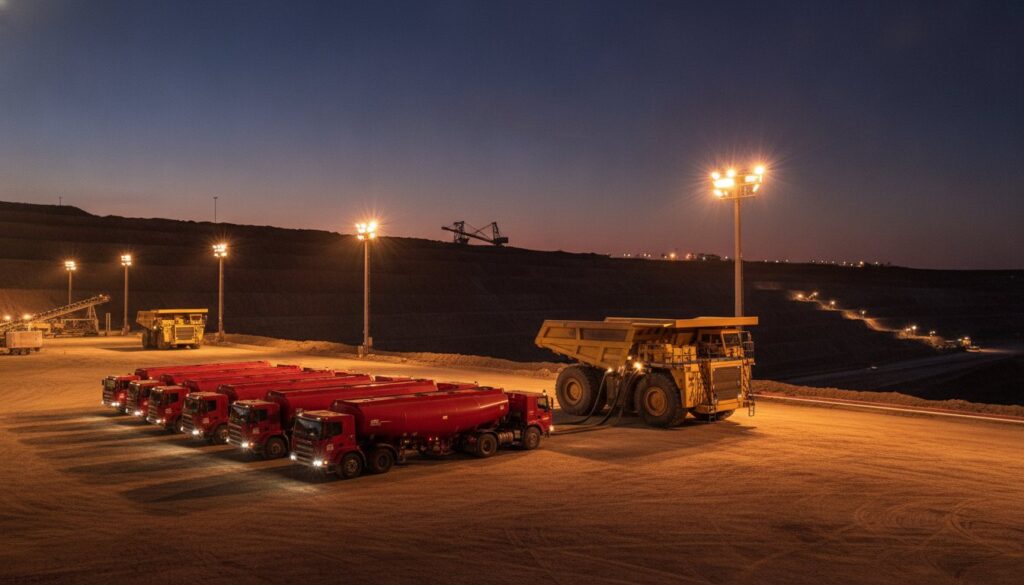
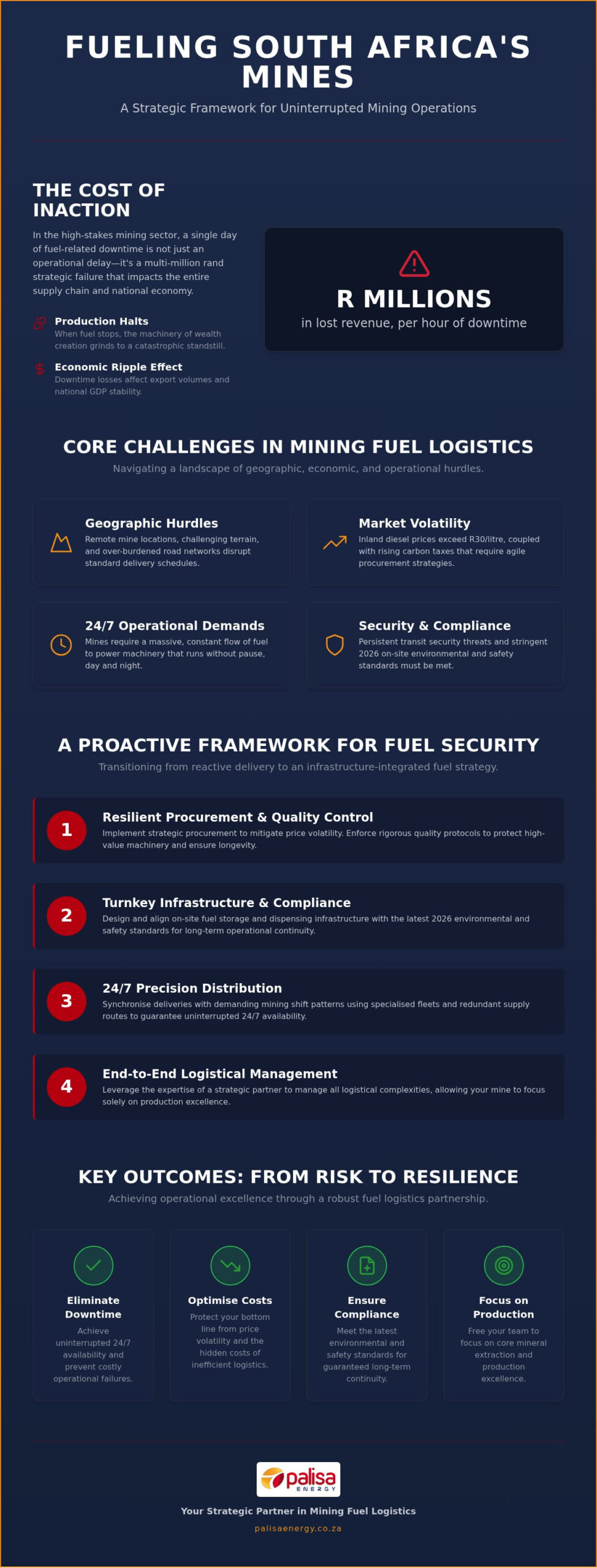
In 2026, a single day of fuel-related downtime on a South African mine isn’t just an operational hiccup; it’s a multi-million rand failure of strategy that echoes through the entire supply chain. You’ve likely felt the mounting pressure of inland diesel prices crossing the R30 per litre mark this September, whilst simultaneously managing the persistent threats of transit security and stringent on-site storage compliance. Executing effective fuel logistics for mining operations South Africa requires more than a simple delivery schedule; it demands a sophisticated, end-to-end framework that acts as a steadfast guardian against market volatility and operational risk.
We understand that your primary focus must remain on production and mineral extraction, not the granular anxieties of stockout prevention or the escalating carbon tax rates. This guide promises to equip you with the strategic insights needed to eliminate downtime and optimise cost efficiency across your entire South African footprint. We will examine the critical pillars of uninterrupted 24/7 availability, from turnkey infrastructure planning to the establishment of resilient procurement partnerships that ensure your operations remain both compliant and profitable in an increasingly complex energy landscape.
Key Takeaways
- Eliminate the risk of multi-million rand operational failures by transitioning from reactive delivery to a proactive, infrastructure-integrated fuel strategy.
- Optimise fuel logistics for mining operations South Africa through 24/7 distribution programmes designed to match demanding shift patterns across remote territories.
- Protect your bottom line from the dual threats of transit security risks and price volatility by implementing rigorous quality protocols and strategic procurement.
- Ensure long-term operational continuity by aligning on-site fuel infrastructure with the latest 2026 environmental and safety compliance standards.
- Leverage the expertise of a strategic energy partner to manage complex logistical hurdles, allowing your mine to focus entirely on production excellence.
The Critical Role of Fuel Logistics for Mining Operations in South Africa
Fuel serves as the vital pulse of heavy industry. Within the context of South Africa’s mining industry, energy security is synonymous with operational survival. Unlike retail or light commercial sectors, mining requires a massive, constant flow of energy to power excavators, haul trucks, and processing plants that run without pause. A failure in the delivery mechanism doesn’t merely delay a shipment; it halts production entirely. This high-stakes environment makes fuel logistics for mining operations South Africa a critical strategic discipline rather than a simple transport task. When the flow of diesel stops, the machinery of wealth creation grinds to a catastrophic standstill.
The South African landscape presents a unique set of geographic and environmental hurdles. Mines are frequently located in remote regions, far from coastal refineries and major urban hubs. Reaching these sites requires navigating over-burdened road networks and challenging terrain that can easily disrupt standard delivery schedules. A standard distribution model, designed for the predictable needs of urban commercial fleets, inevitably fails in this industrial context. It lacks the resilience to handle the sheer volume of bulk fuel required or the flexibility to adapt to the 24/7 heartbeat of a mine site.
Understanding the Mining Fuel Supply Chain
The journey from refinery to a remote pit is a complex logistical feat that requires meticulous planning. In 2026, this path is further complicated by a volatile market where inland diesel prices have breached the R30 per litre mark. Procurement must be more agile than in previous years, requiring a diverse mix of bulk products including high-performance lubricants and various diesel grades to maintain machinery longevity. Effective supply chain management ensures that the right product reaches the right equipment at the precise moment it’s needed. This involves coordinating multiple touchpoints, from refinery allocations to specialised tanker fleets capable of traversing rugged territory whilst maintaining strict safety standards.
Economic Impact of Logistical Inefficiency
Logistical inefficiency carries a heavy price tag that extends beyond the cost of the fuel itself. When fuel stockouts occur, the resultant downtime can cost a large-scale operation millions in lost revenue every single hour. These losses aren’t limited to the mine’s balance sheet; they ripple through the national economy, affecting export volumes and GDP stability. Inefficient logistics also inflate operational expenditure through increased maintenance costs caused by irregular supply intervals or the use of sub-standard fuel during emergencies. Reliable fuel logistics for mining operations South Africa ensure that procurement costs remain predictable, even whilst the market faces significant volatility and rising carbon tax rates. By securing a robust supply chain, mining houses protect their margins and contribute to the broader economic resilience of the nation.
Executing Seamless Distribution to Remote Mining Sites
Precision in movement is the bedrock of supply chain resilience. For fuel logistics for mining operations South Africa, the challenge lies in bridging the gap between national refineries and the rugged, often inaccessible locations where mineral wealth is extracted. This is not a mere transport exercise; it is a tactical deployment. We must select fleets with the mechanical fortitude to survive unpaved, mountainous routes whilst maintaining the agility to navigate underdeveloped infrastructure. Managing these “last-mile” hurdles requires a deep understanding of local geography and a commitment to maintaining delivery schedules regardless of environmental volatility.
Achieving 24/7 Operational Continuity
Mines operate on a relentless cycle that knows no pause. To ensure uninterrupted production, delivery programmes must be synchronised with specific mining shift patterns. By organising arrival windows during periods of lower on-site activity, we minimise congestion at offloading points and enhance safety for ground personnel. A robust nationwide distribution network serves as a critical safety net, providing redundant supply routes should primary arteries be blocked by weather or regional disruptions. Palisa Energy acts as a proactive partner in this space, offering 24/7 operational support to ensure that industrial clients never face the prospect of a dry tank. This level of strategic diesel supply management transforms fuel from a variable risk into a stable, predictable asset.
Technology and Real-Time Logistics Monitoring
Transparency builds trust and secures value in high-volume energy transfers. Modern telematics allow for the granular tracking of bulk fuel shipments, providing mine managers with real-time data on volume, location, and estimated arrival times. This digital oversight is essential for precise inventory planning and rigorous audit accuracy. Real-time monitoring prevents fuel loss in transit by providing immediate alerts for unauthorised stops or unexpected changes in tank pressure. Beyond security, these insights allow for the continuous optimisation of routes. By reducing unnecessary idling and improving delivery efficiency, we lower the overall carbon footprint of the logistics operation, aligning with the stringent 2026 environmental mandates and carbon tax requirements.
The final kilometres of a delivery are often the most treacherous. Steep gradients and seasonal conditions can easily bog down standard commercial vehicles. Only by deploying specialised, high-clearance tankers and experienced operators can we guarantee that the final stage of the journey does not become a bottleneck. This meticulous approach to distribution ensures that the mine’s heartbeat remains steady, powered by a supply chain that is as resilient as the machinery it fuels.
Mitigating Risks: Security, Quality, and Price Volatility
Operational excellence in fuel logistics for mining operations South Africa is frequently defined by what doesn’t happen. In a region where bulk diesel is viewed as a high-value liquid currency, the absence of theft, contamination, and procurement shocks is the true measure of a successful strategy. Managing these risks requires a shift from passive oversight to active guardianship. It’s about building a defensive perimeter around your energy supply that starts at the refinery gate and extends to the very moment the fuel enters your machinery’s tank.
Securing the Fuel Supply Chain
The threat of fuel theft and siphoning in South Africa has evolved into a sophisticated criminal enterprise. Protecting your assets demands more than basic locks; it requires a multi-layered security protocol that leaves no room for compromise. We implement tamper-evident seals on all tanker valves alongside GPS-tracked routes that trigger immediate alerts if a vehicle deviates from its pre-approved path. This digital tether ensures that every litre is accounted for whilst in transit.
Human integrity remains the most critical link in this chain. By utilising strictly vetted personnel and maintaining a chain of custody that is documented at every touchpoint, we significantly reduce the risk of internal collusion. Security must be particularly heightened during on-site offloading, which remains the most vulnerable moment in the delivery cycle. Establishing sterile, monitored offloading zones ensures that the transition from tanker to storage tank is performed with clinical precision and absolute accountability.
Maintaining Quality and Compliance
Contaminated fuel is a silent killer of mining productivity. Even minor particulate matter or water ingress can lead to catastrophic engine failure in high-performance mining equipment, resulting in repair costs that far exceed the value of the fuel itself. Standardising fuel testing at the point of delivery is not an optional extra; it’s a fundamental requirement for maintaining machinery longevity. Rigorous testing protocols verify that the fuel meets the specified sulphur content and density standards before it’s accepted into your infrastructure. For a deeper look at protecting your operational assets, explore our framework for Fuel Security for Business South Africa.
Beyond the fuel itself, the strategic use of high-quality industrial lubricants is essential for reducing friction and heat in heavy-duty components. This integrated approach to quality ensures that your fleet operates at peak efficiency whilst adhering to the safety standards mandated for hazardous material transport. In a market where inland 50ppm diesel has surpassed R30 per litre this September, every drop must perform at its maximum potential. We also account for the financial risks of price volatility, using strategic procurement partnerships to navigate the fluctuations of the Slate Levy and rising carbon taxes, ensuring that your procurement costs remain as predictable as your production schedules.
Infrastructure and Compliance: The Foundation of Fuel Security
Infrastructure is the silent engine of energy security. Whilst the transport phase handles the movement of product, the on-site depot determines the ultimate efficiency of fuel logistics for mining operations South Africa. Designing these facilities to facilitate rapid tanker turnaround is essential for maintaining the momentum of the entire supply chain. If the offloading point becomes a bottleneck, the cost of idling vehicles and delayed shifts begins to erode your margins. In 2026, scaling storage capacity has transitioned from a convenience to a non-negotiable insurance policy against global supply chain shocks and local distribution delays. By maintaining a significant on-site buffer, mining houses can weather temporary disruptions without impacting their production targets.
Strategic Fuel Infrastructure Planning
Effective infrastructure is never a one-size-fits-all solution. It requires a deep understanding of the mine’s specific consumption patterns and fleet requirements. Customised depot design ensures that dispensing equipment is positioned for maximum efficiency, reducing the time vehicles spend idling during refuelling cycles. Integrating these systems with digital inventory management provides a transparent, real-time view of fuel levels, allowing for automated replenishment triggers that prevent stockouts before they occur. For a detailed roadmap on building these resilient systems, consult our guide on Strategic Fuel Infrastructure Planning.
Compliance Auditing and Safety Standards
Navigating the regulatory landscape in South Africa requires meticulous attention to detail and a commitment to absolute safety. Compliance isn’t a static achievement; it’s a continuous process of auditing and refinement. Key standards, such as SANS 10089-3:2010, dictate the technical requirements for storage, but true safety goes beyond the letter of the law. We recommend a rigorous compliance checklist for 2026 that includes:
- Tank Integrity: Regular pressure testing of both underground and above-ground storage units.
- Spill Containment: Implementation of reinforced bunding capable of containing 110% of tank capacity.
- Emergency Response: Deployment of specialised spill kits and advanced fire suppression systems at all dispensing points.
- Personnel Training: Continuous training programmes for all on-site staff in safe fuel handling and hazardous material protocols.
By mitigating environmental risks through proper containment and robust auditing, mines avoid the severe financial and reputational damage associated with soil or water contamination. Palisa Energy provides the industrial expertise needed to conduct thorough compliance audits, ensuring your site meets every modern safety mandate whilst maintaining operational pace. If you need to secure your site’s future against regulatory hurdles, partner with our infrastructure specialists to implement a turnkey storage solution.
Partnering with Palisa Energy for Mining Excellence
Reliability is the currency of the mining sector. In an environment where every minute of downtime translates into significant revenue loss, the choice of an energy partner becomes one of the most consequential decisions an executive team can make. Palisa Energy operates as more than a mere supplier; we serve as a steadfast guardian of your operational continuity. By leveraging our national footprint and robust partnerships with leading oil companies, we ensure that your mine remains powered, protected, and prepared for the challenges of the 2026 industrial landscape. We take pride in managing the intricate details of the energy sector so you don’t have to.
A Holistic Approach to Energy Solutions
True energy security is found at the intersection of bulk supply and strategic foresight. We provide a comprehensive service model that combines high-volume diesel supply with logistical expertise and turnkey infrastructure planning. This integrated approach ensures that your fuel strategy is not a series of disconnected deliveries, but a unified system designed for maximum efficiency. Our 24/7 operational support provides a critical safety net for around-the-clock mining operations, ensuring that help is always available, regardless of the hour or the complexity of the requirement. For a broader perspective on managing these systems, read our comprehensive guide to Fuel Logistics in South Africa.
Commitment to Growth and Sustainability
We understand the unique pressures of the South African industrial landscape, from the rising costs of carbon taxes to the logistical hurdles of remote site access. Our role is to manage these complexities so your team can focus on its core objective: mineral extraction and production excellence. By adopting a proactive approach to fuel logistics for mining operations South Africa, we help you move beyond reactive crisis management and into a state of predictable, sustainable growth. We don’t just sell diesel and industrial lubricants; we invest in the longevity of your operation through rigorous compliance auditing and meticulous supply chain oversight. This dedication to excellence ensures that your procurement costs remain stable even whilst the market fluctuates.
The transition to a more resilient energy framework begins with a clear understanding of your current vulnerabilities. We invite you to take a decisive step toward total operational security by engaging with our specialists for a comprehensive fuel logistics and infrastructure audit. Let us help you optimise your procurement strategies and fortify your on-site capabilities, ensuring your mine remains a formidable force in the national economy for years to come. Contact Palisa Energy today to secure the future of your energy supply chain and experience the stability of a truly strategic partnership.
Securing Your Operational Future with Strategic Energy Partnerships
The industrial landscape of 2026 demands a departure from traditional, reactive supply models. We’ve established that the foundation of mining excellence rests on three critical pillars: resilient distribution, uncompromising security protocols, and infrastructure designed for maximum logistical turnaround. By integrating these elements into a cohesive framework, you transform energy from a volatile risk into a stable, strategic asset. Mastering fuel logistics for mining operations South Africa isn’t merely about securing the next delivery; it’s about building a supply chain capable of withstanding global shocks whilst maintaining peak production.
Palisa Energy stands ready to act as your steadfast guardian in this complex sector. We combine nationwide petroleum distribution with expert infrastructure planning and dedicated 24/7 industrial support to ensure your mine never faces the prospect of a dry tank. It’s time to move beyond the anxieties of stockouts and regulatory hurdles. Contact Palisa Energy to optimise your mining fuel logistics and fortify your operation against the uncertainties of tomorrow. Your journey toward total energy security starts with a partner committed to your long-term growth and success.
Frequently Asked Questions
How does remote fuel logistics differ from standard distribution in South Africa?
Remote logistics requires navigating underdeveloped infrastructure and difficult terrain, necessitating specialised high-clearance vehicles that standard urban fleets simply don’t possess. Unlike commercial deliveries, fuel logistics for mining operations South Africa must synchronise with relentless 24/7 shift cycles to prevent catastrophic production halts. This demands a more resilient supply chain capable of managing complex “last-mile” hurdles in mountainous regions where road quality is often poor and site access is strictly restricted.
What are the primary security risks for mining fuel transport in 2026?
The most significant threats include sophisticated fuel siphoning and high-value cargo theft whilst in transit. In 2026, criminal enterprises have become increasingly organised, making tamper-evident seals and GPS-tracked routes essential for every industrial delivery. Vulnerabilities are often highest during on-site offloading, where a lack of monitored zones can lead to significant volume loss. Maintaining a strict chain of custody with thoroughly vetted personnel is the only way to mitigate these evolving risks.
How much on-site fuel storage should a typical mining operation maintain?
A mining operation should ideally maintain enough storage to act as a buffer against supply chain shocks for at least seven to ten days of peak production. This capacity allows the site to weather temporary distribution delays or regional infrastructure failures without halting machinery. Scaling storage has become a strategic insurance policy in 2026, especially as global market volatility and local logistics hurdles make just-in-time delivery increasingly risky for high-volume industrial consumers.
Can Palisa Energy provide 24/7 fuel delivery to remote national locations?
Yes, Palisa Energy specialises in 24/7 operational support and nationwide distribution for industrial clients across the country. Our network is designed to reach remote mining sites regardless of their location, ensuring that fuel availability matches your around-the-clock shift patterns. By partnering with leading oil companies, we maintain a reliable supply chain that provides a critical safety net for operations that cannot afford even a single hour of fuel-related downtime or production delays.
What compliance standards must mining fuel depots meet in South Africa?
Mining fuel depots must adhere to strict environmental and safety regulations, including SANS 10089-3:2010 for the installation and decommissioning of storage tanks. Compliance involves implementing reinforced bunding that can contain 110% of tank capacity, alongside maintaining advanced fire suppression systems at all dispensing points. Regular audits are required to ensure that spill containment protocols and personnel training meet 2026 standards, protecting the operation from the severe legal and financial consequences of contamination.
How does real-time monitoring improve fuel supply chain efficiency?
Real-time monitoring utilises telematics to provide granular data on vehicle location, fuel volume, and delivery timing. This transparency allows mine managers to plan inventory with clinical precision, reducing the risk of emergency orders and stockouts. Beyond security, monitoring identifies inefficiencies such as unnecessary idling or route deviations, allowing for the continuous optimisation of fuel logistics for mining operations South Africa whilst helping to lower the overall carbon footprint of the industrial supply chain.
What is the benefit of sourcing industrial lubricants from a bulk fuel supplier?
Sourcing lubricants from your bulk fuel supplier simplifies procurement and ensures that all energy products meet the same rigorous quality standards. Using high-performance lubricants is essential for reducing friction and heat in heavy-duty mining machinery, which directly impacts equipment longevity and maintenance costs. A holistic supply approach ensures that your fleet receives compatible, high-quality products that are delivered through the same secure, monitored logistical framework as your primary diesel supply.
How can a mine mitigate the impact of fuel price volatility?
Mines can mitigate volatility by establishing strategic procurement partnerships that provide more predictable cost structures. Whilst price adjustments are announced monthly by the DMRE, a proactive partner like Palisa Energy helps navigate the complexities of various levies and rising carbon taxes. Scaling on-site storage also allows mines to buy in bulk during more favourable periods, creating a necessary financial buffer against the sharp price increases seen throughout 2026.