

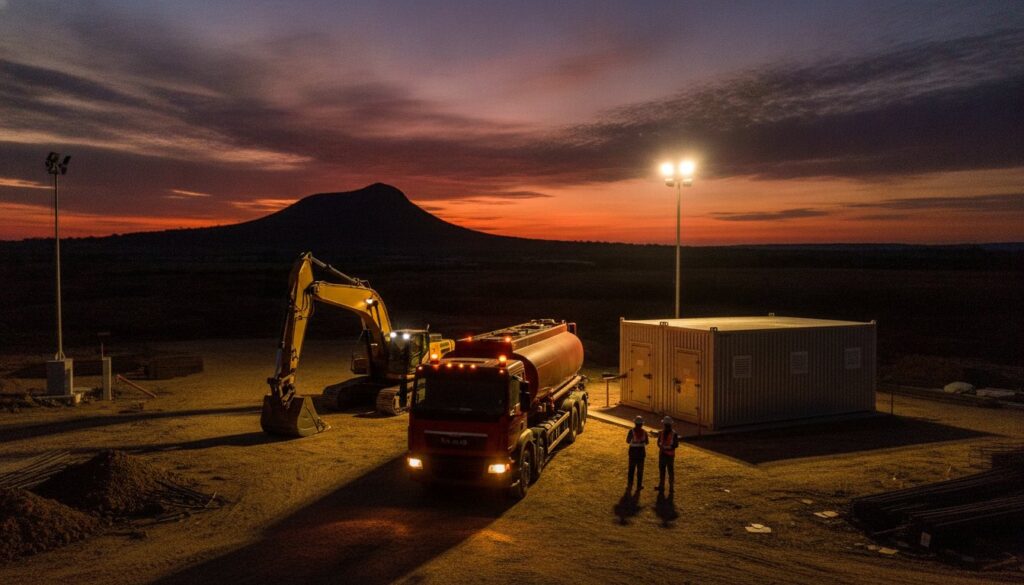
Fuel security is no longer a matter of simple delivery; it’s a high-stakes logistical strategy that determines whether a capital-intensive project finishes on schedule or stalls under the weight of avoidable delays. You understand that managing bulk diesel for construction sites involves far more than just keeping tanks full. It requires a proactive, uncompromising stance against fuel theft, on-site shrinkage, and the rigorous environmental compliance standards that have mandated double-walled storage systems across all temporary sites since the start of 2026.
We recognise the immense pressure of maintaining machinery uptime whilst navigating an increasingly volatile energy market. This guide will empower you to optimise your site’s fuel logistics, ensure uninterrupted operations, and manage bulk diesel procurement with professional precision. Precision is paramount. By moving beyond the “just-in-time” retail model, you can secure a strategic advantage that protects your bottom line. We will examine the essential components of fuel security, from turnkey infrastructure planning and compliance auditing to the implementation of transparent cost management systems that provide total visibility over your national energy spend.
Key Takeaways
- Learn how to position bulk diesel as a strategic energy catalyst to eliminate machinery downtime and maintain project momentum.
- Overcome the logistical challenges of nationwide fuel distribution to remote areas by utilising specialised delivery fleets designed for rugged terrain.
- Master the requirements for establishing secure on-site storage depots that comply with stringent environmental regulations and safety standards.
- Discover how procurement of bulk diesel for construction sites serves as a financial hedge against market volatility whilst improving your project’s B-BBEE rating.
- Transition to a holistic fuel security model that integrates reliable supply with turnkey infrastructure planning and 24/7 operational support.
The Critical Role of Bulk Diesel in Modern Construction Operations
Bulk diesel is the primary energy catalyst that drives modern industrial progress. It powers the heavy machinery and site generators required to transform architectural blueprints into physical structures. Without a robust supply, the most sophisticated project plan remains static. Relying on frequent, fragmented refills is an operational inefficiency that introduces unnecessary variables into an already complex environment. In contrast, securing bulk diesel for construction sites ensures that high-capacity equipment operates at peak performance without the friction of constant logistical coordination. This shift from reactive procurement to a strategic partnership allows for better financial forecasting and operational stability. Fuel security is defined as the precise intersection of consistent availability, uncompromised product quality, and absolute regulatory compliance.
Diesel 50ppm vs 500ppm: Choosing for Machinery Longevity
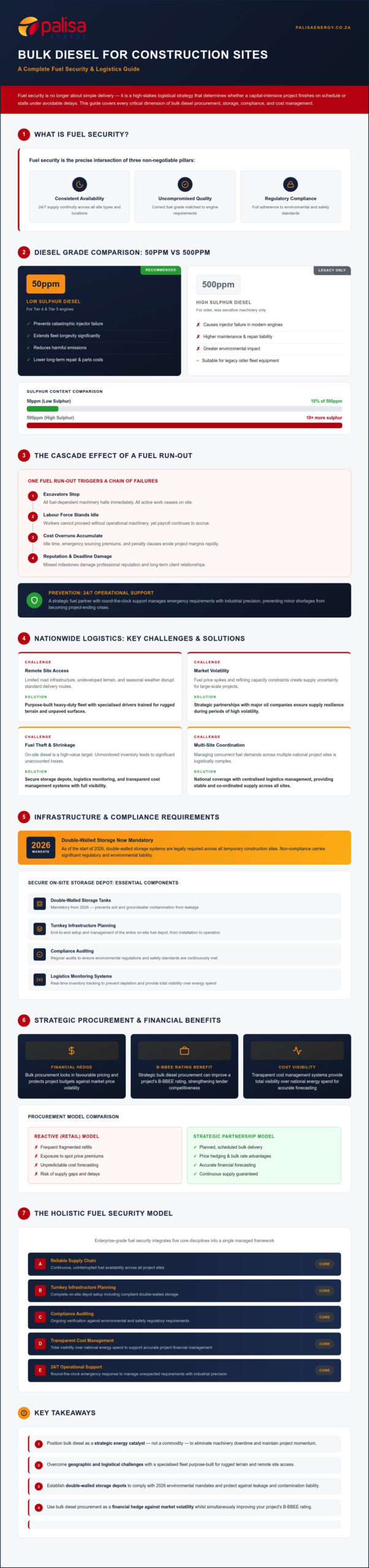
Modern construction fleets increasingly feature Tier 4 and Tier 5 engines designed for lower environmental impact. These precision-engineered components require 50ppm (low sulphur) diesel to function correctly. Whilst 500ppm remains available for older, less sensitive machinery, the high sulphur content can lead to catastrophic injector failure and increased maintenance costs in newer models. Opting for 50ppm reduces harmful emissions and extends the longevity of your hardware. This choice represents a significant long-term saving on repair labour and spare parts, ensuring your fleet remains a reliable asset rather than a maintenance liability. It is a commitment to both operational excellence and environmental responsibility.
The Impact of Fuel Continuity on Project Deadlines
A single fuel run-out causes a cascade of logistical failures. When excavators stop, the labour force stands idle, yet the payroll clock continues to run. These delays often result in substantial cost overruns that erode project margins and damage professional reputation. Establishing a partnership with a supplier that acts as a steadfast guardian of your supply chain provides more than just fuel; it offers the stability required for growth. With 24/7 operational support, emergency requirements are managed with industrial precision, preventing minor shortages from becoming project-ending crises. This level of reliability requires proper on-site infrastructure, where fuel tank construction and safety standards are rigorously met to prevent leakage or contamination. By integrating logistics monitoring with turnkey infrastructure, project managers can focus on delivery rather than depletion. This proactive approach ensures that every litre of diesel translates directly into project progress.
Navigating the Logistics of Nationwide On-Site Fuel Distribution
Managing the distribution of bulk diesel for construction sites across a national footprint requires more than a standard transport fleet. It demands a sophisticated logistical framework capable of reaching underdeveloped regions where infrastructure is often non-existent or compromised. We move beyond simple distribution by leveraging strategic partnerships with major oil companies. This ensures supply resilience even during periods of high market volatility or refining capacity constraints. By maintaining a fleet that is fit-for-purpose for rugged terrain, we guarantee that high-stakes projects remain operational regardless of their geographic isolation. It’s about engineering a supply chain that survives the most demanding site conditions. A dedicated strategic partner does not merely deliver fuel; they manage the entire movement with industrial confidence and unwavering support.
Overcoming Geographic Hurdles in Construction Supply
Remote sites present unique challenges that standard vendors often overlook, particularly when coordinating the supply of bulk diesel for construction sites located in underdeveloped regions. Coordinating deliveries to locations with limited road infrastructure requires a meticulous understanding of terrain and seasonal weather patterns. Precision timing is essential. Managing large-scale fuel loads on unpaved surfaces necessitates drivers with specialised training and vehicles equipped for heavy-duty industrial environments. For companies managing multiple concurrent projects across the country, national coverage is not a luxury; it’s a prerequisite for stability. Adhering to federal safety regulations during the transport and offloading process ensures that your site remains compliant and safe from the moment the tanker arrives at the perimeter.
Real-Time Monitoring and Logistical Transparency
Logistical transparency is the foundation of trust in the energy sector. Digital tracking systems now provide real-time visibility into every fuel movement, allowing site managers to plan with absolute certainty. This data-driven approach improves delivery accuracy and prevents the “just-in-time” anxiety that often plagues high-demand periods. 24/7 logistics coordination ensures that any disruption is identified and mitigated before it impacts your machinery uptime. Integrity is maintained from the uplift terminal to the final site tank, ensuring that the fuel remains uncontaminated and accounted for. This holistic monitoring protects against fuel shrinkage and ensures that every litre is delivered exactly where it is needed. If you are looking to enhance your operational efficiency, you can partner with a strategic fuel reseller that prioritises logistical precision and long-term reliability.
Infrastructure and Compliance: Establishing Secure On-Site Storage
Securing a reliable supply of bulk diesel for construction sites is only half of the equation; the physical infrastructure required to house that energy must be equally robust. Establishing an on-site fuel depot is a complex undertaking that demands industrial precision and a deep understanding of environmental safety. A poorly planned storage area doesn’t just risk project delays; it invites fuel theft, shrinkage, and catastrophic environmental liabilities. Following a methodical, step-by-step approach ensures your site remains a bastion of operational stability. This process begins with a comprehensive site assessment to identify stable ground and optimal accessibility for delivery tankers, followed by the establishment of safety exclusion zones. Once the physical layout is confirmed, the deployment of compliant storage hardware and the implementation of a rigorous auditing schedule create a secure energy hub that supports uninterrupted machinery operation.
Designing Efficient and Compliant Fuel Depots
Efficient depot design begins with the strategic placement of storage assets to maximise machinery access whilst minimising environmental risk. Safety exclusion zones are mandatory to protect personnel and assets from thermal hazards and accidental impact. Central to this is the use of bunded or double-walled tanks, which became the mandatory standard following the phase-out of single-walled systems at the end of 2025. These systems act as a secondary containment barrier, effectively eliminating the risk of soil contamination during high-volume offloading. For those operating within the region, understanding strategic fuel infrastructure planning South Africa is essential for maintaining local compliance and ensuring that your depot design meets the latest industrial benchmarks.
Turnkey Solutions and Construction Management
Scaling storage capacity shouldn’t introduce operational friction or require you to manage a disparate group of contractors. By utilising turnkey solutions, businesses can bypass the complexities of dealing with multiple vendors for fuel supply and infrastructure. A single strategic partner manages the design, installation, and ongoing auditing of the depot, ensuring that every component aligns with national safety standards. Professional consulting services provide the necessary oversight to ensure that your site’s bulk diesel for construction sites is stored under optimal conditions. This holistic management approach covers everything from initial site modelling to final compliance sign-off, allowing project managers to maintain their focus on construction milestones. It’s a model of “vision followed by execution” that builds long-term trust through unwavering support and operational excellence.
Strategic Procurement and Fuel Cost Management
Procurement represents the final pillar of a robust energy strategy. In an era of heightened market volatility, the strategic sourcing of bulk diesel for construction sites allows firms to bypass the high margins of retail forecourts and secure a more predictable cost base. Effective procurement is not a passive transaction; it’s a sophisticated financial lever that protects project margins from the unpredictable swings of the global energy market. By shifting to a wholesale model, businesses can better manage their cash flow whilst ensuring that their machinery never stands idle due to preventable supply gaps. This approach requires a delicate balance between volume requirements and on-site storage capacity, ensuring that every litre purchased is accounted for and utilised efficiently. Sustainable growth is built upon these foundations of fiscal discipline and logistical foresight.
Managing Industrial Costs through Strategic Sourcing
Wholesale markups on bulk quantities provide a superior return on investment compared to “just-in-time” retail refuelling. Beyond the immediate price advantages, preferential procurement plays a decisive role in securing large-scale project tenders. B-BBEE accreditation is a critical component of this process, as it directly impacts a firm’s ability to participate in significant infrastructure developments. Aligning with a partner that understands these regulatory nuances ensures that your energy spend contributes positively to your overall compliance rating. For a deeper analysis of these market dynamics, you can explore our guide on fuel security for business South Africa, which details the risk management trends defining the current industrial landscape.
Risk Management and Contractual Resilience
Global price volatility remains a constant threat to local construction budgets, with diesel prices experiencing an 8.77% increase in August 2026 alone. Mitigating these risks requires more than just reactive buying; it demands a resilient contractual framework that offers transparent pricing models. Long-term contracts serve as a shield against sudden spikes in crude oil costs or refining capacity constraints, providing the stability necessary for long-term project planning. This level of transparency ensures that site managers can forecast energy expenses with industrial precision, removing the guesswork from large-scale logistics. A steadfast guardian of your supply chain prioritises these sustainable partnerships over short-term gains. If you are ready to secure your project’s future, contact Palisa Energy to discuss a tailored procurement strategy that meets your specific operational demands.
Partnering with Palisa Energy for Enterprise-Grade Fuel Security
Achieving total energy resilience requires a partner that looks beyond the fuel tanker. Palisa Energy provides a holistic ecosystem where bulk sales, advanced logistics, and turnkey infrastructure planning converge to protect your project’s momentum. We recognise that the supply of bulk diesel for construction sites is a high-stakes operation that demands more than just reliability; it requires a proactive commitment to safety and operational excellence. By integrating every facet of the supply chain, we empower you to focus on delivery whilst we manage the complexities of energy procurement and storage. This is not a passive service but a strategic alliance designed to ensure your machinery never stops and your margins remain protected from the friction of logistical failures.
A Vision of Operational Excellence
We act as a visionary enabler for industrial growth by managing the intricate details that often lead to project stagnation. Our role as a steadfast guardian of your supply chain is underpinned by 24/7 operational support, ensuring that emergency requirements are met with industrial precision at any hour. This unwavering commitment to uptime is what separates a mere vendor from a dedicated strategic partner. We believe in the integration of technological innovation with traditional reliability. By utilising real-time monitoring and advanced infrastructure auditing, we provide a level of transparency that builds trust and fosters long-term stability. Your operational excellence is our primary objective, and we achieve this through a relentless focus on integrity, safety, and the pursuit of progress.
Securing Your National Supply Chain
Managing multi-site operations across vast distances requires a national distribution network that is both agile and resilient. Our partnerships with major oil companies provide the foundation for this reliable nationwide reach, ensuring that even the most remote projects receive the same level of enterprise-grade security. As one of the leading bulk diesel suppliers South Africa depends on for large-scale infrastructure, we offer a turnkey approach that simplifies complex procurement. Initiating a partnership is a methodical process that begins with a comprehensive audit of your current fuel logistics and storage needs. From there, we design a customised supply framework that includes infrastructure planning and logistics monitoring. Secure your project’s energy future today by aligning with a partner that values precision as much as you do.
Securing the Energy Future of Your Infrastructure Projects
Maintaining project momentum in a volatile energy landscape requires a strategic alliance that prioritises supply continuity and operational integrity. You’ve seen how the professional management of bulk diesel for construction sites integrates advanced logistics with compliant storage infrastructure to eliminate the risks of project downtime and fuel shrinkage. Stability drives growth. By transitioning from reactive refuelling to a holistic procurement model, your firm gains the stability needed to scale national operations with confidence.
Palisa Energy stands as a steadfast guardian of your supply chain, offering 24/7 national logistics support and turnkey infrastructure planning. Precision is paramount. As a B-BBEE Level 1 strategic partner, we ensure that your energy spend contributes to your compliance objectives whilst powering your heavy machinery with uncompromised reliability. Let us manage the complexities of your fuel security so you can focus on the construction of the future.
Partner with Palisa Energy for reliable bulk diesel supply and logistics to secure your site’s operational excellence. We are ready to build that future alongside you.
Frequently Asked Questions
What is the difference between 50ppm and 500ppm diesel for construction machinery?
The primary difference lies in the sulphur content, measured in parts per million. 50ppm is a low-sulphur variant required for modern Tier 4 and Tier 5 engines to prevent injector damage and ensure environmental compliance. Whilst 500ppm remains suitable for older, less sensitive machinery, the cleaner combustion of 50ppm significantly reduces maintenance costs and exhaust emissions. Choosing the correct grade is vital for the longevity of your high-value construction fleet.
How much bulk diesel can be delivered to a construction site at one time?
Delivery volumes are typically determined by your on-site storage capacity and the physical accessibility of the location. We coordinate loads ranging from small 1,500-litre drops for mobile bowsers to full 40,000-litre tanker loads for large-scale storage depots. When managing bulk diesel for construction sites, it’s essential to balance your consumption rates with your storage footprint to ensure a continuous supply whilst avoiding the risks associated with overfilling or stagnant fuel.
Does Palisa Energy provide emergency 24/7 diesel deliveries for sites?
Yes, we provide 24/7 operational support to ensure that your project never stalls due to fuel depletion. Our national logistics network is designed to respond to urgent requirements at any hour, providing a steadfast guardian for your machinery uptime. This round-the-clock availability is a cornerstone of our commitment to industrial excellence, allowing site managers to mitigate the impact of unforeseen consumption spikes or logistical disruptions without compromising project deadlines.
What are the legal requirements for on-site fuel storage in South Africa?
In South Africa, on-site fuel storage is governed by strict environmental and safety standards, including SANS regulations. As of January 2026, single-walled storage systems have been phased out, making compliant double-walled or bunded tanks a mandatory requirement for temporary sites. These regulations ensure that your facility prevents soil contamination and meets rigorous fire safety protocols. We provide compliance auditing to ensure your infrastructure adheres to the latest national HSSEQ standards for industrial sites.
How can I prevent diesel theft and fuel shrinkage on my construction site?
Preventing fuel shrinkage requires a combination of robust infrastructure and real-time monitoring. Utilising secure, lockable bunded tanks and digital flow meters allows for precise tracking of every litre dispensed. We implement logistics monitoring systems that provide total visibility over fuel movements from delivery to consumption. This data-driven approach identifies discrepancies immediately, protecting your bottom line from the financial impact of on-site theft and ensuring that all bulk diesel for construction sites is fully accounted for.
What is a bunded fuel tank and why is it recommended for construction sites?
A bunded fuel tank is essentially a secondary containment system, often described as a tank within a tank. The outer layer, or bund, is designed to hold at least 110% of the inner tank’s capacity in the event of a leak or spill. This design is highly recommended for construction sites as it prevents catastrophic environmental contamination and ensures compliance with South African safety laws. It provides a vital layer of protection for both your assets and the surrounding environment.
How does B-BBEE accreditation affect the procurement of bulk diesel?
B-BBEE accreditation is a fundamental factor in procurement, particularly for large-scale infrastructure projects and government tenders. Partnering with a Level 1 strategic partner allows construction firms to enhance their own preferential procurement scores, which is often a prerequisite for winning high-value contracts. This alignment ensures that your energy spend contributes directly to your regulatory compliance and social development goals whilst securing a reliable, enterprise-grade supply of bulk petroleum products for your nationwide operations.
Can Palisa Energy assist with the design and construction of a temporary fuel depot?
Yes, we offer comprehensive turnkey infrastructure planning and construction management for temporary fuel depots. Our professional consulting services cover everything from initial site layout and safety exclusion zones to compliance auditing and final installation. By providing a single point of contact for both fuel supply and depot infrastructure, we simplify the scaling process for your project. This holistic support ensures that your storage facility is engineered for maximum efficiency and uncompromised safety from day one.