

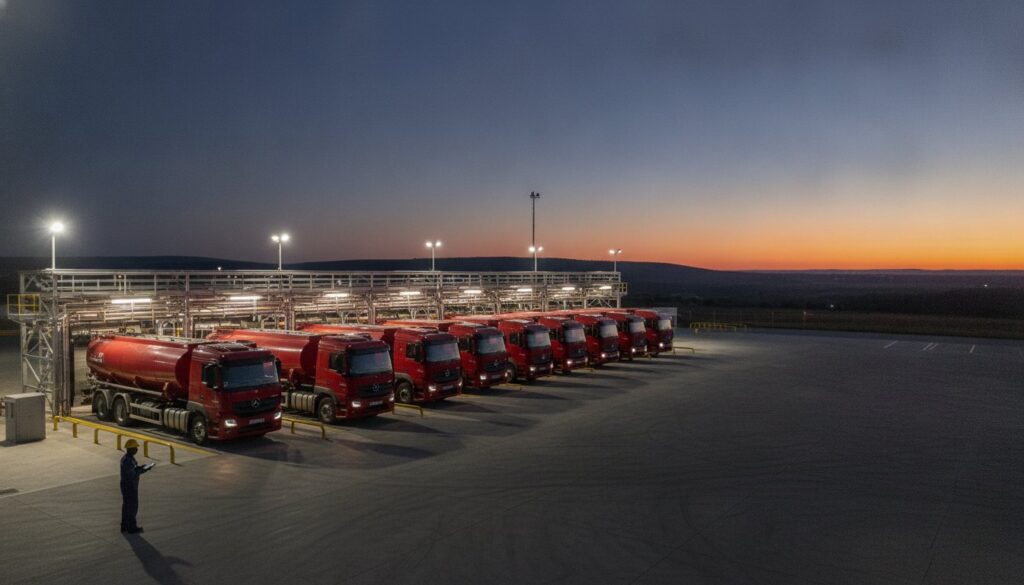
In the current industrial climate, treating fuel as a simple commodity is a risk your operation cannot afford; bulk diesel is a strategic asset that must be engineered through precision logistics. As of July 2026, with wholesale prices for 50ppm diesel at R25.17 per litre, the margin for error in procurement has narrowed significantly. You likely understand the frustration of supply chain disruptions during peak demand or the silent erosion of your bottom line caused by hidden delivery costs. Identifying the right bulk diesel suppliers South Africa offers is no longer just about the lowest quote; it’s about securing a resilient partnership that guarantees machinery longevity and operational continuity.
We promise to provide the clarity required to master the complexities of high-volume fuel procurement and protect your enterprise from the volatility of the energy sector. This guide examines the critical intersection of regulatory compliance, such as the R308 per tonne carbon tax rate, and strategic cost optimisation. You’ll gain a comprehensive understanding of how to audit supplier reliability, navigate the upcoming Clean Fuels 2 standards, and implement a procurement framework that ensures your generators and fleets never run dry. By aligning your operational needs with sophisticated supply chain strategies, you can transform fuel from an unpredictable expense into a pillar of industrial stability.
Key Takeaways
- Understand the critical distinction between primary producers and wholesale resellers to ensure your procurement strategy aligns with South Africa’s unique industrial landscape.
- Identify the technical requirements of modern engine technology by decoding the shift from 500ppm to 50ppm diesel and the implications for machinery longevity.
- Evaluate the logistical infrastructure of bulk diesel suppliers South Africa to secure a 24/7 delivery guarantee that withstands nationwide supply chain disruptions.
- Implement a five-step auditing framework to calculate the Total Cost of Ownership, ensuring your fuel spend is optimised far beyond the initial wholesale price.
- Transition from transactional purchasing to a strategic partnership model that prioritises operational excellence and long-term energy security.
The Landscape of Bulk Diesel Supply in South Africa
Diesel powers the engine of the South African economy. It isn’t just fuel; it’s the foundation of mining, agriculture, and heavy manufacturing. With the persistent instability of the national power grid, bulk diesel has transitioned from a supporting utility to a primary operational necessity. Industrial procurement officers no longer view fuel through a lens of simple cost per litre. Instead, they prioritise the security of supply to insulate their operations from systemic shocks. In a market where supply chain disruptions can halt production lines overnight, the reliability of your energy partner is the ultimate competitive advantage.
Understanding the market structure is vital for any executive stakeholder. The industry comprises primary oil producers who manage refining and large-scale imports, and wholesale resellers who provide the agility and last-mile logistics required by end-users. Many Fuels Industry Association of South Africa (FIASA) members provide the essential link between high-volume refining and the specific needs of industrial sites. Partnering with reputable bulk diesel suppliers South Africa ensures that your business benefits from this established infrastructure while receiving bespoke service that majors often cannot provide. This distinction is critical when choosing a partner capable of managing the complexities of nationwide distribution.
The Strategic Importance of Fuel Continuity
Downtime is a silent profit killer. In manufacturing and logistics, a single day of fuel-induced stoppage can lead to millions in lost revenue. This reality has forced a shift in how enterprises manage energy risk. Forward-thinking companies are moving away from ad-hoc spot purchases toward resilient, long-term supply agreements. These contracts provide a buffer against local market fluctuations and guarantee that your fleet or generator remains operational during peak demand periods when smaller suppliers might falter. Reliability isn’t a luxury; it’s a prerequisite for growth. Enterprises that have not yet established a contingency plan should consider the full implications of supply failure by reviewing a dedicated resource on sourcing emergency bulk diesel delivery in South Africa to understand how to maintain operational continuity when primary supply chains are disrupted.
Navigating the South African Regulatory Environment
The Department of Mineral Resources and Energy (DMRE) regulates wholesale prices, yet the logistical execution remains a private sector challenge. Compliance extends beyond simple delivery. It involves adhering to B-BBEE requirements, which are essential for preferential procurement and maintaining your social licence to operate. Additionally, high-volume fuel transport is governed by rigorous environmental and safety standards. Ensuring your supplier meets these legal mandates protects your brand from liability and ensures the safe handling of hazardous materials on your site. A partner who understands these complexities manages the risk so you don’t have to.
Technical Specifications: 50ppm vs 500ppm Diesel
Understanding the technical composition of your fuel is as critical as securing its delivery. The “ppm” designation refers to parts per million of sulphur content; a metric that dictates both environmental impact and mechanical performance. Historically, South African industry relied on higher sulphur variants, but the evolution of high-pressure common rail engines has necessitated a rapid shift. Modern machinery requires 50ppm diesel to prevent the clogging of sophisticated emission control systems and ensure optimal combustion. While 500ppm remains available, its application is increasingly limited to older, less sensitive industrial equipment where the higher sulphur content won’t cause immediate component failure.
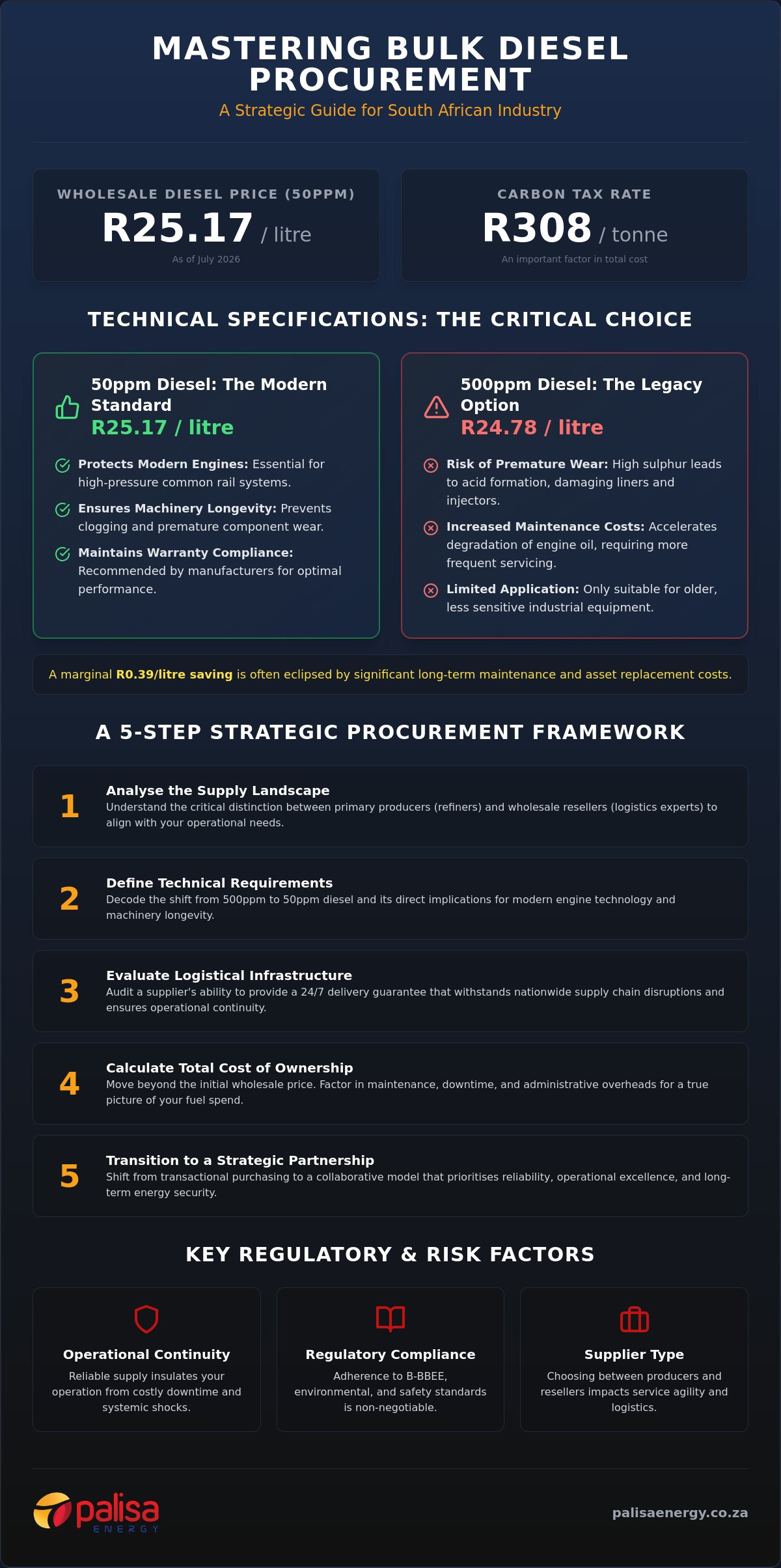
Choosing between these grades involves a complex calculation of maintenance cycles versus initial procurement costs. As of July 2026, the wholesale price difference between 50ppm (R25.17) and 500ppm (R24.78) is approximately R0.39 per litre. This marginal cost saving with 500ppm is often eclipsed by the accelerated degradation of engine oil and the formation of sulphuric acid during combustion. Using high-sulphur fuel in modern engines leads to premature wear on cylinder liners and fuel injectors, ultimately shortening the lifespan of your assets. Leading bulk diesel suppliers South Africa recommend 50ppm for any fleet or generator set manufactured within the last decade to maintain warranty compliance and operational efficiency.
This focus on preventative maintenance is a standard across all high-performance machinery; for instance, marine engines in coastal hubs require similar technical oversight, such as a Yamaha outboard service durban, to ensure long-term reliability and performance in demanding conditions.
50ppm Diesel: The Modern Industrial Standard
50ppm diesel has become the benchmark for industrial excellence. By significantly reducing particulate matter and acidic by-products, this fuel grade extends the intervals between oil changes and filter replacements. For backup generator fleets, which often sit idle for extended periods, the stability and cleanliness of 50ppm fuel are indispensable. To ensure your equipment remains in peak condition, you can visit Representaciones BURG SpA for expert guidance on critical spare parts for Perkins and Caterpillar engines. This ensures that when a power failure occurs, the start-up is seamless and the power delivery remains consistent without the risk of injector fouling.
Fuel Integrity and Quality Assurance
Technical specifications mean little if the fuel is compromised during transit. Fuel contamination, particularly water ingress or microbial growth, poses a severe risk to high-volume users. Sourcing from reputable entities that adhere to the guidelines set by the Fuels Industry Association of South Africa is the only way to guarantee product purity. Rigorous testing protocols at major oil company terminals ensure that the diesel reaching your site meets the precise chemical profile required. To safeguard your equipment, you should partner with a supplier that prioritises batch-tested quality assurance from the point of upliftment to the final drop.
Assessing Operational Excellence in Fuel Logistics
Logistical precision is the invisible force that keeps South African industry in motion. Distributing fuel across the diverse and often challenging terrains of the country requires more than just a fleet of vehicles; it demands a sophisticated logistical architecture. Across the nation’s diverse and often challenging geographical landscape, encompassing everything from bustling industrial centres to remote operational sites, the ability to navigate complex geographical constraints is a hallmark of superior service. For high-volume users, 24/7 logistical support isn’t a premium feature but a non-negotiable requirement. When your operations run around the clock, your fuel supply must mirror that commitment to ensure that critical infrastructure never faces a dry tank scenario.
A supplier’s fleet capacity serves as a primary indicator of their operational maturity. To provide holistic support, bulk diesel suppliers South Africa must maintain a versatile range of delivery assets tailored to specific site requirements. This includes agile 1,500L bowsers designed for tight urban generator placements where space is at a premium, as well as massive 40,000L bulk tankers engineered for large-scale industrial reserves. This scalability ensures that whether you’re refuelling a single backup unit or a massive fleet of earth-moving equipment, the delivery method is optimised for safety, speed, and site-specific constraints.
Technology-Driven Distribution Networks
Modern fuel logistics rely heavily on real-time data to guarantee delivery precision. By integrating GPS tracking and advanced telematics, providers can offer transparent transit updates and accurate arrival times. These systems do more than just track a truck; they provide a layer of security that is vital in the South African context. Automated fuel management systems allow for the precise tracking of consumption and help eliminate “fuel shrinkage” or theft through rigorous, transparent logistical protocols. This digital oversight transforms the supply chain into a measurable, high-integrity process that protects your investment from the moment of upliftment. Understanding how to optimise these systems is explored in depth in this strategic guide to fuel logistics in South Africa, which examines the integration of real-time intelligence for uninterrupted industrial supply.
Health, Safety, and Environmental (HSE) Standards
Operational excellence is inseparable from a commitment to safety. High-volume fuel handling is a high-stakes activity that requires strict adherence to HSSEQ (Health, Safety, Security, Environment, and Quality) accreditations. Expert drivers must be specifically trained in hazardous material handling to manage the risks associated with on-site decanting. Furthermore, every delivery must be supported by the correct safety equipment, from spill kits to fire suppression systems, ensuring that your site remains compliant with national environmental regulations. Choosing a partner who prioritises these standards protects your brand from liability and ensures that every litre is delivered with the highest regard for human and environmental safety.
A Framework for Strategic Fuel Procurement
Strategic procurement is not merely an exercise in cost reduction. It is a rigorous process of risk mitigation and asset protection. Moving beyond the “per-litre” price requires a deep understanding of the Total Cost of Ownership (TCO). This calculation must account for the R0.39 premium for 50ppm diesel against the potential R100,000 plus cost of engine repairs or the catastrophic revenue loss associated with a manufacturing stoppage. When evaluating bulk diesel suppliers South Africa, the lowest price per litre is frequently a deceptive metric that ignores the broader economic impact of delivery failures. A resilient procurement strategy balances competitive wholesale rates with the absolute necessity of supply continuity.
Negotiating supply agreements demands a sophisticated approach to price flexibility and volume guarantees. High-volume users should seek contracts that offer transparent pricing models linked to the Department of Mineral Resources and Energy (DMRE) monthly adjustments. These agreements must also include clearly defined Service Level Agreements (SLAs) regarding delivery windows and product purity. By integrating fuel procurement into your broader business continuity planning, you transform a volatile variable into a predictable operational pillar. Energy security is achieved when procurement is treated as a strategic partnership rather than a series of isolated transactions. Enterprises seeking to reduce procurement costs through fuel logistics optimisation in South Africa will find that aligning distribution strategy with volume requirements delivers measurable gains in both cost efficiency and supply resilience.
Auditing Your Internal Fuel Requirements
Accurate volume forecasting is the cornerstone of a stable supply chain. You must determine your peak consumption rates during high-demand cycles rather than relying on annual averages. This data allows for the identification of storage bottlenecks that could jeopardise operations during supply shortages. Assessing your on-site infrastructure ensures that your storage capacity can accommodate the 40,000L bulk deliveries required for maximum cost efficiency. Fuel security is the strategic intersection of on-site storage capacity and delivery frequency.
Selecting the Right Supply Partner
Verification is the final step in securing your energy future. You must audit the credentials of potential partners, ensuring they possess valid independent reseller licences and established refinery uplift agreements. A supplier’s track record in high-stakes industries like mining or heavy construction provides evidence of their ability to manage complex logistical demands. Seek “turnkey” partners who offer more than just diesel; look for those who provide infrastructure support and automated management systems. To ensure your procurement framework is robust and future-proof, you should request a strategic procurement consultation to align your volume requirements with a reliable distribution network.
Securing Your Industrial Future with Palisa Energy
Palisa Energy operates at the intersection of industrial necessity and logistical excellence. We recognise that for your enterprise to thrive, fuel must be a constant, not a variable. Amongst the primary bulk diesel suppliers South Africa, we distinguish ourselves by moving beyond the transactional. We function as a strategic partner; a steadfast guardian of your operational continuity. Our role is to manage the intricate logistics of supply so that your executive team can focus on core growth. By aligning our capabilities with your long-term objectives, we provide the stability required to navigate the complexities of the South African energy sector.
Our approach to nationwide distribution is defined by a refusal to compromise. We maintain a 24/7 operational support structure that mirrors the relentless pace of the mining and manufacturing industries. Whether your assets are located in urban industrial centres or remote agricultural regions, our logistics network ensures that your fuel supply remains uninterrupted. This resilience is built upon a foundation of meticulous planning and a deep commitment to safety. We don’t just move volume. We deliver peace of mind through a supply chain that is transparent, secure, and rigorously audited to meet the highest industrial standards. Discover how our methodology translates into practice by reading our case study on what it means to be a reliable fuel supplier in South Africa, which details the systems and support structures we deploy to keep industrial operations running without interruption.
Turnkey Fuel Solutions for Enterprise
Growth requires infrastructure that can scale. Palisa Energy provides customised infrastructure planning that goes far beyond simple delivery. We assist our clients in designing fuel depots and storage solutions that are engineered for future expansion and strict regulatory compliance. Our turnkey solutions manage the entire fuel lifecycle, from initial procurement and refinery upliftment to on-site storage management. By leveraging our established partnerships with major oil companies, we secure the highest quality 50ppm and 500ppm diesel. This ensures that your machinery receives the purity it requires to function at peak efficiency while extending its operational lifespan.
Contact Palisa Energy for a Strategic Consultation
Securing a resilient fuel supply starts with a comprehensive understanding of your specific requirements. Our industrial experts are available to discuss your high-volume needs and identify potential efficiencies in your current procurement model. We develop bespoke logistics plans that account for nationwide operations and peak demand cycles, ensuring that your business is never left vulnerable to market fluctuations. It’s time to transition from a simple supplier relationship to a strategic energy partnership that prioritises your long-term success. Partner with Palisa Energy for reliable bulk fuel supply and ensure your industrial future is built on a foundation of unwavering reliability.
Empowering Your Industrial Momentum
Mastering the complexities of industrial fuel procurement requires a fundamental shift from transactional purchasing to strategic asset management. You’ve seen that the technical distinction between 50ppm and 500ppm diesel is not merely a technicality; it’s a critical decision that dictates the longevity of your machinery and the efficiency of your maintenance cycles. In a volatile energy market, identifying the most reliable bulk diesel suppliers South Africa provides is the only way to insulate your enterprise from systemic supply chain disruptions. True energy security is found at the intersection of technical purity, 24/7 nationwide logistical support, and a steadfast commitment to HSSEQ compliant operations.
Palisa Energy stands ready as your dedicated strategic partner, leveraging established partnerships with major oil refineries to ensure your operations remain in constant motion. By choosing a partner that prioritises growth and operational stability, you transform your fuel supply into a resilient foundation for future expansion. It’s time to move beyond the uncertainty of spot-market procurement and embrace a holistic energy solution. Request a comprehensive fuel logistics and supply proposal from Palisa Energy and secure the momentum of your South African operations today.
Frequently Asked Questions
How do I choose between 50ppm and 500ppm diesel for my industrial machinery?
You should choose 50ppm diesel for any modern machinery manufactured within the last decade or equipment fitted with advanced common rail fuel systems. Whilst 500ppm is technically viable for older, high-tolerance industrial engines, the long-term maintenance savings of 50ppm usually outweigh the marginal price difference. Consult your equipment’s technical manual to ensure compliance with warranty requirements and to prevent premature fuel injector failure.
What are the legal requirements for on-site bulk diesel storage in South Africa?
Legal compliance for on-site storage is governed by SANS 10131 and various municipal health and safety by-laws. You’re required to implement secondary containment, such as bund walls, to prevent environmental contamination in the event of a leak. Additionally, high-volume storage often necessitates specific fire safety certifications and environmental impact assessments to meet national safety standards and protect your site from liability.
Can Palisa Energy provide nationwide diesel delivery for multi-site operations?
Palisa Energy provides a comprehensive nationwide distribution network designed specifically to support complex, multi-site industrial operations. We coordinate deliveries across diverse geographical regions to ensure that every facility in your network maintains absolute fuel continuity. This centralised management approach simplifies your procurement process and provides a single point of professional accountability for your entire fuel lifecycle and logistical requirements.
How quickly can bulk diesel be delivered in an emergency situation?
Emergency delivery timelines are typically governed by the specific Service Level Agreements established in your supply contract. Whilst standard industrial turnarounds often range between 24 and 48 hours, contracted partners benefit from priority dispatch during periods of high demand or national supply constraints. Maintaining a strategic reserve on-site is the most effective way to manage the lead time required for high-volume refills. For a comprehensive understanding of how to prepare for and manage urgent fuel requirements, consult this detailed guide on emergency bulk diesel delivery in South Africa to ensure your contingency planning is fully equipped to handle critical supply scenarios.
What factors influence the wholesale price of bulk diesel in South Africa?
The wholesale price of fuel is primarily dictated by international crude oil costs and the Rand/US Dollar exchange rate. These factors are used by the Department of Mineral Resources and Energy to adjust prices on the first Wednesday of every month. When evaluating bulk diesel suppliers South Africa, it’s vital to ensure their pricing models are transparently linked to these official DMRE adjustments to avoid hidden premiums.
Why is B-BBEE Level 1 accreditation important when choosing a fuel supplier?
Partnering with a B-BBEE Level 1 supplier significantly enhances your own preferential procurement scorecard and supports national economic transformation objectives. In the energy sector, this accreditation reflects a supplier’s commitment to integrity and social responsibility. It allows your business to claim the maximum possible points for fuel spend, which is often one of the largest line items in an industrial budget. For a deeper understanding of what separates a truly dependable energy partner from the rest, explore this in-depth look at the qualities that define a reliable fuel supplier in South Africa and how those standards translate into measurable operational outcomes for your business.
What is the minimum volume required for a bulk diesel delivery?
Minimum delivery volumes vary based on the specific logistical asset utilised, starting at approximately 1,500L for mobile bowsers designed for urban generator refills. For large-scale industrial sites, bulk tanker deliveries typically range from 10,000L to 40,000L to optimise transport costs and efficiency. Selecting the correct volume for your site ensures that you benefit from the economies of scale associated with high-volume wholesale procurement.
How can real-time monitoring reduce fuel costs for my business?
Real-time monitoring reduces costs by providing granular visibility into consumption patterns and identifying potential fuel theft or “shrinkage.” These automated systems alert management to unusual tank level drops, allowing for immediate intervention and correction. By integrating telematics into your storage infrastructure, you can eliminate manual dipping errors and ensure that every litre of diesel is accounted for and utilised efficiently.